
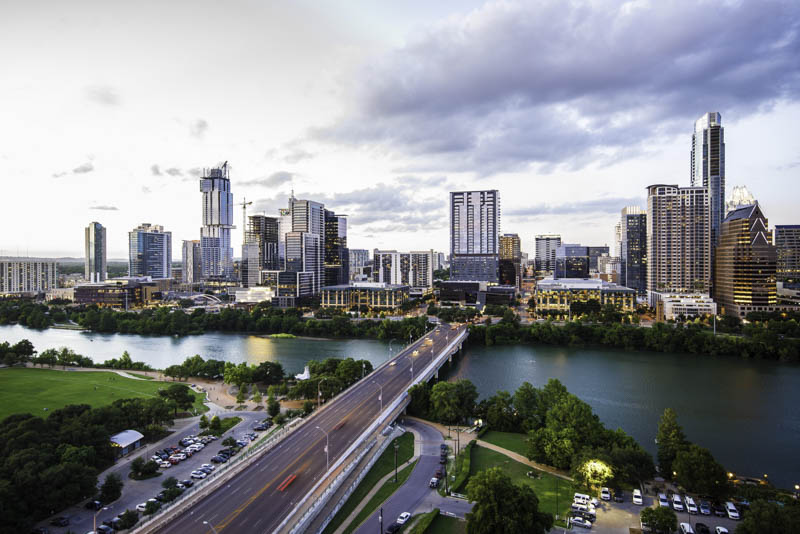
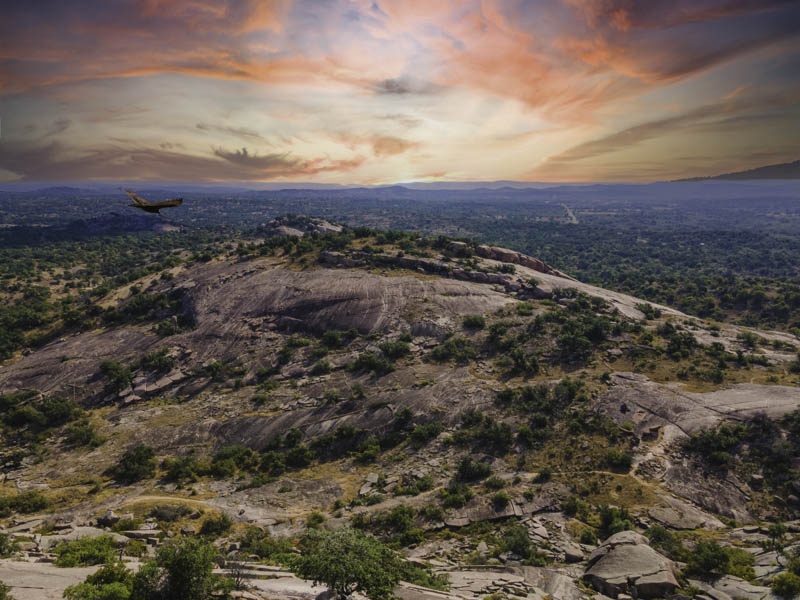
Hill Country is named after the rugged limestone and granite hills that are prevalent in the region. Located upon the Edwards Plateau, Hill Country is often considered the crossroad of the state. Covering 31,000 square miles of land, the region reaches parts of the West, South, and Central Texas.
The Cost of Building a Home in Hill Country


With its low cost of living and economical force, Texas’s capital Austin is seeing an increase in population. As Austin offers more desirable high-paying jobs, the rapid growth is spilling over into other neighboring cities like San Marcos, Kyle, and Buda. Dripping Springs, New Braunfels, and San Antonio are also among the fastest-growing cities in the state. As the population grows, home construction is also on the rise. Between 2012 and 2021, most of the building permits issued in Austin are primarily for single family homes and multifamily units.
However, due to supply chain disruptions and the amount of time home construction takes the total cost to build a home in the region is increasing. According to data analysis, 60% of households in Austin are being priced out of home ownership. The city is also ranked third with the largest price difference between new and existing homes. Despite the increasing cost of supplies and materials, other cities in the region report an increase in the application of residential and commercial permits. New Braunfels has processed an all-time high of 248 residential permits in July of 2021 compared to 163 in the same month the previous year. On the other hand, Boerne reports that almost half of the population in the city own their homes.
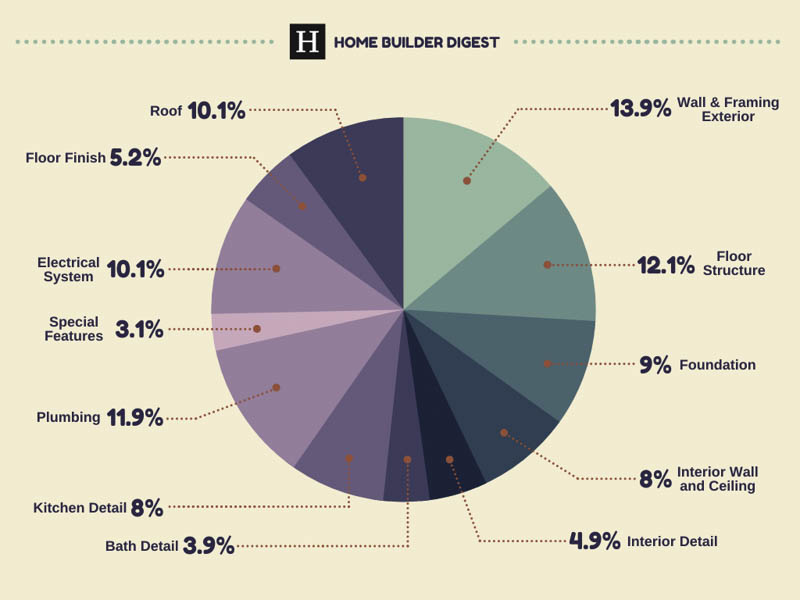
Figure 1. Typical cost breakdown of a single-family home constructed using the conventional method, according to Home Builder Digest.
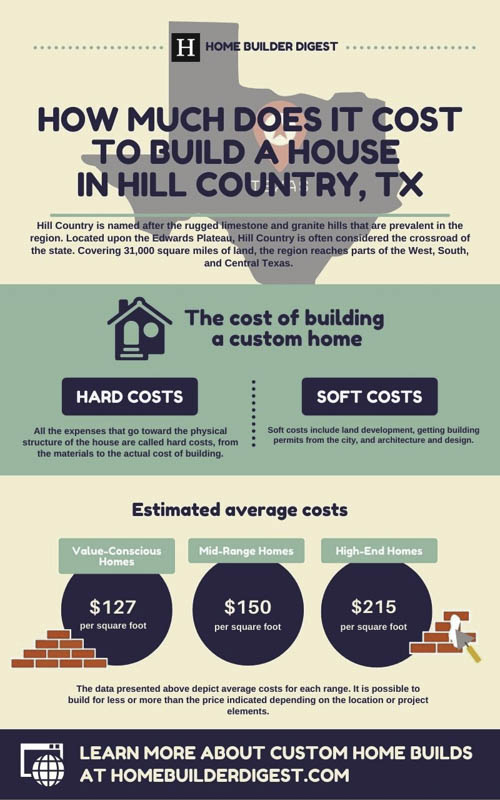
The cost to build a home in the region may vary depending on the location of the project. A big city like Austin may cost higher than other cities due to it being the state capital. However, this does not mean that other cities will be less expensive. In general, building a mid-range home in the region may cost homeowners $150 per square foot. Other variables can influence the total building cost, but the two kinds of costs—hard costs and soft costs—are the most relevant ones.
Hard Costs
Basic and simple home construction in the Hill Country area will usually cost around $127 per square foot on average, while mid-value type homes that require a little more skill to work on additional details cost an average of $150 per square foot. A more customized home with higher-end finishes, otherwise known as a high-end home, in Hill Country will cost about $215 per square foot on average. It should be noted that these figures are estimates; firms may charge more or less depending on details like project location, square footage, and customized features.
On top of construction costs, project owners need to take into account the costs incurred from foundation, roofing, heating, ventilation, and air conditioning (HVAC), and electrical installation.
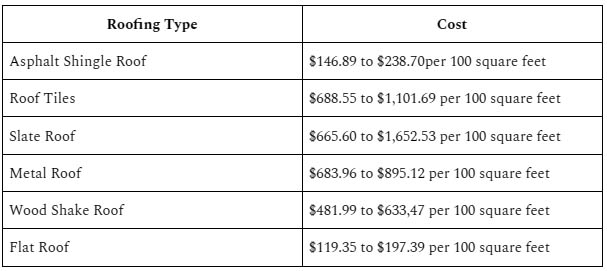
Texas’ roofing costs generally range between $126.62 to $1,753.20 per 100 square feet, depending on the roofing type. The following table provides price ranges that project owners can expect to see:
The cost for Major systems is a combination of HVAC, electrical, and plumbing. The following are the average costs for major systems in the Hill Country area: an HVAC system is about $1,786, while a plumbing system is $317, and electrical installation is $335.
Soft Costs
Cost of the Land
The population in the Hill Country area of Texas is currently expected to grow by 35% within the next 20 years. Currently, Hill Country has a population of about 3.8 million people; the area has grown by 50% in the past two decades. The positive population growth means that the land in this region is more likely to increase compared to places with stagnant or negative population growth.
Plots available for residential development in the Hill Country area have an average cost of $244,991.67. The cheapest lot for sale costs $95,000 and is about 3,920 square feet. This particular lot is located along Ozark Drive in San Marcos. Meanwhile, the most expensive lot costs $599,900. It is about 111,949 square feet and can be found along Lawnmont Avenue in Austin.
Permits and Other Fees
Permit fees vary from city to city in the region. Most of the major cities in Hill Country have a building permit fee that is charged per square foot. The cities follow different editions of the International Building Code (IBC), with Austin recently adapting the 2021 edition. Boerne, on the other hand, follows the 2009 version, based on the city’s residential information and checklist. According to public data on new residential construction in the region, homeowners paid an average of $1,752 in permit fees. This estimate may still increase or decrease depending on the complexity of the project.
Most of the major cities in the Hill Country Region have a building permit fee that costs less than $1 per square foot, according to their schedule of fees. At $0.15 per square foot, Fredericksburg has the lowest building permit fee. The city of Boerne comes in second with a building permit fee of $0.30 per square foot. In San Marcos, the building permit fee is $0.49 per square foot with a minimum of $115. A building permit in New Braunfels costs $0.50 per square foot for new residential construction and additions.
The building permit fee in Austin differs from the other cities mentioned above. According to the city’s schedule of fees, a homeowner would have to pay a permit fee of $1,017.12 for an average 2,000-square-foot home. This estimate includes a 4% surcharge tech fee put into place by Austin’s Development Services Department (DSD), which is implemented for all permit fees. Furthermore, $20 will be added to the total cost of the permit fee for each additional 100 square feet of the project. Besides the building permit fee, project owners are required to pay other fees which include the base application fee, trade fees, miscellaneous fees, and more.
The permit fee for auxiliary power (solar) in Austin is $185.40 for a home greater than or equal to 1,000 square feet. Any trade permit fees pulled under a general contractor in San Marcos are $43. The plumbing and mechanical permit fees in Fredericksburg cost $15 plus labor costs. In addition to this, Fredericksburg requires homeowners with projects located in the city’s historic district to complete a building permit and acquire a Certificate of Appropriateness for Historic Review. Any alteration done in the historic district must be built in a way that retains the building’s original material and features. For mobile and manufactured homes in New Braunfels, homeowners must pay a fee of $50. Individual fees apply to miscellaneous structures, pool additions, and more to the properties. Homeowners are advised to check for city-specific cost guides to further understand the fees.
Architecture and Design Fees
Architects will typically charge based on the total construction value. For architects in the Hill Country area, that would be in the 9 to 11% range, depending on the services rendered, project complexity, and architect experience. The national range is about 5 to 20% of total construction cost.
Project owners may also come across firms that charge by the hour or by square footage. Pricing is dependent on the request, project location, and the architect’s position, experience, training, and reputation. The most common services are layered drawings, project management, concept development, consultation, and site visits.
Major Cities
Austin
Austin has one of the strongest housing markets in America. Its diversified and established economy from years of development has resulted in its maintained economic expansion during the pandemic. Homes in the area have undergone an increase in value and sales due to rising demand; the median home price is currently $624,000.
The cost of new home construction—without other costs—starts at $143 to $149 per square foot for basic homes, $150 to $192 per square foot for more detailed work, and $193 to $253 per square foot and above for high-end homes. These figures are based on the data from the last five years gathered from the online contractor marketplace BuildZoom (BZ). Additionally, the cost of hiring an experienced architect to render their services is about 5 to 20% of the final construction costs. Some firms may charge $350 to $450 per square foot, depending on the complexity and customization of the project. Luxury homes can cost nearly double, with a range of $600 to $800 per square foot. Project owners can also expect to pay $75 to $250 per hour for other firms.
The average cost of a lot in the Austin area range from $69,500 to $1.5 million, based on Zillow lots sized from 10,890 to 21,780 square feet. Due to the area’s positive population growth, the cost of land is expected to increase more than those in cities with negative or stagnant population growth.
San Marcos
San Marcos is a college town located between Austin and San Antonio. The large outlet mall and historic downtown square have attracted numerous families and individuals to its neighborhoods. The typical cost to build a 2,000-square-foot house in San Marcos is about $248,000. That would be about $100 to $155 per square foot, with some firms charging up to $210 per square foot.
Currently, San Marcos is experiencing an annual population growth of 0.19%. This means that land in the area is more likely to increase in price compared to those in areas that are experiencing negative or stagnant population growth. The average cost of land in San Marcos, based on lots on Zillow, is $140,000. Lot sizes vary between 21,780 to 26,572 square feet.
New Braunfels
New Braunfels is a city that is roughly 45 square miles and has a population of almost 100,000 people. It is one of the fastest-growing cities in the country with an annual growth rate of 5.96%. Hiring a new home builder in the area would cost about $37,345 to $54,718.
With the area’s positive growth rate, land in the area is expected to be more expensive. The lots being sold on Zillow have an average cost of $181,667. Lot sizes generally range from 10,450 square feet to 60,984 square feet.
What Leading Custom Home Builders and Architects that Serve the Hill Country Area Say
Get a free cost estimate
When the World Health Organization (WHO) declared COVID-19 a pandemic on March 11, 2020, Steve Zbranek, Co-owner of Zbranek & Holt Custom Homes in Austin, knew there would be trouble. He writes about the pandemic’s effect on the housing market: “The first sign of trouble came from positive COVID tests, creating new job site rules, and city-mandated job site lockdowns.”
These new regulations were quickly followed by labor shortages that affected all companies. “It became very obvious how important human resources were to building new homes on a predictable schedule,” Zbranek continued.
To make matters worse, delays in supply issues have affected not only the cost of the materials but also the time spent building the house itself. Zbranek relays that lead times for windows, appliances, and utility fixtures “contributed to us missing delivery deadlines and budgets.” The more time spent waiting for supplies, the more it adds up to the total cost of the home construction.
With the lockdown protocols set in place, people opted to work from home. This new lifestyle has fueled the country’s housing market as people look for a more suitable home that fits their needs regardless of the location. Matt Fajkus, Principal Architect of Matt Fajkus Architecture shares that the housing market in Austin has always been expensive, and the pandemic has made it more expensive. As Austin continues to see population growth and sees an increasing demand for new homes, Fajkus notes that Austin will be the “new base in the region.” Fajkus also adds that “The costs are not likely to drop from this level in the future; it’s only a matter of whether they will gradually grow or more steeply grow in coming years.”
While the world adjusts to the new normal, Zbranek encourages everyone to take an active part in the new process of home construction as the industry learns to build with new rules. “Our jobs were always challenging and we accepted those challenges,” said Fajkus.
Melanie McGinley Sparks of Kurk Homes acknowledges the challenges of cost escalation and material shortages her firm has seen in the past few years. In light of these, she shared how proud she was of her team’s “resilience, flexibility, and dedication to our homeowners.”
“When homeowners and design/build firms come together to work on such a personal and emotional project, the best advice is to keep an open line of communication – and keep the big picture in mind,” Sparks shared.
With the current trends, it is wise for both homebuilders and homeowners to stay ahead of the curve and be patient. Fajkus elaborates on this expressing that “The best clients gave us the inspiration we needed to do our jobs and adjust to the changing circumstances.”
The Future of Hill Country’s Residential Construction Industry
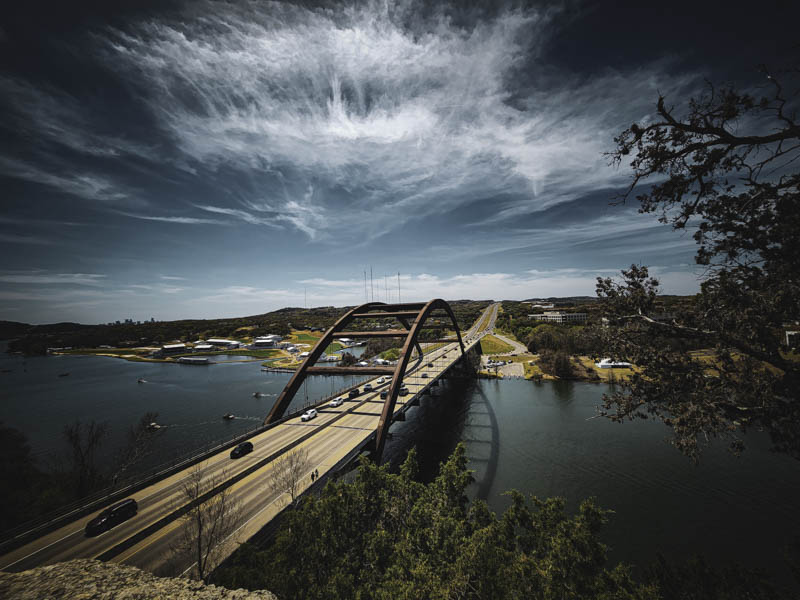
The Texas Hill Country is rich in natural resources. Some of its cities like New Braunfels and San Marcos were founded around large springs connected to the Edwards Aquifer. As the population continues to grow, many lots are being developed to become residential neighborhoods.
According to the Texas Hill Country Conservation Network, 7% of the region has been developed as of 2016. Many of these expansions are located in the eastern part of the region where urban centers, Austin and San Antonio, are located. In San Marcos, a 416,204-square-foot multi-family apartment complex is expected to begin construction in December. As Austin’s median home price rises, many nearby suburbs are offering homes for less than the metro area’s price.
In January, Facebook’s parent company Meta signed the largest lease in downtown Austin with 589,000 square feet of space across 33 floors. Experts believe that this will draw more than 100,000 employees to the area and nearby cities. With so much movement going on, rezoning and the development of neighborhoods are also rampant across the region. Despite a lack of affordable housing in the region, much construction and the purchase of luxury homes are taking place. Moreover, according to real estate experts, Austin, Dripping Springs, and Lake Travis are prime waterfront locations.
Many locals in Hill Country are considering the effects of the region’s ongoing development on the local ecosystem. Conservation biologists strive to save at least 30% of the land in order to preserve the region’s essential ecological function. As of 2021, only 5% are being conserved. With more than 95% of undeveloped land, environmentalists are fighting back against further devastating developments in the region. As for the future of the region’s housing market, the Hill Country is attempting to strike a balance between keeping up with population expansion and maintaining its land.
Cost Saving Tip for Building a Home in Hill Country, Texas
Design With the Terrain to Minimize Site Work Costs
Hill Country’s rugged limestone and granite landscape is one of its greatest appeals—but it can also be one of the biggest budget items on a custom home project if not approached thoughtfully. Extensive grading, blasting through rock, and building elaborate retaining walls to create a flat building pad on a sloped Hill Country lot can add tens of thousands of dollars to the project before a single wall goes up. The most cost-effective approach is to design your home to work with the natural contour of the land rather than against it. Experienced Hill Country architects and builders often recommend stepped or split-level floor plans that follow the slope, reducing the volume of cut-and-fill earthwork required while creating architectural interest through varied ceiling heights and distinct living zones. This approach also preserves the natural character of the site—including native trees, rock outcroppings, and natural drainage patterns—that drew you to the property in the first place. Retaining walls, when needed, can often be minimized by thoughtful building pad placement rather than leveling the entire lot. Working with a builder who has extensive experience on Hill Country terrain is critical, as they can evaluate a lot’s buildability during the pre-design phase and identify the optimal building envelope that balances views, access, and site work costs. This early collaboration between architect, builder, and site often produces the most cost-efficient and visually striking results.
Frequently Asked Questions
Which areas in—or near—Hill Country are among the best for custom home building?
The Hill Country spans a vast area of Central Texas, and the best location depends on your priorities for proximity to metro areas, views, acreage, and price point. The Dripping Springs and Driftwood area, west of Austin, has become one of the premier custom home destinations, offering rolling hill terrain, live oak groves, and a growing food-and-wine culture while remaining within commuting distance of Austin. Fredericksburg, in the heart of Hill Country, attracts buyers seeking a small-town lifestyle with German heritage, a vibrant Main Street, and access to wineries, peach orchards, and wildflower meadows. New Braunfels and the Gruene area, between Austin and San Antonio, combine river recreation on the Comal and Guadalupe Rivers with a strong community feel and rapidly growing infrastructure. Boerne and Fair Oaks Ranch, northwest of San Antonio, offer upscale master-planned communities and custom lot opportunities with hill and creek views. Wimberley provides an artistic, bohemian village atmosphere with swimming holes, galleries, and wooded lots along Cypress Creek and the Blanco River. Marble Falls and Horseshoe Bay on Lake LBJ attract lakefront custom builders with water recreation and golf course amenities. The Lago Vista and Jonestown areas on Lake Travis provide a more affordable lakeside alternative closer to Austin.
How does Hill Country’s climate potentially impact home building costs?
Hill Country’s climate is characterized by hot, dry summers with temperatures frequently exceeding 100 degrees, mild winters with occasional freezing events, and a severe weather profile that includes flash flooding, hailstorms, and occasional tornadoes. The intense summer heat drives the need for robust HVAC systems with high cooling capacity, and builders increasingly recommend high-efficiency heat pump systems that perform well in both heating and cooling modes. The region’s intense UV exposure at elevation accelerates the weathering of exterior materials, making durable roofing, high-quality exterior paint, and properly sealed stucco or stone finishes important investments. Hill Country is particularly susceptible to flash flooding during heavy rain events, as the rocky limestone terrain does not absorb water readily, causing rapid runoff that can overwhelm low-lying areas. Homes built near creeks, rivers, or low-water crossings must account for this risk through proper elevation, drainage engineering, and flood zone awareness. Hail is a frequent concern in Central Texas, and many custom builders recommend Class 4 impact-rated roofing materials that offer both durability and insurance premium reductions. The year-round building season—with only brief interruptions during extreme heat or severe weather—helps keep construction timelines predictable.
What should I know about soil and terrain conditions before buying a lot in Hill Country?
Hill Country’s defining geological feature—the limestone and granite bedrock of the Edwards Plateau—is the most significant factor affecting construction costs on any given lot. Many properties have shallow rock at or near the surface, which provides excellent structural bearing but can dramatically increase excavation costs for foundations, utility trenching, septic systems, and driveways. In some cases, blasting or hydraulic rock breaking is required, adding substantial expense and permitting complexity. A geotechnical investigation before purchasing any Hill Country lot is essential, as rock depth can vary from inches to many feet within the same property. Sloped lots—which are common and prized for their panoramic views—require careful evaluation for retaining wall needs, access road engineering, and drainage management. The thin topsoil layer over limestone means that septic systems are common in Hill Country, and the type of system required depends on soil percolation rates and depth to bedrock; engineered or aerobic septic systems may be required where conventional systems are not feasible. Water availability is another critical consideration, as many Hill Country properties rely on wells or water co-ops rather than municipal water systems, and well depth and yield vary significantly by location. Buyers should investigate water rights, availability, and costs before committing to a lot.
Broadly speaking, is it cheaper to build or buy an existing home in Hill Country right now?
Hill Country’s real estate market has experienced significant price growth, driven by the explosive expansion of the Austin and San Antonio metros and the appeal of the region’s natural beauty, wine country culture, and recreational amenities. Existing home prices in the most popular areas—Dripping Springs, Fredericksburg, New Braunfels, Boerne—have risen sharply, and inventory is limited, particularly for homes on larger acreage with views. At the same time, new construction costs in Hill Country are inherently higher than on flat terrain because of the rocky soil, septic system requirements, potential need for well water, and the site work involved in building on slopes. On a cost-per-square-foot basis, buying an existing home is generally less expensive than building a comparable custom home in Hill Country, especially when land acquisition and site development costs are included. However, existing homes in the area vary widely in quality, and many older properties may lack modern energy-efficient features, proper foundation engineering for the rocky terrain, and updated mechanical systems. For buyers who want a home tailored to a specific Hill Country lot—capturing views, integrating with the landscape, and built for long-term durability on challenging terrain—custom construction remains the path to achieving that vision, despite the higher upfront investment.
Considering building a home in Hill Country?
Contact us for a free consultation