
Home » Cost Guides » Alabama Cost Guides » How Much Does it Cost to Build a House in Birmingham?
Although Birmingham houses Alabama’s most populous county, it is only the second-most populous city in the state next to Huntsville. Despite that, the city remains an ever-thriving center of investment. Birmingham grew its economy by 4,000% since its founding in 1871. Starting from pre-existing farm towns, it then expanded to mining, steel and iron production, and railroading industries. Today, the city has branched out into medical research, finance, and service hubs while maintaining its manufacturing roots. Birmingham has proven itself to be a prosperous city filled with various job opportunities, progressive culture, interesting history, and numerous activities in its vibrant downtown.
The Cost of Building a Home in Birmingham
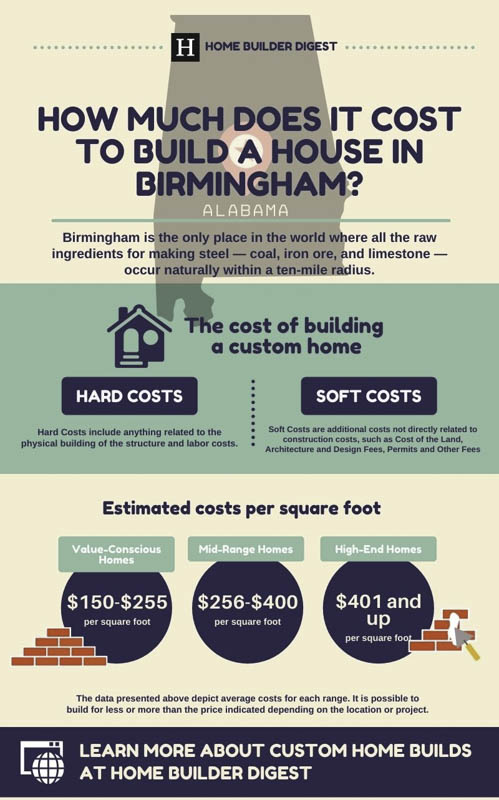


According to Home Builder Digest, building a 2,600-square-foot home in the United States will cost around $400,000 — roughly $155 per square foot. Fixr provides an estimate of $360,000, which is slightly lower. Homeowners will get a standard-built home with mid-grade materials at either pricing bracket. As the house is modified more, the price point rises in proportion to the size, quality of materials, and level of finish.
The median home building cost in Birmingham is around $255 per square foot. Opting for a value-conscious approach may lower this value ranging from $150 to $255 per square foot. On the other hand, a more luxurious approach will increase the value starting from $400 per square foot and up. To build a 2,500-square-foot home in Birmingham, aspiring homeowners will need an estimated budget of roughly $375,000 to $1,000,000. This estimated price may increase even further depending on the aspects that will be mentioned later on.
It’s difficult to give an exact figure as to how much it costs to build a house in Birmingham. The overall construction cost will be determined by the owner’s wants and needs. Several challenges in the building sector have yet to be resolved, particularly the fluctuating status of material costs. Aside from that, there are several other elements to consider, as they may considerably impact the overall construction cost. They can be classified into two separate categories: hard costs and soft costs.
Hard Costs
The term “hard costs” refers to all of the fees associated with the actual construction of the home. Materials used, labor fees, additional amenities, and landscaping are examples of these.
Birmingham’s average basic building cost is $110 per square foot, including labor fees, materials, and site cleanup. Some projects may cost as low as $90 per square foot or as high as $200 per square foot, depending on the size, complexity, level of finish, and location. Building a 2,500-square-foot home in Birmingham will cost roughly $225,000 to $500,000.
The value breakdown according to job or task is as follows:
- Foundation: $5.55 per square foot — $14,000
- Framing: $3 to $12 per square foot — $7,500 to $30,000
- Roofing: $3.20 to $5.50 per square foot — $8,000 to $13,750
- Drywall:
- Regular: $10 to $19 per sheet
- Ultra-light: $10 to $19 per sheet
- Mold and Moisture Resistant: $14 to $21 per sheet
- Fire-Resistant: $12 to $23 per sheet
- Glass Mat Exterior Wall Sheathing: $20 to $27 per sheet
- Flooring:
- Carpet: $2 to $6 per square foot — $5,000 to $15,000
- Hardwood: $2 to $30 per square foot — $5,000 to $75,000
- Tile: $1 to $25 per square foot — $2,500 to $62,500
- Vinyl: $2 to $3 per square foot — $5,000 to $7,500
- Laminate: $5 per square foot — $12,500
Heating, Ventilation, and Air Conditioning (HVAC): $5,000 to $10,000
As mentioned, labor fees are included in the estimated value above. However, these contractors could bill project owners depending on the contract and negotiations. If that’s the case, here’s a breakdown of how much each service costs, as per ZipRecruiter:
- Construction Manager: $38 per hour
- Electrician: $20 per hour
- Plumber: $28 per hour
- Framer: $17 per hour
- Roofing Contractor: $18 per hour
- HVAC Technician: $21 per hour
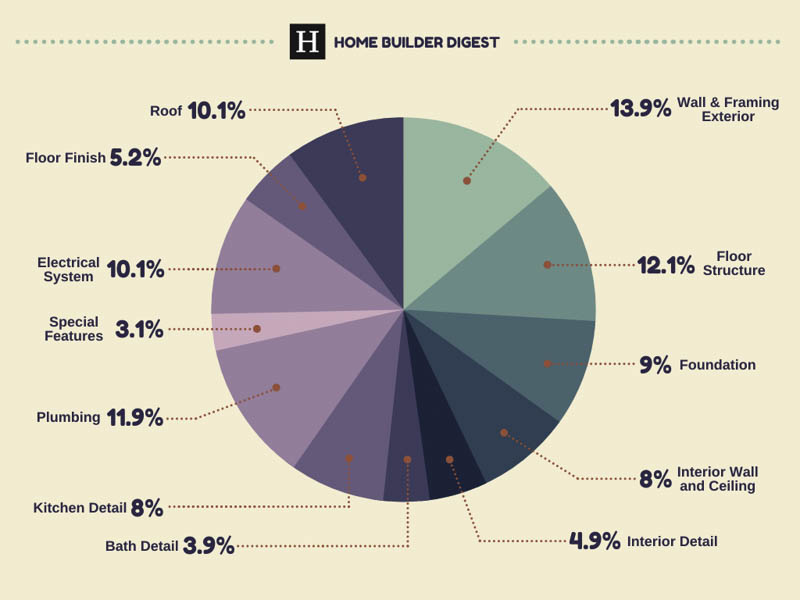
Figure 1. Typical cost breakdown of a single-family home constructed using the conventional method, according to Home Builder Digest.
Soft Costs
Soft costs are fees that are not directly related to the actual building of the physical home. Typically, these costs are estimated and settled prior to the start of construction. Fees relating to land acquisition and development, local government authorizations, and the overall design and layout of the home are included in this category.
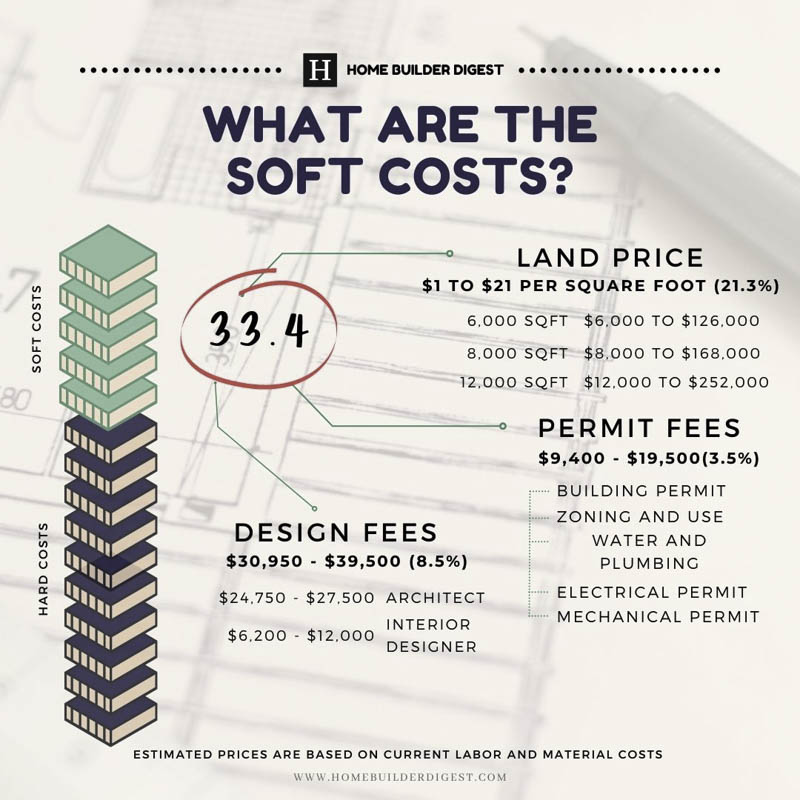
Figure 2. Soft cost percentage and average price range of additional fees, determined from the overall cost of custom home building in Birmingham.
Cost of the Land
According to recent listings in the real estate marketplace Redfin, the average land size available in Birmingham is 20,660 square feet or approximately 0.5 acres. In terms of cost, the average listing price is roughly $115,000 or around $7 per square foot. The cheapest land available costs $30,000 for a 30,056-square-foot wooded lot — about $1 per square foot. It is located in the Forest Brook Subdivision and within Homewood City limits, an affluent suburb. The most expensive land, on the other hand, costs $280,000 for a 13,068-square-foot land — about $21 per square foot. It is also within the Homewood City limits and is near highway 280, Brookwood mall, and an elementary school.
According to Birmingham’s Zoning Ordinance, the minimum lot requirement for a detached single family dwelling is between 4,500 to 15,000 square feet, depending on the density of its respective district. Following the regulations set by the local government, residential land acquisition in Birmingham will cost $31,500 to $105,000.
Permits and Other Fees
Before starting any construction, project owners must obtain a permit from the local government. Members of the board will review the plans submitted and evaluate whether or not the project is acceptable. If approved, the project owners will be issued a permit that will act as a go signal on the project. If it is rejected, changes must be made, and the plan must adhere to the regulations. This is an important stage as it guarantees that the structure and property are safe for both homeowners and the neighborhood.
The Technical Code of the City of Birmingham states that any permit will be charged with a minimum fee of $50. As for the expenses to be paid, the permits necessary for new construction and their respective fees are shown in the table below:
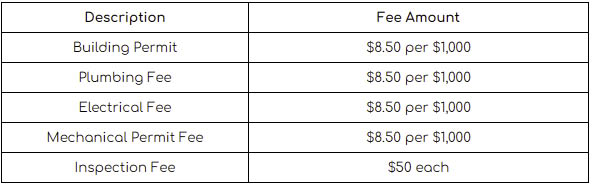
Suppose that building a 2,500-square-foot home costs $275,000. The total building permit fee for this project would be around $9,400.
Based on permits found in the online contractor platform BuildZoom (BZ), homeowners in Birmingham paid an average of roughly $17,000 for their home building permits. The least amount for a permit fee would cost around $13,300 for a $165,000 valued project. On the other hand, the most amount paid costs around $19,500 for a $250,000-valued-home.
Architecture and Design Fees
Architects and designers charge for their services in a variety of ways. The most common methods are percentage and hourly. Other methods, such as a hybrid of the two, are used when a negotiation is made between project owners and architects. Fees also vary depending on the designer’s experience, expertise, and reputation. Compared to relatively new designers, renowned designers are likely to charge higher design fees.
In terms of percentage, architects in Birmingham typically charge 9 to 10% of the overall construction cost. There may be instances that this rate will either increase or decrease depending on the workload, complexity, intricateness of details, and the home’s size. Suppose the basic construction fee for a 2,500-square-foot home in Birmingham costs $275,000. The total architecture fee to construct a new single family home will land at about $24,750 to $27,500. This rate only covers the agreed-upon scope of work; any additional services are typically paid hourly.
According to ZipRecruiter, the average hourly fee of architects in Birmingham costs $40 per hour. Basic architectural services take 480 to 600 hours to complete making the total design fees range from $19,200 to $24,000. Full architectural services demand more time and effort; therefore will take longer. A rough estimate is about 1,095 hours, but it can vary. For design fees alone, this will cost about $43,800.
How do Birmingham’s custom home building costs compare to nearby cities?
According to the United States Census Bureau, Alabama is situated in the country’s southern region, specifically the Southeastern part. The south has the lowest median housing price among the four areas, at only $110 per square foot — about 14.5% less than the national average. Alabama follows this trend as it is one of the low-costing states in the Southeastern region. With a median listing price of $105 per square foot, Alabama is in the 9th spot out of 12 states.
In terms of home building costs across major cities in Alabama, the median prices are relatively the same, ranging from $110 to $120 per square foot — around $275,000 to $300,000 for a 2,500-square-foot home. To recall the value mentioned earlier, the median building cost in Birmingham is $110 per square foot. The median home building value for each city is as follows, including its percentage difference from Birmingham:
- Anniston: $115 per square foot, 4.5% more expensive
- Auburn: $120 per square foot, 9.1% more expensive
- Decatur: $110 per square foot, equal costs
- Huntsville: $115 per square foot, 4.5% cheaper
- Montgomery: $120 per square foot, 9.1% cheaper
- Tuscaloosa: $120 per square foot, 9.1% more expensive
Focusing on the Birmingham Metro Area (Birmingham-Hoover-Talladega-Cullman), bids from BuildZoom (BZ) show that the home building costs in the area range from $170 to $350 per square foot — $425,000 to $875,000 for a 2,500-square-foot home. More specifically, value-conscious homes start at $170 per square foot, mid-range homes start at $190 per square foot, and high-end homes start at $350 per square foot.
What Leading Custom Home Builders and Architects that Serve the Birmingham Say
The following are insights offered by home builders and architects that serve the Birmingham area regarding the city’s current challenges and trends, including more information on the construction industry and housing market.
Joshua Dean, president of Precision HomeCrafters, shared that according to numerous economists, including NAHB’s chief economist Rob Dietz, there is possibly a significant slow in the economy next year. This will offset both demands in new and existing homes and affect the remodeling industry. As for home building in general, they predict that the industry will remain steady as two generations — millennials and baby boomers — will consistently drive demand. As interest in housing stays solid, materials and labor costs experience otherwise. Their prices have become volatile in the past two years, with lumber costs significantly increasing in the spring of 2021. It skyrocketed again by early 2022, reaching its peak price of three times its historical value. This created various supply chain disruptions and additional costs burden to project owners and home buyers. Another contributing factor to the rising home values is the building codes and regulations. Dean explained that modernization of the system greatly contributed — about 20 to 30% — to rising new home prices for the past 15 to 20 years. Although homes are now safer and more energy-efficient, these upgrades come at a cost, and homeowners are forced to comply. To help future homeowners, Dean advised them to sign fixed-price contracts with contractors while their prices are still in the lower end of the range. “Reconsider patience as a virtue and be willing to wait for the right deal and at the right time,” he added.
The Future of Birmingham’s Residential Construction Industry
Birmingham is known to be a city with an outstanding quality of life while retaining its affordable cost of living. The recent inflations brought by the pandemic sparked the interest of many people and decided to relate to this city. With the sudden spike in demand, the construction industry and real estate market have difficulty keeping up. Zillow’s Home Value Index reported that the typical home value of single family homes in Birmingham increased by 45% since the start of the pandemic. Homes were priced at $70,000 in March 2020, then grew to $100,000 by February 2022. The price surge was also buoyed by the low housing inventory, which went down by 49% year-over-year. Despite this, the city’s real estate market remains hot while the economy continuously recovers. Homes are in the market for only 10 days before being purchased, and most are sold for their asking price, as per the Alabama Center for Real Estate.
Aside from the reports mentioned above, supply chain issues also intensely pushed home construction prices. The cost of lumber is one of the industry’s most notable material price increases, which has tripled its price in the previous years. Additionally, a popular subflooring material, Oriented Strand Board (OSB), also significantly increased since January 2020 with a 665% inflation. The results are progressively inflating home building costs which have increased by at least $50,000, according to the National Association for Home Builders (NAHB). This makes it a critical setback for aspiring homeowners as achieving their dream home becomes more challenging. Builders are also greatly affected by this issue as they lose potential deals despite their efforts in being transparent and thoroughly explaining to project owners the possible complications. Russel Davis, the executive vice president of the Home Builders Association of Alabama, expressed that in his 40 years in the construction industry, they have experienced various challenges. Still, the current issues rank high as they have never seen this before.
Regardless of the housing sector’s current issues, there is still an uptick in home building in Alabama. NeighborWho, a property search website, sits at the 9th spot for the top cities in the nation for increased new home builds. Home building permits issued in the state increased by 19.4% — nearly 17,600 permits issued in 2020 alone. Further solving the scarcity of homes in Alabama, the state government recently awarded 16 new $1,000,000+ construction licenses to builders, including a new loft apartment building that will be situated in Downtown Birmingham.
Cost Saving Tip for Building a Home in Birmingham
Negotiate a Fixed-Price Contract While Costs Are Competitive
Birmingham’s construction market offers a strategic advantage that many other U.S. metros do not: a deep pool of experienced builders competing at price points well below the national average. This competitive environment gives homeowners meaningful leverage to negotiate fixed-price contracts that protect against the material cost volatility that has plagued the industry in recent years. A fixed-price contract—as opposed to a cost-plus arrangement—locks in the total construction cost at the time of signing, shifting the risk of lumber spikes, supply chain disruptions, and subcontractor price increases from the homeowner to the builder. In a market like Birmingham, where builders are accustomed to working within tighter margins and where there is healthy competition for custom projects, many reputable firms are willing to offer fixed-price terms in exchange for securing the contract. The key is to negotiate this structure early, while your project is still in the design phase and before material orders are placed. Be sure the contract clearly defines the scope of work, specifies all materials and allowances, and outlines how change orders will be handled so there are no ambiguities later. Pairing a fixed-price contract with a well-defined set of plans and specifications minimizes the risk of costly surprises and gives you budget certainty from groundbreaking to move-in—a valuable advantage in any construction market, but especially achievable in Birmingham’s builder-friendly landscape.
Frequently Asked Questions
Which areas in—or near—Birmingham are among the best for custom home building?
The over-the-mountain suburbs south of downtown—Homewood, Mountain Brook, Vestavia Hills, and Hoover—have long been Birmingham’s most sought-after areas for custom home construction, offering excellent schools, established tree-canopy neighborhoods, and strong resale values. Mountain Brook in particular is known for its affluent enclaves and large lots, though available land comes at a premium. For buyers seeking more acreage and newer infrastructure, the communities along the Highway 280 corridor toward Chelsea and Shoal Creek offer larger parcels with rolling terrain and lake or golf course settings at more accessible price points. To the north, Trussville and Clay have seen significant growth with family-friendly master-planned developments and relatively affordable land. Greystone, a well-regarded golf community straddling Hoover and unincorporated Shelby County, remains a popular choice for semi-custom and full custom builds in a resort-style setting. Within the city itself, neighborhoods like Crestwood South and Avondale have attracted buyers interested in teardown-and-rebuild projects on established lots close to Birmingham’s revitalized dining and entertainment districts. Liberty Park, a large master-planned community east of the city, offers a range of lot sizes with community amenities and proximity to major employment centers.
How does Birmingham’s climate potentially impact home building costs?
Birmingham’s humid subtropical climate brings hot, long summers and mild but occasionally cold winters, both of which influence construction specifications and costs. High summer humidity and frequent rainfall demand moisture-resistant building practices throughout the structure—including proper vapor barriers, mold-resistant drywall and insulation, and well-designed drainage systems around the foundation. HVAC systems must be sized for sustained cooling loads, and high-efficiency units with strong dehumidification capability are a practical necessity for comfort and energy management. Central Alabama also sits within a region prone to severe thunderstorms and tornadoes, particularly during spring. While Alabama’s building code does not mandate the same level of wind resistance as coastal Florida, many custom home builders in the Birmingham area recommend—and homeowners increasingly request—fortified construction features such as reinforced roof connections, impact-resistant garage doors, and safe rooms or storm shelters. These additions provide meaningful protection and can also qualify homeowners for insurance discounts through programs like the IBHS FORTIFIED Home designation. On the positive side, Birmingham’s moderate winter temperatures mean frost-line depths are relatively shallow compared to northern states, keeping foundation costs lower, and the mild climate allows for construction activity through most of the year with fewer weather-related delays.
What should I know about soil and terrain conditions before buying a lot in Birmingham?
Birmingham’s geography is defined by the southern tail of the Appalachian Mountains, and the city’s terrain varies considerably—from the ridgelines and valleys of Red Mountain and Shades Mountain to the flatter areas north and east of downtown. This varied topography means that soil conditions can differ dramatically from one lot to the next, even within the same neighborhood. The most common concern is the prevalence of heavy clay soils, which expand when saturated and contract during dry spells. This shrink-swell cycle can exert significant pressure on foundations, leading to cracking and settlement if not properly addressed during design and engineering. A geotechnical investigation before purchasing a lot is strongly recommended, as it will reveal clay content, bearing capacity, groundwater levels, and the depth to bedrock. Lots situated on Birmingham’s ridgelines may have shallow rock that increases excavation costs but provides excellent structural bearing. Valley lots, conversely, may have deeper alluvial soils that require more extensive foundation engineering. Slope is another critical factor: the hilly terrain that gives many Birmingham neighborhoods their scenic appeal can require significant investment in grading, retaining walls, and stormwater management. Buyers should also check whether a lot sits within a floodplain, as some of the lower-lying areas near creeks and tributaries carry FEMA flood zone designations that affect both buildability and insurance requirements.
Broadly speaking, is it cheaper to build or buy an existing home in Birmingham right now?
Birmingham remains one of the more affordable metropolitan areas in the United States for both building and buying, but the relative economics have shifted in recent years. Existing home values have risen significantly—climbing roughly 45% since the start of the pandemic—while construction costs have also increased due to volatile material prices and labor constraints. In most cases, purchasing an existing home in Birmingham is still less expensive on a per-square-foot basis than building a comparable new custom home, particularly in established neighborhoods where the land is already developed and infrastructure is in place. However, Birmingham has a large inventory of older homes, many built decades ago with outdated electrical systems, aging HVAC equipment, and building practices that predate modern energy codes. Bringing an older home up to current standards through renovation can be costly and unpredictable, especially when hidden issues like foundation settlement or outdated plumbing are uncovered during the process. Building new in Birmingham offers the advantage of current energy-efficient systems, modern open floor plans, and code-compliant construction at a cost that is still well below the national average for new custom homes. For buyers who value lower long-term maintenance costs, a builder warranty, and the ability to design a home to their exact specifications, building new in the Birmingham market presents a compelling value proposition—especially given that the region’s construction costs remain among the most competitive in the country.
Considering building a home in Birmingham?
Contact us for a free consultation