
Fort Collins is known for its recreational opportunities, cultural attractions, active nightlife scene, and family-oriented activities. The city is described as a picturesque downtown area with businesses in manufacturing, technology, bioscience, clean energy, agri-technology, and service-related industries. Along with the rest of Colorado, Fort Collins is recovering from the effects of the COVID-19 pandemic.
However, keynote speaker Rich Wobbekind from the 2022 Economic Forecast in Loveland noted that Colorado’s economic recovery for 2022 will be slightly slower than in 2021. Experts have mostly attributed the slowdown to unemployment and low workforce participation.
The Cost of Building a Home in Fort Collins
For the construction industry, the labor shortage has been an ongoing issue for several years. Many people, especially those from skilled trades, are retiring and there are not enough people to fill the gap left behind. The lack of labor has, in part, resulted in the construction industry limiting the number of projects taken on. Supply chain issues have also affected the industry’s ability to take advantage of the high demand for homes.
Many firms prefer to build fewer homes than be unable to finish the job within the contracted period, which is affecting the cost of homes.
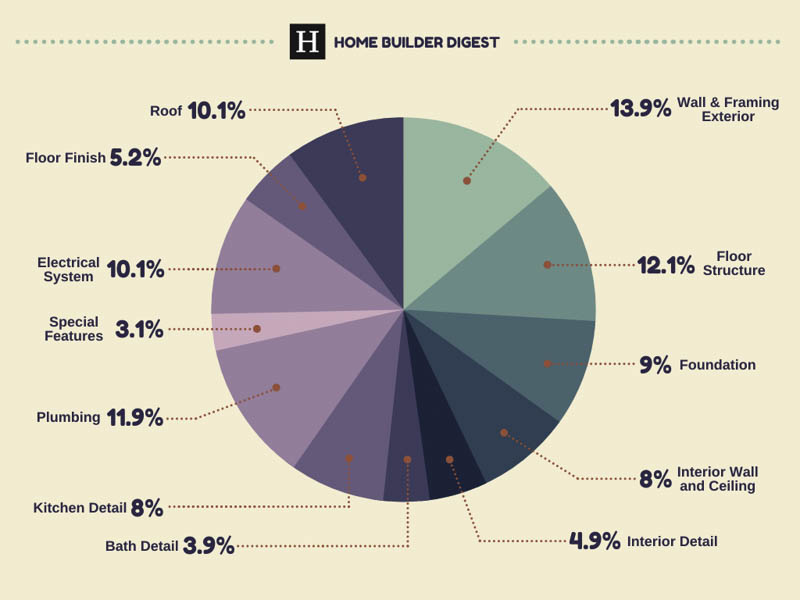
Figure 1. Typical cost breakdown of a single-family home constructed using the conventional method, according to Home Builder Digest.
The national average cost of new home construction is about $207 per square foot, whereas the average cost in Fort Collins is around $245 per square foot. Project owners can expect to see construction costs range between $217 to $274 per square foot, depending on the project’s details. The more intricate and customized the design, the higher the cost.
On top of the home building cost, project owners will also have to pay attention to fluctuations in their hard and soft costs. Hard costs are related to the parts of construction that are physically part of the house, including framing, foundation, plumbing, flooring, and roofing. Soft costs, on the other hand, are factors like land costs, permitting fees, and architectural and design costs. It should be noted that these costs are independent of each other; a shift in hard or soft costs will not affect the other.
Hard Costs
Construction costs in Fort Collins will typically be priced at $217 to $245 per square foot for basic and simple homes. Projects with a little more detail—typically mid-value type homes—will go up to $246 to $273 per square foot. Homes that are built at $274 per square foot and above are usually high-end homes in the Fort Collins area. It should be noted that the provided figures are from the online contractor marketplace BuildZoom (BZ) and are based on bids from previous projects. Project owners may see firms charging at higher or lower prices based on details like square footage and additional features.
On top of construction costs, project owners need to take into account the costs incurred from foundation, roofing, heating, ventilation, and air conditioning (HVAC) and electrical installation.
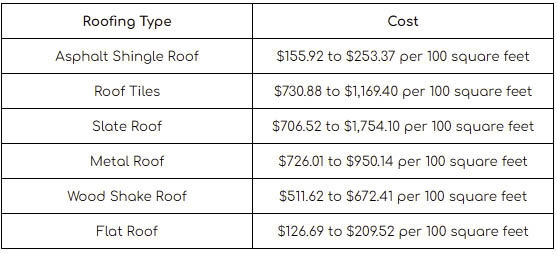
Fort Collins’ Roofing costs can range anywhere from $126.69 to $1,754.10 per 100 square feet, depending on the roofing type. The following table provides price ranges that project owners can expect to see:
The cost for Major systems is a combination of HVAC, electrical, and plumbing. The following are the average costs for major systems: an HVAC system is about $11,000, while a plumbing system is $1,950, and electrical installation is $419.
Soft Costs
Soft costs are composed of the intangible aspects of home construction. Some of the common ones are the cost of land, permit fees, and architectural and design fees.
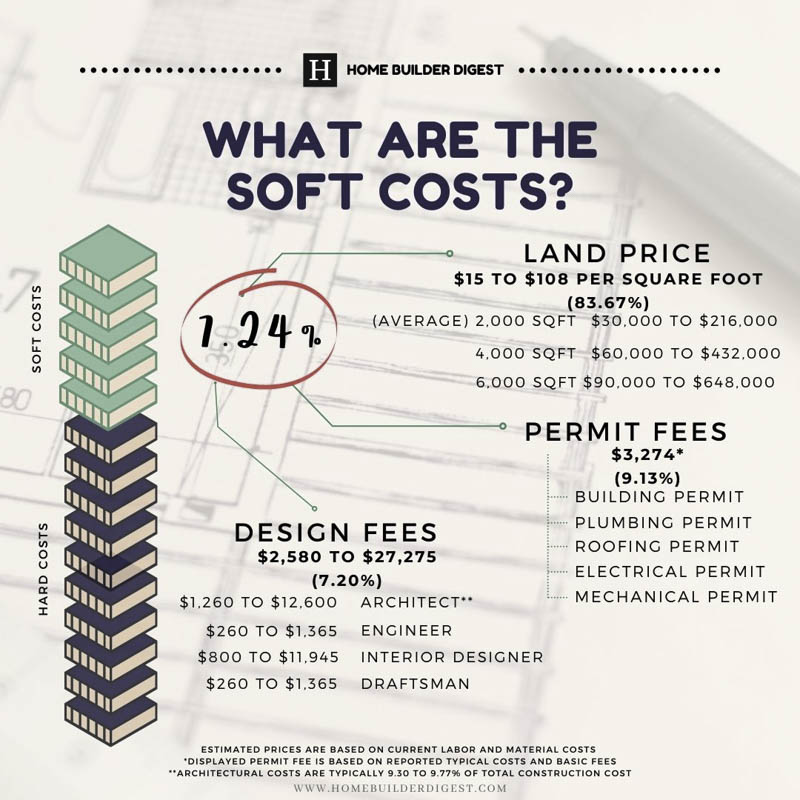
Figure 2. Soft cost percentage and average price range of additional fees, determined from the overall cost of custom home building in Fort Collins.
Cost of the Land
Fort Collins is currently growing at an annual rate of 1.10%, which means the city is experiencing positive population growth. With more people living in Fort Collins, it is expected that land prices will increase more than in cities with stagnant or negative population growth.
The plots of land available for sale in Fort Collins on Zillow have an average price of $407,850. The cheapest lot is 3,920 square feet and is being sold for $92,000. It is located in Evensong Court. Meanwhile, the most expensive lot is 71,438 square feet. It is priced at $699,000 and can be found in South East Fort Collins.
Permits and Other Fees
Information for permit fees in Larmier County, which Fort Collins is part of, can be found on this website. The website provides several application forms, one of which is the residential building permit application form.
The following table contains information taken from the building permit fee schedule:
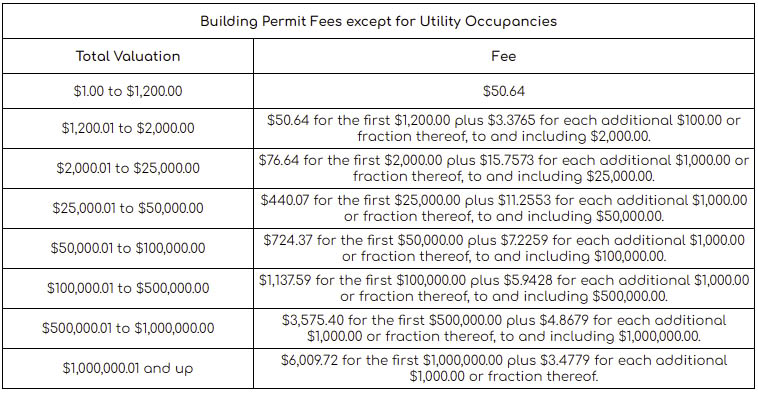
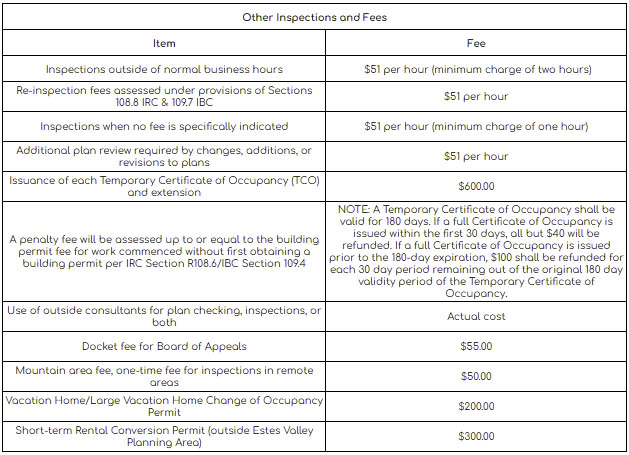
Details for plumbing and mechanical permit fees can also be found on the building permit fee schedule provided above. Additionally, there is a plan review fee of 50% of the building permit fee.
Architecture and Design Fees
Most architects will charge based on the total construction value. For Fort Collins, architecture firms typically charge about 9.75 to 10.23%, depending on the services rendered, project complexity, and architect experience.
Some architectural firms may also charge by the hour or by square footage. Pricing is dependent on the request, project location, and the architect’s position, experience, training, and reputation. Most new home construction project owners will avail of services like layered drawings, project management, concept development, consultation, and site visits.
The Future of Fort Collins’ Residential Construction Industry
According to the Associated Builders and Contractors (ABC), about 650,000 additional workers are needed before the construction industry can meet the minimum demand for labor. The 2022 workforce shortage analysis by the ABC showed that the shortage has led to an even greater need for qualified and skilled professionals than in pre-pandemic years.
The workforce shortage was cited as the most critical challenge to be addressed even in the face of sluggish spending growth. In terms of the residential aspect of the construction industry, this means that there is less labor to meet the high demand for homes. Firms will be forced to accept a limited number of projects to meet deadlines, which will result in price increases. The labor shortage is also burdening firms in tandem with an aging and retiring workforce, material costs, and supply chain disruptions.
According to Bernard M. Markstein, a chief economist with Markstein Advisors, there is a “mismatch between job openings and available labor” because most people are not interested in the construction industry. Most of the next generation are applying for white-collar jobs.
Even if interest does grow, it will take a while for there to be enough skilled labor to become available because construction requires special training. The non-profit Colorado Homebuilding Academy is offering training to about 40 to 60 students a month. Training programs are also available for high school students. Most of the academy’s students are underemployed, unemployed, or career shifters.
Firms around Colorado are also offering apprenticeship programs, especially those in need of more workers. Some firms are working with the Construction Industry of Colorado Training Council to reach multiple schools and prospective employees.
Cost Saving Tip for Building a Home in Fort Collins
Address Expansive Soil Risk Before You Design Your Foundation
Expansive clay soils—locally known as Bentonite—are one of the most significant and most underestimated cost variables in Fort Collins and across the Northern Colorado Front Range. These soils absorb water and swell, then dry out and shrink, creating ground movement that has damaged more residential foundations in this region than any other single factor.
The mistake many buyers make is discovering the soil condition after the foundation is designed, forcing expensive mid-project engineering changes. The correct sequence is to commission a geotechnical soil report before finalizing your lot purchase and before any design work begins. The report will characterize the clay content and swell potential, and the geotechnical engineer will recommend the appropriate foundation type—whether a post-tensioned slab, a pier-and-grade beam system, or a standard slab with special sub-base treatment.
Each foundation option has a meaningfully different cost profile. A standard slab on non-expansive soil is the least expensive. A post-tensioned slab engineered for moderate clay conditions adds cost but is well within the range of what most custom home budgets can absorb. A pier-and-grade beam system—required on the most challenging lots—is significantly more expensive and can add $30,000 or more to the foundation budget alone.
Knowing which category your lot falls into before you commit to a design means you can make informed decisions about lot selection, foundation type, and overall budget from day one. It is far cheaper to pay for a soil report upfront than to redesign a foundation or, worse, to repair one that was not built for the actual soil conditions it sits on.
Frequently Asked Questions
Which areas in—or near—Fort Collins are among the best for custom home building?
The foothills west of Fort Collins, particularly the areas along Horsetooth Reservoir and the communities of Laporte and Bellvue, attract custom home buyers seeking dramatic mountain views, large lots, and a semi-rural setting that puts Rocky Mountain National Park and Estes Park within easy reach. These parcels command premium prices for their scenery but carry higher site development costs due to terrain, limited utilities, and wildfire risk considerations.
Within the city, the southwest quadrant—particularly the neighborhoods around Fossil Creek Reservoir and the communities along Ziegler Road—has been the most active area for custom and semi-custom home construction in recent years. Access to newer infrastructure, top-rated Poudre School District campuses, and proximity to the Fossil Creek trail network make this corridor attractive for families building their long-term homes.
Timnath and Windsor, directly east of Fort Collins along the I-25 corridor, offer competitive land prices within a master-planned community environment. Both communities have seen significant growth, and their proximity to the Fort Collins employment base while maintaining more affordable lot costs has made them popular alternatives for buyers whose budgets do not extend to closer-in Fort Collins addresses.
Loveland, immediately south of Fort Collins, provides another tier of value for Northern Colorado custom home buyers. Its lower land costs, strong community character, and access to Loveland’s own employment base—along with easy access to Fort Collins via US-34—make it a viable alternative for buyers willing to consider a slightly longer commute to the CSU campus or downtown Fort Collins.
How does Fort Collins’s climate potentially impact home building costs?
Fort Collins sits at roughly 5,000 feet of elevation on Colorado’s northern Front Range, and its climate is a genuinely distinct combination of factors: over 300 sunny days per year, cold and occasionally snowy winters, and the intense UV exposure that comes with high-altitude living. Each of these characteristics influences construction costs in specific ways.
The high UV load accelerates the degradation of exterior finishes, paint, and roofing materials much faster than at lower elevations. Builders experienced in Front Range construction specify materials—Class A metal or concrete tile roofing, fiber cement siding, and high-quality exterior paints—that can withstand this exposure without premature failure. The upgrade from standard asphalt shingles to a more UV-durable roofing product is a worthwhile investment in this environment.
Colorado’s Front Range also sits in a wildfire interface zone, and homes near the foothills west of Fort Collins require construction practices that address this risk. Class A roof coverings, ember-resistant vents, non-combustible or ignition-resistant siding, and defensible space landscaping are all part of building responsibly in these locations. Some of these requirements are codified in Larimer County’s regulations; others are simply prudent choices for homeowners in a region that has experienced significant fire events in recent years.
On the positive side, Colorado’s 300-plus days of sunshine make solar energy installations exceptionally productive, and Fort Collins Utilities operates a net-metering program that rewards on-site solar generation. Designing a home with optimal solar orientation and including a rooftop PV system from the start is both environmentally aligned with the community’s values and a strong financial investment in a market where sunshine is reliably abundant.
What should I know about soil and terrain conditions before buying a lot in Fort Collins?
As noted in the cost-saving tip, expansive Bentonite clay soils are the most significant site variable in the Fort Collins market and across much of the Northern Colorado Front Range. These soils are present throughout the area at varying depths and concentrations, and their behavior—swelling when wet, contracting when dry—creates the seasonal ground movement that has damaged foundations across the region.
The good news is that the engineering solutions are well understood and well-practiced by local geotechnical firms and builders. What matters most is identifying the soil conditions before the project starts, not after. A soil investigation with laboratory swell testing is the definitive diagnostic tool, and its cost—typically a few thousand dollars—is trivial relative to the foundation and repair costs that uninformed construction can produce.
Lots in the foothills west of the city present a different set of site considerations: sloped terrain, rocky subsurface conditions that may require blasting or specialized excavation equipment, and the wildfire risk already discussed. Access to municipal water and sewer also diminishes as you move further into the foothill communities, and the cost of well drilling, septic installation, and a potentially longer driveway should be factored into the full site development budget.
Broadly speaking, is it cheaper to build or buy an existing home in Fort Collins right now?
Fort Collins has experienced significant housing price appreciation over the past decade, driven by population growth, the draw of Colorado State University, and the migration of professionals from higher-cost Front Range markets including Denver and Boulder. The result is an existing home market where prices are elevated relative to the city’s historical norms—but still more accessible than Boulder’s notoriously expensive market to the south.
On a per-square-foot comparison, purchasing an existing Fort Collins home is generally less expensive than building a comparable new custom home. Construction costs in Northern Colorado have risen meaningfully, reflecting both the broader national trend and the local competition for skilled labor with the booming Denver metro and mountain resort communities that draw tradespeople from across the region.
The strongest case for building new in Fort Collins centers on the combination of Colorado’s energy code compliance, solar readiness, and climate-specific construction details that new homes offer by design. Older Fort Collins homes frequently lack the insulation levels, air sealing, and foundation engineering that current code requires and that the local soil and climate demand. For buyers who plan to stay long-term, the operational savings and reduced maintenance of a properly built new home consistently offset the higher upfront construction cost.
Considering building a home in Fort Collins?
Contact us for a free consultation