
Home » Cost Guides » Pennsylvania Cost Guides » How Much Does it Cost to Build a House in Philadelphia?
Philadelphia is known for its lively scene. The well-established culture and friendly atmosphere draw in tourists and locals alike. The dynamic restaurant and downtown areas make the city more inviting, especially for those looking to move in. Fortunately for them, the real estate market in Philadelphia is booming despite the COVID-19 pandemic.
The Philadelphia city government has allowed operations to resume after the pandemic forced businesses to cease work during the March to June 2020 period. The city’s housing markets remained resilient thanks to low interest rates and people’s desire for city living. The Greater Center City and nearby areas registered more new unit construction at year-end 2020 than year-end 2019. This development is driven by both local population growth and an increase in people from other metro areas moving into Philadelphia.
The Cost of Building a Custom Home in Philadelphia


The average cost of new home construction in America is around $248,000, or about $100 to $155 per square foot. Costs are dependent on location, project size, and design. Most new home construction sized at 2,000 square feet costs between $201,000 and $310,000. Homeowners that opt to go with a custom design will find that the actual home itself will amount to around 75% of the total cost. The remaining expenses come from the cost of land, financing, finishing, landscaping, and other factors; these can go up to at least $80,000. For example, $85 per square foot from the $100 to $155 per square foot goes to general contractors. A 2,000 square foot customized home by a home builder or developer in Pennsylvania state can range between $345,000 and $450,000. Homes built in Philadelphia are shown to cost from around $145,000 to $435,000 or more.
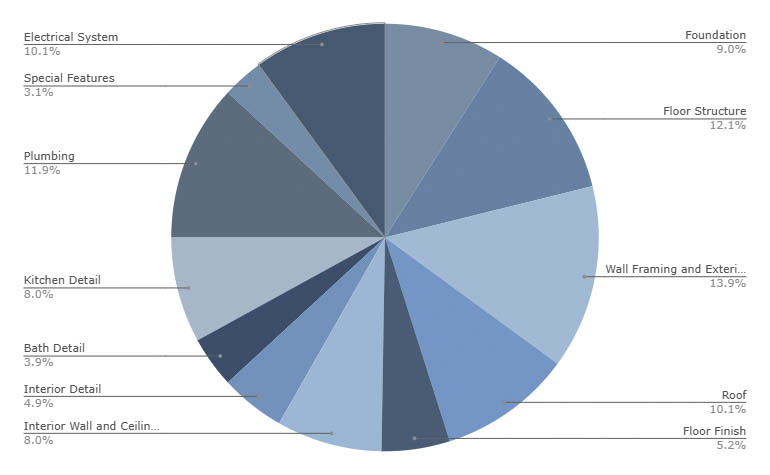
Figure 1. Typical cost breakdown of a single-family home constructed using the conventional method, according to Home Builder Digest. Image Source: National Cost Guide.
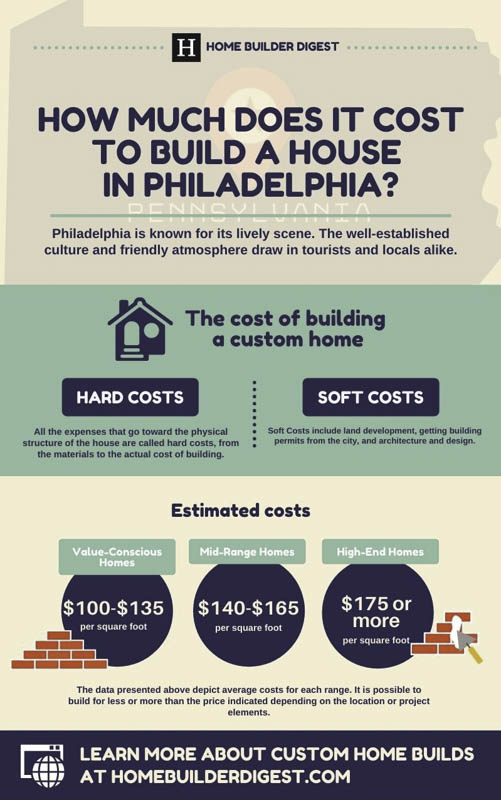
In Philadelphia, a basic and cost-effective home would be $100 to $135 per square foot, while a more customized home would cost $140 to $165. Luxury homes can reach up to $175 and more. The cost will change depending on different factors.
The expenses of new home construction are divided into two categories: hard and soft costs. Both can cause the overall cost to fluctuate, depending on the quality and sourcing of materials and labor. Hard costs cover features like framing, foundation, plumbing, roofing, and flooring. Soft costs consider architecture and design fees, builder fees, permits, and additional features.
Hard Costs
All the expenses that go toward the physical structure of the house are called hard costs, from the materials to the actual cost of building. Data gathered from Philadelphia-based companies Brotherly Love Real Estate and Suburban Solutions show that the cost to build a new home in the city ranges anywhere from $145,000 to $435,000 or more. This would put the cost per square foot at about $100 to $135 for a more basic, value-conscious type of home. A home with perhaps more custom finishes and features along the mid-range would cost somewhere between $140 and $165, while luxury homes can go up to $175 and beyond.
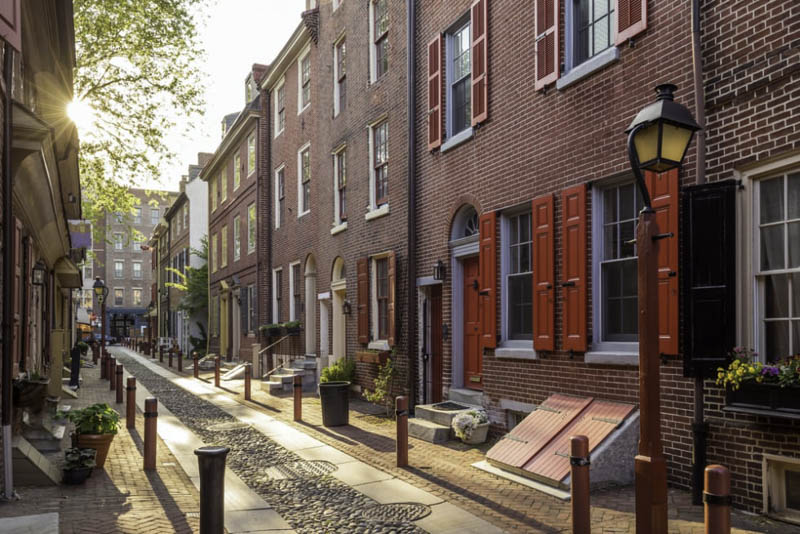
More traditional Philadelphia row homes feature styles ranging from colonial to Victorian, many with brick fronts and porches topped by intricate cornices. However, more recent iterations of the style now feature metal or vinyl bumped-out fronts, open floor plan interiors, and roof decks. One possible reason for this shift is that, on average, brick façades now cost 40 to 60% more than vinyl siding or aluminum — a far cry from where it was in the late 1800s to early 1900s when the row house first became popular in the city.
Builders bulk-buying materials may also be a factor that adds to the prevalence of these new styles. A 2,500-square-foot house would need about 80 sheets of drywall at 32 square feet each. One ½ inch by four feet by eight feet piece is priced at around $11.98, but this could go down to about $10.18 if you buy more than 34 pieces, so a builder working on, say, five properties within the same area will often opt to buy the same material for all. This goes for the house’s layout as well — using the same layout within the same area makes work easier for shared crews and drives labor costs down. It also makes sense because many neighborhoods in Philadelphia have the same lot size for individual properties.
Post-pandemic, supply chain issues are driving material costs up. Online investment resource Millionacres notes that the hike in lumber prices is adding about $24,000 to the cost of a new home, following a more than 400% increase in the raw material’s price, despite the increase of demand. Legal consulting firm Faegre Drinker also observes a dramatic 250 to 300% year-over-year rise in steel, joist, and deck costs. Gypsum and acoustic insulation materials such as ceiling grids, drywall, and joint compound have seen a 5% to 20% increase in some markets. Copper has soared up 175%. Stainless steel increased up to 10%. The shortage of materials is also causing significant delays in delivery times — from 12 to as many as 40 weeks — which in turn leaves many projects up in the air.
Soft Costs
Unlike hard costs, soft costs are expenses that pertain to the non-tangible aspect of construction. These include land development, getting building permits from the city, and architecture and design.
Cost of the Land
According to the US Population Census, Philadelphia’s population was estimated to be 1,603,797 for 2020. The population increased from 2019’s 1,584,064 due to both local population growth and people moving into the city from other metro areas. This trend has resulted in more new construction projects and a quick rebound for real estate leasing and sales. Philadelphia’s population movement is also buoyed by continued interest in city living.
The Philadelphia government registered approximately 40,000 vacant lots, with 74% of them being privately owned. Most of the lots for sale in the city are within the $50,000 to $100,000 range. However, the cost of land is not limited to buying a lot. Prospective homeowners are also subject to transfer taxes and fees, especially when beginning new home construction. After acquiring land for a nominal fee, there will be an additional transfer tax. The transfer tax is 4% of either the sales price or the assessed value.
Landwatch shows a listing of 671 underdeveloped land and 688 homesites for sale. The cost of each parcel of land varies between posts. A 4.02 acre of land is up for $1,250,000 while a 0.15 acre parcel is $49,900.
Permits and Other Fees
Most of the permits needed for new home construction are issued by the Department of Licenses and Inspections. Applications for permits can be made, managed, and paid online through the department’s eCLIPSE platform. Permits can also be filed on paper and paid for in-person through scheduling an appointment to visit the L&I Permit and License Center.
As of July 1, 2020, the following are the rates for new home construction permits:
- New construction of a one- or two-family building: $1,086
- Copy of a permit or certificate: $15
- 500 square feet or less: $207
- Over 500 square feet: $207 (plus $60 per additional 100 sq. ft or fraction thereof above 500)
- Foundation only (500 sq. ft. or less): $207
- Foundation only (501 to 2500 sq. ft): $362
- Foundation only (More than 2500) $621
- Manufactured or Industrialized Housing construction of one- or two-family building: $465 per building
There are also permits for installations and miscellaneous items. These include antennas, fence walls, fences, outdoor decks, ramps, signs, solar panels, and pools. For miscellaneous permits, the cost can vary from $113 to $258 depending on what work will be done.
About 3,842 permits were filed during 2020 for new housing units in the Greater Center City, which is the third-highest number of recorded permits in the past 30 years. Housing construction, home sale prices, and rents were also recorded to have returned to pre-pandemic levels by December 2020. Despite the Greater Center City accounting for only 6% of Philadelphia’s land area, it has about 27% of the total new units built city-wide in 2020.
In 2020, developers secured permits for 3,842 new housing units in the Greater Center City area, fewer than the number issued in 2019 but the third-highest of the past 30 years. By December, housing construction, home sale prices, and rents had returned to pre-pandemic levels. And while Greater Center City takes up only a mere six percent of Philadelphia’s overall land area, it accounts for 27 percent of the total new units built citywide in 2020. Those moving to Philadelphia choose the neighborhoods that surround downtown close to jobs and academic institutions.
Architecture and Design Fees
The typical cost of hiring an architect to work with lies can range from $2,015 to $9,050 and above, depending on the scale of the project. Philadelphia architects, in particular, can charge $2,466 to $6,168 or more. Most architects charge anywhere from 5% to 20% of the total construction cost. According to Philadelphia-based firm Metcalfe, the cost of architectural services for mid-range and high-end ground-up construction is typically 16% of the total construction cost.
There are other ways that architects price their services. Other than giving an overall project price or pricing based on project percentage, there’s also the option of charging hourly and per square foot. Most architects will charge $70 to $250 for hourly work or $2 to $10 per square foot.
Projects with a limited scope can also be priced based on who is in charge. A principal architect can charge $150 to $250 per hour, a project manager can charge around $125 per hour, and an intern architect can charge between $70 to $90 per hour depending on their experience.
There will sometimes be changes in the pricing, which can be made through a change order. These changes come from unplanned events or conditions that result in increased overall expenditure. With the market volatility, some firms have construction contracts that address and account for unforeseen increases and delivery delays. Owners are advised to carefully plan accordingly to ensure projects remain properly financed throughout the process.
How do the custom home building costs in Philadelphia compare to other nearby cities?
Permit data gathered from online contractor marketplace BuildZoom (BZ) from the last five years show more additions and renovations being done in the cities around Philadelphia. However, for the new construction permits that turned up, total project valuation falls within more or less the same range as the city. For Point Breeze, a residential neighborhood in Pittsburgh, home building costs start at $112,900 and can go as high as $677,700, averaging at $304,742. Homes in Conshohocken average at $191,177, going as low as $82,000 and up to $271,283. The few new home permits from nearby West Chester average at $316,196, starting at $191,000 and going as high as $485,000. Most of these are two-story single-family detached dwellings.
Major Custom Home Building Cost Trends Across the Web for Philadelphia
 Responses on forums like BiggerPockets say that, on the low end, new construction of single-family homes in Philadelphia would roughly range between $105 to $120 per square foot, while multifamily building construction would start at $120 and can go way up from there. This estimate from a developer serving the city assumes a more conservative level of finishes; costs can run a lot higher with more expensive materials and appliances. He also notes that the cost per square foot goes up the more features are incorporated into smaller total square footage while maintaining the same costs for kitchen work, HVAC, the foundation, and other basic structures, the same way multiple one-bedroom multifamily units cost more to build than multiple three-bedroom units. Other factors to consider would be the amount of material needed to realize the design, as well as the cost to bring in utilities. For example, if city water pressure is low in the area, a fire pump may need to be installed, which can double the cost of the sprinkler system.
For row homes, the mid-level range would be $110 to $130 per square foot. A row home with a basic foundation, full basement, attic, mid-range doors, windows, appliances, and finishes completed over a turnkey process would average at $261,465 per unit, totaling about $522,900 for a whole building, excluding lot cost.
What Leading Custom Home Builders and Architects that Serve the Philadelphia Area Say
Principal Alan Metcalfe, AIA, LEED AP, NCARB, and technical director David Williams, AIA, NCARB, of Metcalfe have noted the cost of construction has gone up from its pre-pandemic levels. 2019 year-end construction pricing was at around $300 per square foot. A 1,500 to 2,000 square foot home inclusive of construction, design, site utilities, and engineering fees would cost between $450,000 to $600,000. In 2021, a house of the same size will need about $750,000 due to things like labor and supply shortages. Other pricing factors include project timeline, difficulty finding general contractors, high labor rates, and cost of materials.
Metcalfe predicts the cost of construction to go down within two years. The firm advises homeowners to find contractors early in the designing process to find out the pricing and receive advice. Homeowners can also negotiate the job price and start date to reduce the risk of unforeseen changes in cost control. Metcalfe also suggests working with a well-established business, since that would mean it has good relationships with subcontractors. Homeowners are also recommended to work with a good architect. Metcalfe said, “A good architect will work closely with you both on the design […] and they will represent your interests with your contractor. They will make sure the contract drawings are built as drawn by the contractor so that the dream house you purchased on paper becomes a reality.”
Metcalfe stated that the pricing for custom homes differ based on the scope of work. Most firms offer services based on specific client budgets. Value-conscious architecture services for home renovations are estimated to be between $10,000 and $17,000. This includes a basic plan layout, one to two design meetings, and limited finish selections. For a wider range of services, value-conscious homeowners could also reach up to $20,000 to $40,000. A mid-range and higher-end ground-up project, meanwhile, is expected to cost around 16% of the construction expenses. Mid-range budgets receive full architectural services, basic structural engineering, and full construction administration. Higher-end projects typically focus on a completely custom-designed new home but do not cover site design fees or expensive interior design. Anthony Holowsko, COO of custom home builder Rotelle Studio(e), has seen material shortages increasing costs at an alarming rate. Township fees have remained stable, but permitting is taking longer as a result of the high demand for housing, as well as shortages in staffing for the different phases of the building process — engineers, soil scientists, county inspectors, township staff, etc. He estimates the cost of their homes to be at $135 for more value-conscious builds. Mid-range homes would cost between $155 to $165, while high-end homes would go up to $175 and beyond. These prices include some allowances for site improvement work.
Kirsten Malenke, the marketing communications coordinator of high-end custom home builder C. Raymond Davis & Sons, shared some of the firm’s forecasts for the new construction industry in Philadelphia. Malenke stated, “Since the start of the Covid-19 pandemic, the number of high-end custom homes that are being designed has increased dramatically.”
Most of the high-end custom homes are located outside the Philadelphia Metropolitan area. Some of these areas are Pocono Mountains, the Jersey Shore, and rural areas in the north and west. The typical size of these houses is about 10,000 to 15,000 square feet on average, which cost around $350 to $450 per square foot and up. The pricing is dependent on the level of finishes and features.
Raymond Davis & Sons noted the material cost increases and supply chain issues caused by the COVID-19 pandemic. While there has been an increase in the number of custom homes being designed and built, several projects are being put on hold due to material costs and supply chain issues. Costs have gone up an approximate 15% since the beginning of the pandemic, which is 12% higher than pre-pandemic annual increases.
The Future of the Philadelphia Residential Construction Industry
The past few years have seen widespread redevelopment—specifically in the neighborhoods of Brewerytown, Francisville, Sharswood, Point Breeze, Grays Ferry, Pennsport, Kensington, Olde Kensington, and Fishtown. Many multifamilies are also rising up in Olde Kensington as an RM-1 zone.
However, the beginning of the pandemic saw several Philadelphia industries undergo an indefinite stop to operations, which caused firms to lose big amounts of revenue. Construction firm owners were also faced with problems concerning how long they could keep certain parts of the workforce or whether to cut salaries. Most firms had decided to lay off most, if not all, their workers, which has resulted in massive job loss for the area. Fortunately, Philadelphia’s housing markets remained resilient throughout the economic and health crisis. The historically low interest rates and appeal of city living kept the industry from completely declining in 2020. The Philadelphia construction industry was further supported by the local government’s go-ahead to resume operations in late spring after the pandemic’s first wave calmed down.
The Greater Center City and nearby areas registered more new units under construction at year-end 2020 than year-end 2019. This is the result of the combined effect of the second quarter pause and the surge from the third and fourth quarter. About 3,842 permits were filed for new housing units, which is the third-highest amount recorded in the past 30 years.
Growth Outlook for 2021/2022 and Beyond
The Philadelphia construction industry began to shape up in 2021. It is projected to grow by an additional 10% within the final quarter of the year, which is better than earlier projections that expected a steady market. Market experts suspect the projected growth is mainly due to the residential sector, which is more active than expected. The increase of residential construction is also acting as a lifeline for most of Philadelphia’s markets.
However, it should be noted that the market is expected to experience a decline in 2022. Philadelphia’s population has not experienced any significant changes over the last four decades, so the demand for residential construction will not hold up for long compared to other cities. Additionally, the construction material shortage continues to affect the construction industry’s attempts to meet the demand for single-family homes. The shortage is causing materials to reach record-high pricing levels for lumber and other material types.
Midyear reports on the spike in material costs due to supply chain issues further detail the impact delays in delivery are having on the bidding, award, and construction of projects, which are projected to continue well into 2022. Faegre Drinker advises both property owners and contractors to anticipate hold-ups: identify which materials are at-risk for price fluctuations, look for suppliers who can keep a fixed price for a reasonable amount of time or a controlled rate of increase — 5% over 30 days, 30% over 180 days, and so on — pre-order materials as storage allows, and plan for contingencies.
Tiny Homes for the Homeless
Elsewhere on the housing landscape, there has also been an ongoing discussion on building more tiny homes in the city to abate the homeless situation. This began with the close of a homeless encampment on Benjamin Franklin Parkway in October 2020. A move to build two tiny house villages in West and Northeast Philadelphia was backed by city councilmembers when it was first proposed, taking its cues from similar communities in Seattle, where homelessness has also been a serious issue. The proposed design for the transitional Northeast site was to have a central kitchen and communal bathrooms, showers, and laundry areas to support 12 to 24 single-room units or “pods” at 120 square feet each, while the West site will have 12 permanent two-bedroom home under 400 square feet, fully fitted with utilities, bathrooms, and kitchens.
Housing advocates are also lobbying for new regulations that would make it easier to build homes less than 400 square feet throughout the rest of the city. These include allowances for lower ceiling heights and loft space which had not been readily accommodated in the existing building codes. However, they are still experiencing some pushback from the city. Even the West and Northeast villages may not push through with the original proposed 400 square footage per unit, with bidding developers coming in with proposals at a minimum of 600 square feet per unit in accordance with the current zoning codes.
Similarly, not everyone is on board with building more granny flats or accessory dwelling units (ADUs) in the city. While they have received the green light for historically designated buildings, some councilmembers remain wary of allowing more residential density in their districts.
Cost Saving Tip for Building a Home in Philadelphia
Navigate Philadelphia’s Tax Abatement Program to Reduce Your Ownership Costs
Philadelphia offers one of the most generous property tax abatement programs for new construction in any major U.S. city, and understanding how to take full advantage of it is one of the most impactful financial strategies available to custom home builders. Under the current program, newly constructed homes receive a ten-year abatement on the improvement value of the property—meaning you pay taxes only on the land value, not on the building itself, for the first decade of ownership. On a custom home in Philadelphia, where property tax rates are among the higher in the region, this abatement can save tens of thousands of dollars over its duration. The key to maximizing this benefit is ensuring your project qualifies before construction begins and that all application requirements are met with the Office of Property Assessment. The abatement applies to ground-up new construction as well as certain rehabilitation projects that increase the property’s assessed value. Working with a builder and tax professional who understand Philadelphia’s abatement rules—including deadlines, documentation requirements, and the distinction between land and improvement assessments—ensures you capture the full value of this program. When comparing the cost of building new versus buying an existing home in Philadelphia, the tax abatement should be factored into the total ownership cost calculation, as it meaningfully shifts the economics in favor of new construction for the first decade.
Frequently Asked Questions
Which areas in—or near—Philadelphia are among the best for custom home building?
Within Philadelphia proper, the Chestnut Hill neighborhood in the northwest offers a village-like setting with large lots, mature trees, and proximity to Wissahickon Valley Park, making it one of the most established custom home destinations in the city. Society Hill and Rittenhouse Square attract buyers interested in luxury rowhouse or townhome construction in historically significant, walkable settings, though available lots are scarce and design review is rigorous. East Falls, Manayunk, and Roxborough provide more affordable options along the Schuylkill River with views and emerging commercial districts. Graduate Hospital and Point Breeze in South Philadelphia have seen a wave of new construction on infill lots, driven by proximity to Center City and more accessible land prices. On the Main Line—the prestigious suburban corridor stretching west through Lower Merion, Radnor, and Tredyffrin townships—communities like Bryn Mawr, Gladwyne, and Wayne offer estate-lot custom building with top-rated schools and historic character. Across the Delaware River, communities in Cherry Hill and Haddonfield, New Jersey, provide suburban custom options with Philadelphia access. In Bucks County to the north, New Hope and Doylestown offer artistic small-town atmospheres with larger lots.
How does Philadelphia’s climate potentially impact home building costs?
Philadelphia’s climate features four distinct seasons with hot, humid summers, cold winters with regular snow and ice, and transitional spring and fall periods with frequent rain. This full-season range requires homes designed for both efficient summer cooling with dehumidification and reliable winter heating. The frost line in the Philadelphia area extends approximately three feet, requiring foundations and footings to be set below this depth. Full basements are standard and expected in the regional market, adding significant but necessary cost to the foundation phase. The winter freeze-thaw cycle affects exterior material selection, requiring durable masonry, properly detailed flashing, and freeze-resistant pavement and drainage systems. Summer humidity demands effective moisture management in the building envelope, including vapor barriers, mold-resistant materials, and well-ventilated roof assemblies. Philadelphia sits in a moderate wind zone with occasional impacts from nor’easters and tropical storm remnants, requiring structural and roofing connections designed for regional wind loads. The consistent four-season climate allows for year-round construction activity, though winter cold, spring rain, and extreme summer heat may each cause brief delays. Pennsylvania’s energy code requires meaningful levels of insulation and air sealing, which adds to construction costs but reduces long-term heating and cooling expenses.
What should I know about soil and terrain conditions before buying a lot in Philadelphia?
Philadelphia’s terrain varies from the flat coastal plain in the south and east to the rolling Piedmont hills in the northwest, and soil conditions differ accordingly. Much of Center City and South Philadelphia sits on relatively stable alluvial and coastal plain soils, though the high water table in some areas can complicate basement construction and require robust waterproofing and sump pump systems. The northwest neighborhoods—Chestnut Hill, Mt. Airy, and Wissahickon—feature schist and gneiss bedrock of the Piedmont at varying depths, which provides excellent structural bearing but can increase excavation costs. A geotechnical investigation is recommended before purchasing any lot, as conditions vary across the city. Philadelphia’s dense urban fabric means that many custom building projects involve infill lots—building on formerly developed land between existing structures—which can present challenges including contaminated soil from prior industrial use, existing underground utilities, and party wall complications with adjacent buildings. Environmental Phase I assessments are advisable for any urban infill lot. In the suburban Main Line communities, Piedmont clay soils are common and moderately expansive, requiring properly engineered foundations. Properties near the Delaware and Schuylkill Rivers and their tributaries should be checked for FEMA flood zone designations.
Broadly speaking, is it cheaper to build or buy an existing home in Philadelphia right now?
Philadelphia’s housing market offers a wide range of price points, from affordable rowhomes in emerging neighborhoods to multi-million-dollar estates on the Main Line. Existing home prices within the city have risen substantially, driven by strong demand in desirable neighborhoods and limited inventory. On a cost-per-square-foot basis, buying an existing home is typically less expensive than building a comparable custom home, particularly in established neighborhoods where land is already developed. However, Philadelphia’s housing stock is among the oldest in the country, with many rowhomes and townhomes dating to the 19th and early 20th centuries. These properties frequently need substantial investment in updated plumbing, electrical, HVAC, insulation, and structural remediation. Building new in Philadelphia offers the significant advantage of the city’s property tax abatement, which eliminates taxes on the improvement value for ten years—a benefit that can save tens of thousands of dollars and meaningfully shifts the total cost of ownership in favor of new construction. Combined with modern energy efficiency, current code compliance, and a builder warranty, new construction in Philadelphia represents a compelling value proposition for buyers with the budget and timeline to build, particularly when the long-term tax savings are factored into the equation.
Considering building a home in Philadelphia?
Contact us for a free consultation