
Home » Cost Guides » Virginia Cost Guides » How Much Does it Cost to Build a House in Chesapeake, Virginia?
Chesapeake is a regional transportation hub known for being one of the most important commercial shipping ports worldwide. The city also has strong manufacturing, retail, and technical and professional service industries. According to Mayor Rick West’s State of the City address, Chesapeake is a thriving community for businesses to begin expanding. City leaders currently have several multi-million dollar projects in progress in the city.
The Cost of Building a Home in Chesapeake


Unfortunately, the construction industry in Chesapeake may have a difficult time keeping up with demand from both the residential and commercial sides. Firms continue to experience supply chain crises and skilled labor shortages, leading to a stretched-out workforce. On top of firms losing over half of their workers, there are no trade skills being taught in schools or apprenticeship programs being offered to close the gap left behind.
The Associated Builders and Contractors (ABC) foresees a massive shortage in at least one area of skilled labor for the rest of 2022. ABC’s forecast predicts a shortage of about 665,000 construction workers. While entry-level construction laborers increased by 72.8%, the total number of construction workers only went up by 25%.
Firms have also reported struggling with supply-related issues. With manufacturing sites having shut down due to the COVID-19 pandemic, getting materials has become difficult and costs have skyrocketed. The Associated General Contractors of America (AGC) stated that construction material costs jumped by almost 20% in 2021. The Producer Price Index for steel mill products went up by 0.2% in December and 127.2% over the last 12 months. Other material price indexes like lumber rose by 12.7% and plywood by 17.6%.
Most firms like the American Contracting Services, LLC do not foresee any price reductions any time soon.
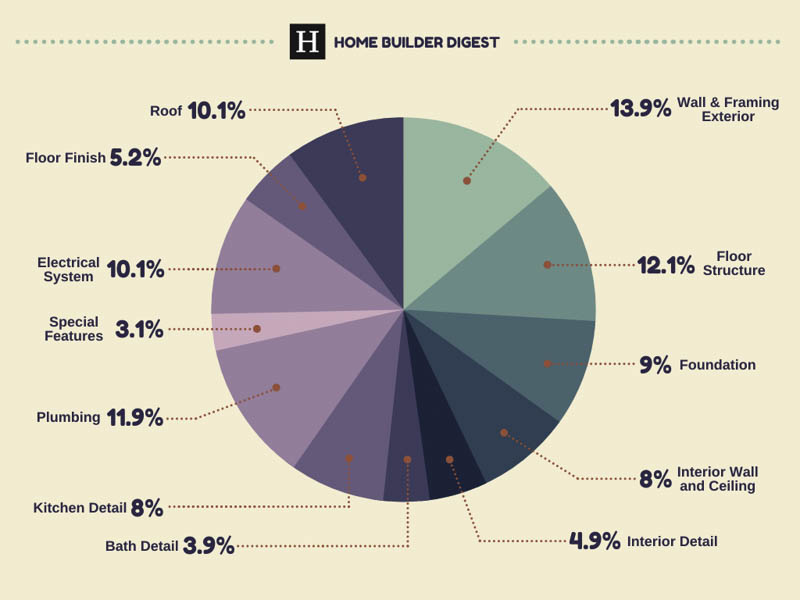
Figure 1. Typical cost breakdown of a single-family home constructed using the conventional method, according to Home Builder Digest.
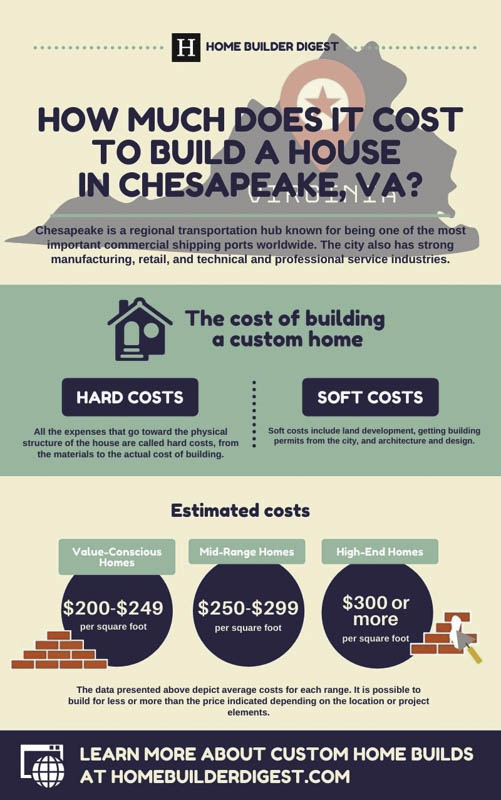
The average cost of construction for Chesapeake is about $250 per square foot, which is much higher than the national average of $207 per square foot. Project owners can expect to see firms charging within the $200 to $300 per square foot range for the home building cost, which does not include things like heating, ventilation, and air conditioning (HVAC), kitchen space, bathroom space, or exterior elements. The actual construction cost will vary from project to project based on the type and quality. This does not include hard and soft costs.
Hard costs cover the aspects of construction that are physically part of the house itself, including framing, foundation, plumbing, flooring, and roofing. Soft costs, meanwhile, are related to things like the cost of land, permitting fees, and architectural and design fees. Project owners should keep in mind that hard and soft costs will fluctuate independently of each other, sometimes without warning.
Hard Costs
Typically, new home construction projects in Chesapeake will start at $200 per square foot for value-conscious homes with basic and simple designs. Project owners who want to build a home with more customized features will come across firms that offer their services starting at $250 per square foot, which is generally for mid-value type homes. Building a fully customized and high-end home, meanwhile, could cost at least $300 per square foot. It should be noted that these figures are estimates and actual prices may be higher or lower depending on the square footage and additional features. These figures also do not include things like HVAC, kitchen space, bathroom space, and exterior elements.
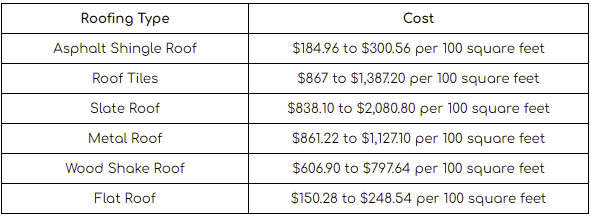
Roofing costs in Chesapeake can range anywhere from $150.28 to $2,080.80 per 100 square feet, depending on the roofing type. The following table provides price ranges that project owners can expect to see:
Major systems are typically composed of HVAC, electrical, and plumbing. HVAC systems will generally cost between $200 to $28,000, depending on the service. Plumbing costs between $92 to $668, while electrical installation costs between $92 to $742.
Soft Costs
Soft costs are expenses that go beyond the actual building of the structure. These costs include land costs, permitting fees, and architectural and design costs.
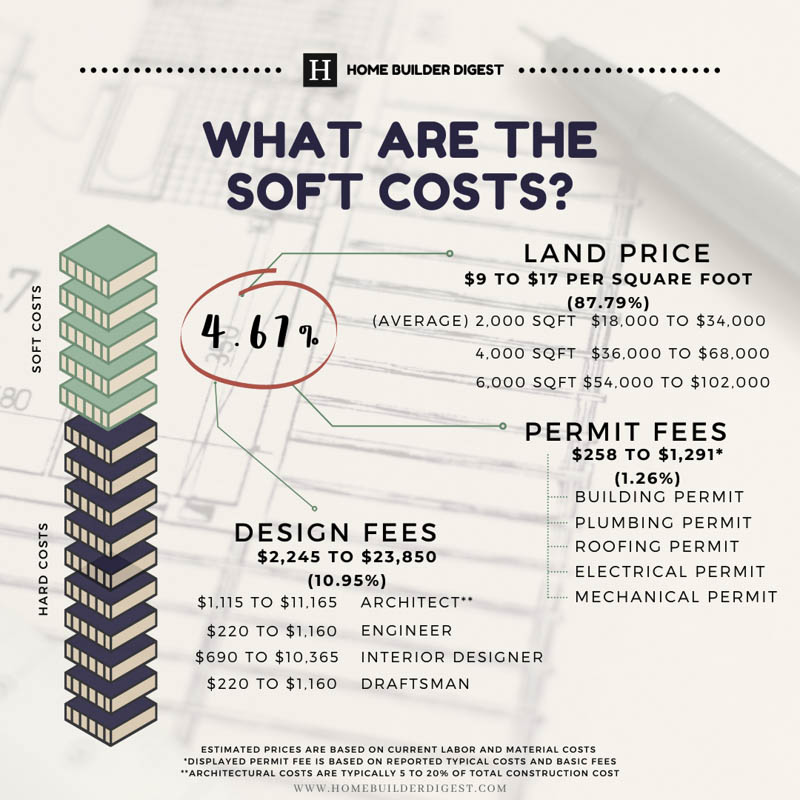
Figure 2. Soft cost percentage and average price range of additional fees, determined from the overall cost of custom home building in Chesapeake.
Cost of the Land
Chesapeake is currently experiencing positive population growth, with an annual growth rate of 0.99%. Because the city has inbound population growth, land costs are expected to increase more than cities with stagnant or negative population growth.
The parcels of land available for sale in Chesapeake on Zillow have an average cost of $123,466.67. The cheapest lot is being sold for $65,000. It can be found along Queen Street and is 7,405.2 square feet. The most expensive lot, meanwhile, costs $214,900 for 20,908.8 square feet. This lot can be found in Bellechase Court.
Redfin’s average cost of land is about $115,828.57. The cheapest and most expensive lots being sold are the same as ones on Zillow. The cheapest lot is being sold for $65,000 while the most expensive lot is priced at $214,900.
Permits and Other Fees
Information on the permitting process in Chesapeake can be found on the local government’s website. The website has forms that are required for residential building permits, which are the Land Disturbing Permit, the Mechanics Lien Agent, and the Commonwealth of Virginia Contractor’s License.
The immediate fees that need to be paid upon permit issuance are as follows:
- The permit fee is based upon the square footage of the structure. The minimum fee is an administrative fee of $40 for issuing each permit, plus an additional $6 per 100 square feet or fraction thereof. The cost for residential permits can also be found on the Residential Fee Schedule.
For example: For a new residential construction project that has 2,200 square feet, the fee will be calculated as follows:
2200 ÷ 100 = 22
22 x 6 = $132 + $40 (administrative fee) = base fee $172
- Minimum fee — $40
- Land Disturber Registration — $30 (for new construction only)
- Zoning Review of residential plans — $10
- Certificate of Occupancy fee — $30 (will be included to the building permit fee)
- Driveway permit fee (if applicable) — $30
- 2% state levy is assessed to each fee by the State of Virginia excluding City water and sewer fees
- Technology Fee — $5
- Hampton Road Sanitary Disposal (HRSD) fee — $1,895 (will be paid separately from other fees)
- City Water Fee (Part II Code of Ordinances – Chapter 78 Utilities – Article IV Rates, Charges and Fees – Section 78-86)
- City Sewer Fee (Part II Code of Ordinances – Chapter 78 Utilities – Article IV Rates, Charges and Fees – Section 78-86)
- Plan Review Fee Schedule
After obtaining the required building permits, the electrical, plumbing, and mechanical and gas permits are required. These permits can be applied for online, through the local government’s eBUILD platform. There is also the option to apply for these permits in person. The following are links to the necessary forms:
- Electrical Permit
- Plumbing Permit
- Mechanical and Gas Permit
Permits found on online contractor marketplace BuildZoom (BZ) show that the average cost of permits in the last five years is $590.10.
Architecture and Design Fees
Architects will typically base their costs on the total cost of construction or total construction value. Nationally, that would be around 5 to 20%, depending on the service, project complexity, and architect experience.
Some firms may also price their services by the hour or by square footage. Chesapeake architects tend to charge $5 per square foot for value-conscious projects, $7.50 per square foot for mid-range projects, and $10 to $13 per square foot for high-end custom homes. These prices are estimates and do not include consultants or interior designers. It is more common to see firms pricing their services in the value-conscious and high-end ranges.
Pricing will typically be based on the request, project location, and the architect’s position, experience, training, and reputation. Some of the most common services homeowners avail of are layered drawings, project management, concept development, consultation, and site visits.
What Leading Custom Home Builders and Architects that Serve the Chesapeake Area Say
Charles Wermers, founder of Wermers Design & Architecture, PLC, shared that the biggest concern at the moment is the cost of construction, which has shot up by 20% in the last couple of years. Firms are also experiencing long lead times. Wermers noted that delayed projects are experiencing cost overruns.
“Projects must be effective, authentic, and efficient to satisfy the needs and program of the owner,” said Wermer. His advice is to put importance on design, stating that style is meant to be a clever and beautiful expression of meeting a client’s needs.
The Future of Chesapeake’s Residential Construction Industry
The construction industry in Chesapeake continues to experience trouble with labor shortages, which ABC expects to last the entire 2022. The labor shortage is a result of several factors, including an aging workforce and a lack of trade skills being taught in schools or apprenticeship programs being offered.
This labor shortage, alongside supply chain issues, is causing the price of construction to rise. Some firms have also taken to limiting the number of projects they accept to prevent missing project deadlines. ABC predicts a shortage of about 665,000 construction workers.
Cost Saving Tip for Building a Home in Chesapeake
Get Ahead of Flood Zone and Elevation Requirements Before You Buy a Lot
Chesapeake is a city defined as much by its waterways as its roads. Stretching across 353 square miles in southeastern Virginia, it encompasses an extraordinary range of terrain—from its urban core and established suburbs to rural farmland, wetlands, and tidal waterways that connect to the Chesapeake Bay and its tributaries.
This geography is beautiful and desirable, but it creates one of the most significant—and most preventable—cost variables in the local custom home market: flood zone classification. A meaningful share of Chesapeake’s most attractive residential land sits in FEMA Special Flood Hazard Areas, which impose minimum finished floor elevation requirements, mandatory flood insurance, and in some cases, specific foundation type requirements that add meaningfully to construction cost.
Before purchasing any lot in Chesapeake, buyers should obtain a current flood map determination, review any available elevation certificates for the specific parcel, and consult with a local builder about the design and foundation implications of the flood zone classification. In some cases, a lot in a flood zone that appears competitively priced will require a pier foundation, stem wall construction, or substantial fill to bring the structure to the required base flood elevation—costs that can easily exceed the apparent discount on land.
Buyers who invest an hour in this research before closing on a lot consistently avoid budget surprises that take weeks to unwind. In Chesapeake, understanding the relationship between a lot’s elevation, its flood zone status, and its foundation requirements is the single most impactful piece of pre-purchase due diligence.
Frequently Asked Questions
Which areas in—or near—Chesapeake are among the best for custom home building?
Chesapeake’s Great Bridge and Battlefield Park areas represent the heart of the city’s established custom home market. Great Bridge offers a mix of older waterfront communities and newer subdivisions with canal and river access, while the neighborhoods surrounding the Battlefield golf course and the Northwest River corridor attract buyers seeking larger lots in a more semi-rural setting.
Deep Creek and the areas north of the South Branch of the Elizabeth River offer proximity to downtown Chesapeake’s commercial core and easy access to Norfolk and the Hampton Roads employment base, with a range of lot sizes from compact suburban parcels to larger riverfront properties. This corridor has seen steady custom and semi-custom construction activity.
For buyers seeking a more rural character with spacious acreage, South Chesapeake—particularly the communities south of Indian Creek Road toward the North Carolina border—offers agricultural and wooded parcels at some of the most competitive prices in the metro area. Buyers here should plan for septic systems and private wells rather than municipal utilities.
Just outside Chesapeake’s city limits, the communities of Suffolk to the west have emerged as an appealing alternative for buyers seeking newer subdivision infrastructure at competitive prices, with easy access to Chesapeake employers and the major Hampton Roads highway network. Virginia Beach and the Currituck County communities across the North Carolina line also serve as geographic alternatives for buyers willing to commute.
How does Chesapeake’s climate potentially impact home building costs?
Chesapeake sits firmly in the humid subtropical climate zone—hot and humid summers with temperatures that regularly reach the mid-90s and dew points that make air conditioning an absolute necessity, followed by mild winters with occasional ice and snow events rather than the sustained cold found in northern markets.
The dominant mechanical cost driver is cooling. HVAC systems in Chesapeake must handle sustained summer heat loads and high humidity simultaneously, and dehumidification is as important a consideration as temperature control. Heat pump systems are well-suited to this climate and are the most common choice in new residential construction in the Hampton Roads region.
Chesapeake’s location near sea level and its extensive tidal waterway network creates ongoing awareness of storm surge risk, particularly during hurricane season. While most residential sites are not in direct storm surge zones, building codes in the Hampton Roads region reflect the coastal exposure, and wind-resistant construction specifications—roof tie-downs, impact-resistant windows in some areas, and enhanced sheathing attachments—are part of the standard construction vocabulary here.
The region’s relatively mild winters minimize frost depth concerns and eliminate the need for basement construction in most locations, which keeps foundation costs lower than comparable homes in northern markets. However, the humid climate requires careful attention to moisture management in crawl space construction, which is the most common foundation type in this part of Virginia.
What should I know about soil and terrain conditions before buying a lot in Chesapeake?
Chesapeake’s terrain is largely flat to gently rolling, shaped by its position on the Atlantic Coastal Plain. This generally means straightforward building conditions from a topographic standpoint—there are no hillside challenges, dramatic slopes, or rocky terrain to navigate as there would be in mountainous parts of Virginia.
The soil profile across most of the city is dominated by sandy loam and clay loam deposits with moderate bearing capacity for residential construction. Conventional slab-on-grade and crawl space foundations are the norm, and foundation costs are predictable in most locations. However, expansive soils do occur in some areas, particularly where heavier clays are present, and seasonal swelling and shrinkage can cause foundation movement if not accounted for in the design.
The more significant soil consideration in Chesapeake is wetland regulation. Virginia’s wetlands protection laws, administered jointly by the Virginia Marine Resources Commission and the Army Corps of Engineers, restrict construction on tidal and non-tidal wetlands and their adjacent buffers. Lots that appear buildable on paper may have significant unbuildable wetland acreage, and a wetlands delineation review is an essential step before purchasing any undeveloped parcel in Chesapeake.
High water tables are common in the lower-elevation portions of the city and near its many waterways. This makes basement construction impractical in many locations and requires careful drainage design even for standard crawl space foundations. Encapsulated crawl spaces with vapor barriers and mechanical dehumidification are the modern standard for new construction in this climate.
Broadly speaking, is it cheaper to build or buy an existing home in Chesapeake right now?
Chesapeake sits in the heart of the Hampton Roads metro area, one of the largest population centers in the mid-Atlantic and the home of the world’s largest naval base. The city’s housing market reflects this stable, military-influenced demand base alongside steady civilian growth. Existing home prices are elevated compared to most of inland Virginia but remain notably below those in Northern Virginia and the Washington DC suburbs.
On a cost-per-square-foot basis, purchasing an existing Chesapeake home is generally less expensive than building a new custom home. The region’s construction costs, while not as high as coastal markets in California or the Pacific Northwest, have risen with the broader post-pandemic increase in labor and material costs.
The case for building new in Chesapeake is particularly strong for buyers who want to design for the coastal climate from the ground up: elevated foundations where flood zone classification warrants it, properly designed crawl spaces with encapsulated vapor barriers, mechanical systems sized for the region’s humidity load, and exterior materials specified for durability in a salt-air adjacent environment.
Many of Chesapeake’s existing homes—particularly those built in the 1970s through 1990s—have aging mechanical systems, minimal crawl space moisture management, and building envelopes that predate modern energy code requirements. Upgrading these features in an older home can add substantially to the effective cost of purchase, narrowing the apparent gap between buying and building new.
Considering building a home in Chesapeake, Virginia?
Contact us for a free consultation