
Home » Cost Guides » Illinois Cost Guides » How Much Does it Cost to Build a House in Chicago?
The city of Chicago is a major world financial center which consistently ranks as the second largest central business district in the United States. Unfortunately, the COVID-19 pandemic hit the city’s economy hard. Chicago saw a peak unemployment rate of 18% in June 2020. As the world recovers and the city continues to bounce back, its employment rate decreased to 7.9% in May 2021. The city also projects to provide over 200,000 new jobs over the next few years, bringing a steadfast employment growth rate of 1.14% every year.
With great job opportunities, more people are choosing to move to the third largest city in the country. Based on the U.S. News & World Report, Chicago is one of the best places to live and retire. It is more affordable compared to other major urban cities – being less expensive than San Francisco by 39% and New York City by 52%. Upon deciding to move to this diverse and thriving city, one should also consider the construction cost and fees it takes to build a home in Chicago.
The Cost of Building a Custom Home in Chicago
A lot of people think that building a custom home is far more expensive than buying a built one, but that’s not always the case. The word “custom” in it means a homeowner can customize a home the way that it fits their family. They can set a budget and not worry about exceeding it as they can focus on their needs and create something that they want — their dream home.
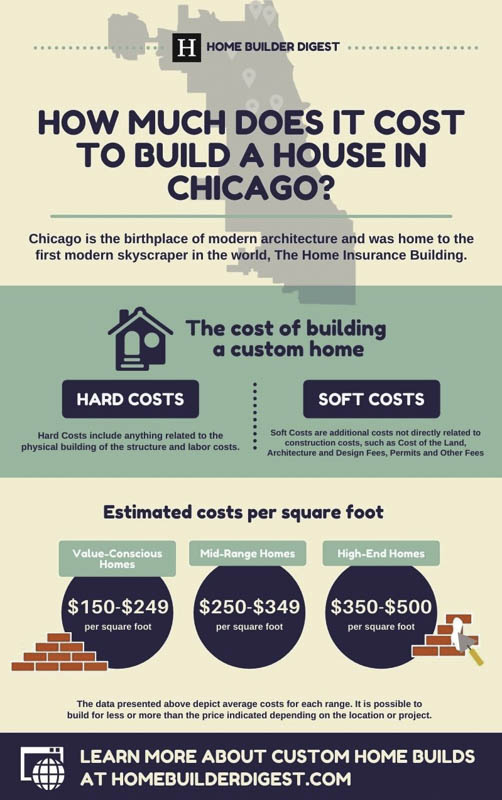


According to the National Association of Home Builders (NAHB), the 2021 average cost to build a new home is $485,128. Several institutions also released their independent market reports, including the U.S. Census Bureau, which lowers this value to an average of $397,800, and HomeAdvisor who further reduces the value to $291,953. HomeAdvisor added that the price range for new value-conscious homes varies between $100 and $200 per square foot. Custom and luxury homes have a higher value that is estimated to be around $200-$500 per square foot, given that these types of homes tend to be more complex and tailor-made according to homeowners. So, how much does it cost to build a house in Chicago? In September 2021, Chicago homes had a median price of $249 per square foot, which is roughly $350,000 for a 1400 square foot home. Despite the pandemic, there is an upward trend for single-family housing construction as more permits for new homes are filed, according to the architectural buildings index.
These are only the average values and not the final answer on how much it cost to build a home in Chicago. Many factors directly contribute to a home’s construction cost, including the location, the size, the home style, the builder and architectural fees, the permits and many more. These factors are divided into two categories: hard costs and soft costs.
Hard Costs
Hard costs involve the physical construction of a new home. These costs include materials, landscaping, labor, and the actual building. In Chicago, the estimated cost of building a new house is around $162.52 per square foot. Depending on the design and style, the price may increase or decrease. This heavily revolves around the homeowner’s taste on whether they prefer a luxury residence or a more value-oriented home.
Delving deeper into details, costs for specific services include the home’s foundation, framing, roofing, key systems, and finishes. According to HomeLight, the estimated price for foundation starts at $8,200. Framing runs somewhere between $20,000 to $50,000 while roofing is estimated to have a price of $8,309. As for key systems and finishes, the key systems lie somewhere between $17,000 to $72,000 and finishes to the home cost around $42,000 to $175,000. One thing to consider before beginning the process is the rise of material costs that has been increasing for over 15 years. There is a 30% increase in steel prices due to the federal trade tariffs. The COVID-19 pandemic also inflated the price of the following: lumber up to 10%, paint to 11%, and concrete up to 13%. These details lead to an average cost of at least $100 to $200 per square foot.

Figure 1. Typical cost breakdown of a single-family home constructed using the conventional method, according to Home Builder Digest.
Home Additions
Besides the actual home, numerous homeowners also add extra amenities to enhance the new home’s appearance or further support their family’s lifestyle. A playground might be a great addition if you have kids or opt for a pool addition where the family can relax and enjoy the summer. The average price of each are as follows:
- Swimming Pool: $36,750 to $100,000
- Heated Floors: $6 to $20 per square foot
- Basement: $10,000 to $40,000
- Outdoor Deck: $4,087 to $15,000
- Playground: $500 – $5000
- Shed: $1,500 – $10,000
- Fence: $2000 – $5,000
- Patio: $2,000- $8,000
- Driveway: $2,300 – $10,000
- Landscaping: $8,000 – $15,000
- Barn: $10,000 – $200,000
- Garage: $22,000 – $60,000
- Tennis Court: $45,000 – $80,000
These amenities can be quite costly, with the size and more complex designs bumping up the price tags. Future homeowners should consider some of these additions early on in the planning process as some are needed to be built with the home. Other amenities can be added later on whenever the owner sees the need for it.
Soft Costs
Soft costs are the costs that involve fees and post-construction expenses. These include permits, architectural fees, engineering fees, and other miscellaneous fees. Permit fees cost around $75 a month with a deposit of $300. As for architectural and engineering fees, it solely depends on the type of house and how large or small the floor plan and landscape is. It is worth noting that Chicago ranks 3rd in average construction costs behind only New York and San Francisco. Here are some of the relevant soft costs which impact Chicago new house construction expenses:
Architecture and Design Fees
Every step of a home construction must be thoroughly planned before being executed. Hiring an architect would be highly beneficial as they take into account the homeowner’s wants and needs while keeping the home within the requirements and regulations. You should also note that each architect and designer charges differently than others—some amount depending on the project percentage cost, per hour rate, or square foot. Experienced and renowned architects may also be more expensive compared to the newer ones in practice.
According to HomeGuide, the average cost for architects to draw basic plans ranges from $2,000 to $20,000, which may increase up to $80,000 for a complete house design and services. These rates often start at $100-250 per hour or $2-$15 per square foot. It takes up 8% to 15% of the overall construction cost for custom homes.
Land Costs
According to the Chicago Tribune, the average price for land runs somewhere between $100-$200 per square foot. A factor that plays into this is the neighborhood the home is in. In addition, the neighborhood will affect the permits and acreage the home will need to fully complete the project. The Chicago Tribune suggests setting aside 20-25% of your total budget for land and associated fees. It is worth noting that because of the harsh winter the city experiences, landscaping prices add additional cost for maintenance after the winter season. This comes at a price of roughly $266.
Permits and Other Fees
As mentioned earlier, permit fees depend on the location and neighborhood of your home. An excerpt from the Chicago City Government permit files states a $75 monthly price with a deposit of $300. The other miscellaneous fees come from additional spaces that may be included into the project. This involves additional rooms and amenities which will increase the final price. In addition, according to a file from the Chicago Government, residences with a maximum of four stories and three dwelling units come at a price of $2000 while homes with more than four stories and more than four dwelling units cost $3000. The local government also recently updated the Chicago Building Code and now follows the 2018 International Building Code. This improves the overall development process and supports more flexible design solutions, including cost efficient practices and modern building techniques and materials.
How do the custom home building costs in Chicago compared to other cities?
According to the Census Bureau, the median contract price for homes in the Midwest is $129 per square foot, which is around $299,561.22 for a 2,322 sf home — the average size of newly constructed homes. Chicago being ranked third in most expensive cities for home construction sees an increase in numerous services that plays a factor on whether people should build a home in the city. As mentioned above, the other two cities ranked higher than Chicago are San Francisco and New York. Chicago’s construction costs are 19.4% higher than the national average compared to New York and San Francisco’s which are 31.7% and 29% percent higher than the national average. This trend continues to show the constant increase in costs due to the ongoing pandemic which plays a significant role in home building.
In June 2020, the average home value in Chicago was priced at $287,000 that inflated to $325,000 in August 2021 — a 10.4% increase, according to Zillow. This price increases as the home gets closer to downtown Chicago and job centers. The Chicago Loop comes after New York City’s Midtown Manhattan as the largest commercial business district in the county; home prices range from $379,000 up to $631,666. The city also has its fair share of upscale and luxury neighborhoods such as Gold Coast, River North, and Streeterville, with homes priced at around $484,090, $474,009, and $444, 965 respectively.
Based on the data gathered from the online contractor platform Buildzoom (BZ), it shows that recent building permits for new construction of single-family dwelling homes in the nearby cities has a median price of $334,472. The cities included and their respective average values are as follows:
- Highland Park: $452,126
- Gurnee: $282, 117
- Naperville: $384,132
- Aurora: $219, 514
We have also gathered substantial information about homes in Oak Park from Element Worx‘s President, Brett Williams. Although fewer new constructions are happening in the area compared to Chicago, master bathroom remodels, kitchens, and other additions are popular, even if they are often costly. Updating old homes’ bathrooms can be especially expensive where total gut jobs and relocation of water and sewer lines are needed. Pricing for these kinds of construction works can go as high as $900 PSF after completion. He also added that their pricing for mid-range projects costs between $375 PSF to $429 PSF, with regards to coach houses — a common type of home in Chicago and nearby areas wherein these are smaller apartments that are built apart from the main building.
Major Custom Home Building Cost Trends Across the Web for Chicago
Online market platforms and online discussion forums suggest that the average cost for building a custom home in Illinois ranges from $103.10-$162.72 per square foot for basic construction, while Chicago ranges from $103 to $500+ per square foot and may increase depending on the different factors discussed earlier. This means that a homeowner can spend at least $51,500 for a 500 square-foot home for basic construction. This value quickly increases up to $890,000 or more depending on size and other factors that would be added as you customize your home. According to Focus, Chicago is one of the most expensive cities to build in — 16.8% higher than the top 30 largest cities across the country. The continuous rise of construction costs directly contributes to this inflation. Focus also reported that there has been a 4% increase in 2017 alone. According to the Commercial Construction Index, one of the problems that directly contributes to the city’s rising construction costs is the shortage of its workers. Many tradespeople are retiring, and companies are finding it challenging to hire and replace them. On top of that, the nationwide construction costs are also going upward and have been increasing for over 15 years. Bisnow reported a 2.2%-3.5% rise in steel framings, fire protection, earthwork, and plumbing systems, with a 30% increase in steel prices. Despite this, Chicago’s construction industry is booming. The COVID-19 pandemic is pushing residents to leave downtown Chicago and move to the suburbs for more space to accommodate the newly mandated work-from-home and remote learning setting — a common trend that can be seen across the nation. This produced a significant increase in single-family housing permits as more residents listed their condominium units.
A common trend can also be seen in the area, according to Geno Benvenuti of Benvenuti and Stein — a custom home builder serving the Chicago area. He noticed that the size of homes is not as critical as function. Homeowners opted for open floor plans instead of the usual formal spaces like living rooms and dining rooms. Large kitchens are also more desirable than can accommodate family and friends. Adding to homeowners’ popular choices are walk-in pantries, spacious mud-rooms, master suite with built-in cabinetry, and master bathrooms with his and hers vanity, separate toilet space, and large showers with multiple heads. You might consider these factors, but in the end, it will still depend on you on how you would customize the home and how it will fit you and your family’s lifestyle and needs.
What Leading Custom Home Builders and Architects that Serve the Chicago Area Say
Aside from the mentioned aspects, we reached out to some of the best custom home builders and architects that serve Chicago to gather more data about the building cost and trends in the area.
According to the owner of Becker Architects, Richard Becker, AIA, LEED AP BD+C, prices have increased compared to the previous years due to the high labor costs in Chicago and the pandemic-related supply chain issues. He also added that the residential construction economy in the city has improved since the pandemic, creating an upward pressure on the overall costs. The firm’s pricing for value-conscious homes start at around $190 per square foot and their mid-range homes start at $350 per square foot — two of which are in the process of completion. Becker Architects is also in the process of developing high-end custom homes — priced at the range of $500 per square foot and up.
Adam Piser, President of Domain Construction, verified the price increase. He added that high demands and lack of qualified, skilled labor workers directly affected the price. With the price of homes per square foot, the firm provided roughly the same values as Becker Architects. Value-conscious homes are priced at $150-$250 PSF, while mid-range homes and high-end luxury homes are priced at $250-375 PSF and $450-$650 PSF, respectively. Adam also provided his insights that project owners should give realistic expectations ahead of time. Although building in this climate is costly and time-consuming, the homeowners will be happier with the final product as having excellent quality homes takes time.
Geno Benvenuti, president of the custom home building firm Benvenuti and Stein, gave a slightly higher value wherein value-conscious homes starts at $255 PSF, mid-range homes at $300 PSF, and high-end homes at $420 and up — these values would include a finished lower level in the square footage. Further confirming what Richard and Adam said, COVID-19 related shortages in materials and labor bumped up the price. These values may further increase up to 12%-20% PSF if the spike does not subside. Geno gave a piece of advice to future homeowners: “In this current inflationary and supply shortage environment, I would recommend that a buyer reins in costs by signing contracts as soon as one can so products get ordered early to lock in costs and to make sure the products are available when needed.”

The president of the Nottingham Builders, Lee Norton, also shared his insights regarding the increase in prices. He reported that for the last 18 months, the industry had seen a significant increase in almost every aspect of homebuilding. We mentioned earlier the inflation in lumber and steel prices, which Lee also confirmed. It has been decreasing as the city of Chicago bounces back, but the prices are still high compared to the pre-pandemic season. Coppers, shingles, cabinets, and other essential materials for construction have also increased. Subcontractor costs are the most recent surge of prices in the industry, where subcontractors are compelled to pay higher wages to get help from workers. This greatly affected the price per square foot the Nottingham Builders offered. With an average cost of $180-$200 PSF in the previous years, the firm has since then increased their prices up to $250-$300 PSF — a 38%-50% increase. MK Construction & Builders have roughly the same values, according to Edyta Topolska. The firm’s price range includes the basement with value-conscious homes valued at around $200 PSF. The trend continues wherein mid-range homes and luxury homes become more expensive as projects are more customized, complex, and require more work — prices for both starts at $275 PSF and $350 PSF, respectively. She also specified the significant factors that greatly affected the cost trends: pandemic, lack of materials, and lack of workers. “Plan your budget accordingly and stick to it. Any changes to your project mean additional material and labor cost.” as recommended by Edyta.
In the architecture aspect, the most commonly used method in pricing for architectural designs is on an hourly basis according to a recent AIA report. Nathan Kipnis of Kipnis Architecture and Planning however provided that the firm uses an hourly to a maximum of “percentage of construction” — estimated at 8%-15% of the total construction cost for full architectural service. This rate changes depending on how complex or how often site visits are needed. Some clients also opt for a set price for limited service and scope of work. For extra work, such as adding square footage or more detailing than the initial plan, this would be typically charged hourly. The pricing for both is generally the same in the end, although having the percentage method can be beneficial as it is more flexible and incremental extra charges are prevented. Construction costs, on the other hand, have been mentioned in the news for a while because of the surge in prices. Nate estimated this price ranging from $300 to $450+ per square foot– excluding the property and landscaping. There are also factors that need to be considered as these directly influence the costs: custom built-ins, special features, level of finishes, and size of home can add to the cost per square foot and construction costs. He expressed that the size can be counterintuitive as the larger the house, the lower the cost is per square foot and vice versa. Smaller projects tend to cost more per square foot since less general footage can accommodate the home aspects needed.
What is the future of residential construction in Chicago?
As Covid-19 continues to ravage the world affecting lives and the economy, the trend of increasing construction costs remains a common theme throughout many cities in the U.S. Chicago being the third most expensive place to build a house, with only San Francisco and New York being more expensive, presents potential homeowners with a difficult decision to make. Building houses comes with a lot of factors from what kind of home the client wants to the landscaping, location, and interior floor plan. This increase in price affects the supply of materials as well. Lumber, steel, bricks, and many others continue to have their prices rise. With these in mind, it is best to take into account all factors mentioned to determine what is the best location and what is the best type of home that will fit your needs while maintaining a cost-effective approach.
Cost Saving Tip for Building a Home in Chicago
Plan for Demolition and Site Clearance Before You Budget for Construction
In Chicago and its close-in suburbs, building a custom home almost always means tearing something down first. The region’s dense urban fabric and established neighborhoods leave very little vacant land, so most new residential construction begins with demolition of an existing structure.
This creates a cost variable that buyers from less urban markets frequently overlook. Demolishing a typical Chicago-area single-family home runs between $11,000 and $23,000, and that figure climbs further if the structure contains asbestos, lead paint, or other hazardous materials requiring abatement. A separate demolition permit—typically around $3,000—adds to the total before a shovel of dirt has been turned for the new foundation.
The smartest approach is to treat demolition as its own budget line item rather than burying it inside a vague contingency. Get a demolition bid before finalizing your construction contract, ideally at the same time you’re reviewing design plans. Some design-build firms can sequence this efficiently, allowing demo to proceed while final architectural drawings are completed.
Additionally, Chicago’s municipal permit system is among the most complex and expensive in the country, with minimum fees significantly higher than cities like Houston or New York. A project that arrives at the permit counter with a complete, professionally prepared plan set moves through the process far faster than one requiring multiple correction rounds—and in Chicago, every week of delay has a real dollar cost in carrying expenses and contractor mobilization.
Frequently Asked Questions
Which areas in—or near—Chicago are among the best for custom home building?
Chicago’s north shore suburbs—particularly Winnetka, Kenilworth, Glencoe, and Lake Forest along the Lake Michigan shoreline—have historically been the epicenter of high-end custom home construction in the Chicago metro. These communities combine landmark-quality residential architecture with well-funded school districts, mature tree canopy, and lakefront access. Land costs and construction standards in this corridor are among the highest in the Midwest.
DuPage County communities including Hinsdale, Burr Ridge, and Oak Brook draw custom builders seeking larger lots and more open landscapes to the west of the city, with lower land costs than the lake shore at the luxury tier. Naperville, a rapidly growing city along the I-88 corridor, has a strong custom home market in its outer neighborhoods where newer subdivisions offer freshly platted lots with modern infrastructure.
For buyers interested in building within Chicago proper, the Lincoln Park, Lakeview, and North Center neighborhoods on the north side see steady infill custom construction on tear-down sites. The western neighborhoods of Bucktown and Logan Square attract design-forward buyers willing to navigate the city’s complex permit process for the benefit of urban walkability and proximity to culture and dining.
How does Chicago’s climate potentially impact home building costs?
Chicago’s continental climate is genuinely demanding—winters that bring sustained subzero temperatures, heavy lake-effect snowfall, and deep frost penetration into the soil, followed by hot and humid summers. Both extremes affect construction costs in meaningful ways.
Foundations in the Chicago area must extend below the local frost line, which can reach 42 inches or more in a severe winter. This increases excavation depth and concrete volume compared to warmer markets. Full basements are the dominant foundation type in the region, both for practical reasons of depth and because the additional square footage is valued by buyers in this market.
The freeze-thaw cycle that runs through Chicago winters is hard on exterior materials. Builders in this market invest in brick, fiber cement siding, and other materials that can withstand repeated cycling between wet and frozen conditions without premature failure. Roofing systems similarly need to be specified for ice damming prevention, which adds attic ventilation and insulation requirements beyond what a milder climate would demand.
The upside is that Chicago’s construction industry is one of the most experienced and well-resourced in the country for cold-climate building. Well-established union and non-union trade networks mean that finding qualified subcontractors is generally easier here than in smaller markets, even if those tradespeople come at premium rates.
What should I know about soil and terrain conditions before buying a lot in Chicago?
Chicago and its surrounding suburbs sit on glacially deposited terrain, and the soil conditions across the metro area reflect this heritage. Much of the urban area is underlain by dense clays deposited when glacial Lake Chicago covered the region thousands of years ago. These clays have moderate to good bearing capacity, but they are slow to drain and can hold water seasonally, making foundation waterproofing and perimeter drainage important investments.
Some portions of the Chicago lakefront and river corridors—including areas that were historically marshland or industrial land—contain fill soils of variable quality. Buying a lot in these areas without a geotechnical investigation is a significant risk, as fill soils can settle unevenly or have low bearing capacity that requires deep foundation systems to address.
In the suburbs, particularly the north shore communities and areas along river valleys, sloped terrain introduces the possibility of landslide risk and erosion in areas with steep clay-over-sand profiles. Buyers of lots in these locations should commission a geotechnical report before purchase to understand both the foundation design requirements and any regulatory restrictions associated with sensitive slope areas.
Broadly speaking, is it cheaper to build or buy an existing home in Chicago right now?
Chicago’s existing housing market offers a wide range of price points, and on a pure cost-per-square-foot basis, buying an existing home is generally less expensive than building new in most submarkets. The city and its established suburbs have abundant existing inventory, much of it well-built and architecturally interesting.
However, Chicago ranks among the most expensive cities in the country in which to build—only San Francisco and New York consistently exceed it in per-square-foot construction costs. This cost premium is driven by union labor requirements on larger projects, the high municipal permit fees, high sales tax applied to building materials, and the cost of building for a climate that demands durable, well-specified assemblies.
For buyers who want a fully customized home and are prepared for the complexity of the Chicago permitting environment, building new remains viable—particularly in the suburbs where land is more accessible and the permitting process is less onerous than in the city proper. The key is entering the process with realistic cost expectations, a complete design before permit submission, and a builder with documented experience in the local jurisdiction.
Considering building a home in Chicago?
Contact us for a free consultation