
Home » Cost Guides » North Carolina Cost Guides » How Much Does it Cost to Build a House in Durham?
With an economy mostly known for its healthcare and pharmaceutical companies, Durham is nicknamed the City of Medicine. The city also has strong information technology and biotechnology industries. Durham companies have shown remarkable adaptability to the effects of the COVID-19 pandemic, with increased job opportunities at the beginning of 2022. The local real estate and construction industries are also seeing more chances of recovery compared to the period following the 2020 economic slowdown.
The Cost of Building a Home in Durham


Much like the rest of America, Durham is also seeing the effects of the housing boom. Demand for available houses picked up mid-2020 and has only risen since then. It has become something of a norm to expect high demand and low supply, which is causing people to move towards having homes built from the ground up.
Fortunately for the construction industry, its employment rate has improved close to pre-pandemic levels which will aid it in meeting demand. Most material costs have also reportedly gone down due to restrictions easing up. Builders and project owners will be glad to know lumber prices have dropped 27%, which dropped from $1,515 per square foot to $1,113.
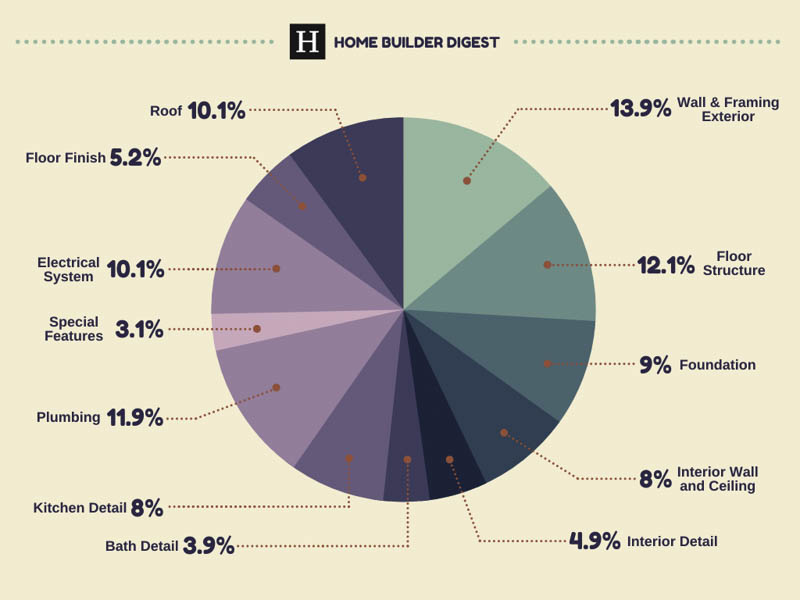
Figure 1. Typical cost breakdown of a single-family home constructed using the conventional method, according to Home Builder Digest. Image Source: National Cost Guide.
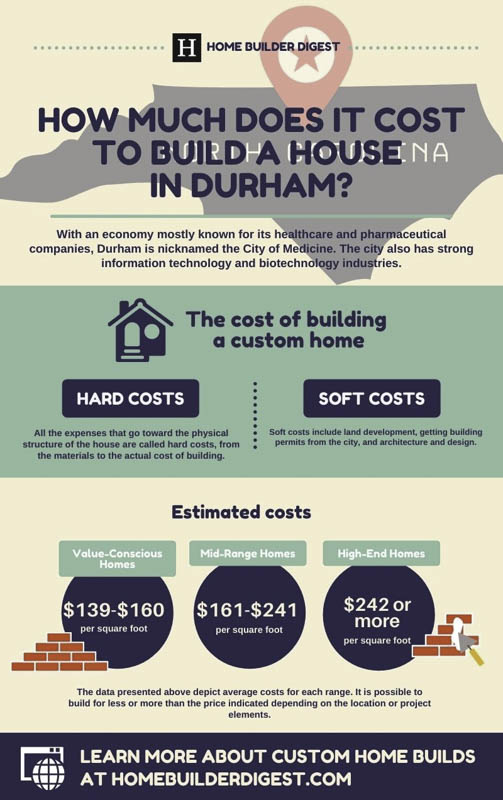
Compared to the national average of new home construction costs at $100 to $155 per square foot, Durham’s new home construction cost average is $128.92 per square foot. The specific cost per square foot will depend on the type and quality of the project, ranging between $135 to $241 per square foot. A basic home project would be priced differently from a mid-value and high-end home. Some factors like location and contractor experience will also affect the pricing.
There are also hard and soft costs to take into consideration. Hard costs are understood as the physical aspect of the house, which includes framing, foundation, plumbing, roofing, and flooring. Softs costs, meanwhile, are things like architecture and design, permits, and additional custom features. Home project owners should keep in mind that these costs will fluctuate independently.
Hard Costs
Get a free cost estimate
New home construction projects in the Durham area will cost an average of $280,924 to complete. Prospective homeowners can expect to see prices ranging from $135 to $241 per square foot, although contractors who work for $135 to $138 per square foot are uncommon. Most firms will instead offer their services for anywhere between $139 to $160 per square foot for budget-friendly projects. Mid-value homes, meanwhile, are priced at $161 to $241 per square foot. Anything starting at $242 per square foot and above are luxury or high-end custom homes.
On top of the construction costs, project owners will have to consider the costs of foundation, roofing, HVAC installation, electrical installation, labor, and other hard costs.
Roofing costs differ depending on the type of roof. The table below shows the typical pricing range available for Durham:
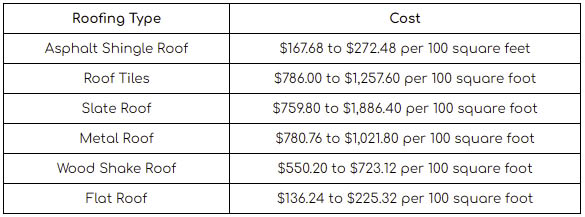
In some cases, new roofing will cost about $350 to $500 per square foot, including materials and labor.
HVAC installation prices will also differ depending on type and weight. The table below provides figures project owners can expect to pay:
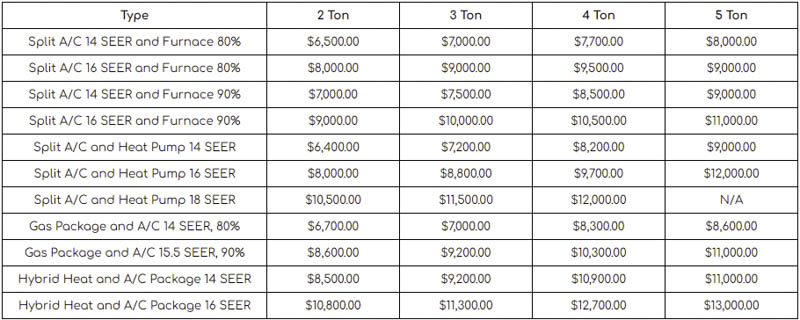
Electrical panel costs will range between $1,500 to $3,000. Wood flooring installation can cost anywhere from $6.92 to $9.71 per square foot, including mid-grade solid hardwood. Vinyl flooring, meanwhile, costs about $3.30 to $4.19 per square foot, which includes labor and a mid-grade tile.
Soft Costs
Get a free cost estimate
Soft costs are the aspects of construction that are not physically part of the project itself. These include land, permits, architecture, and design.
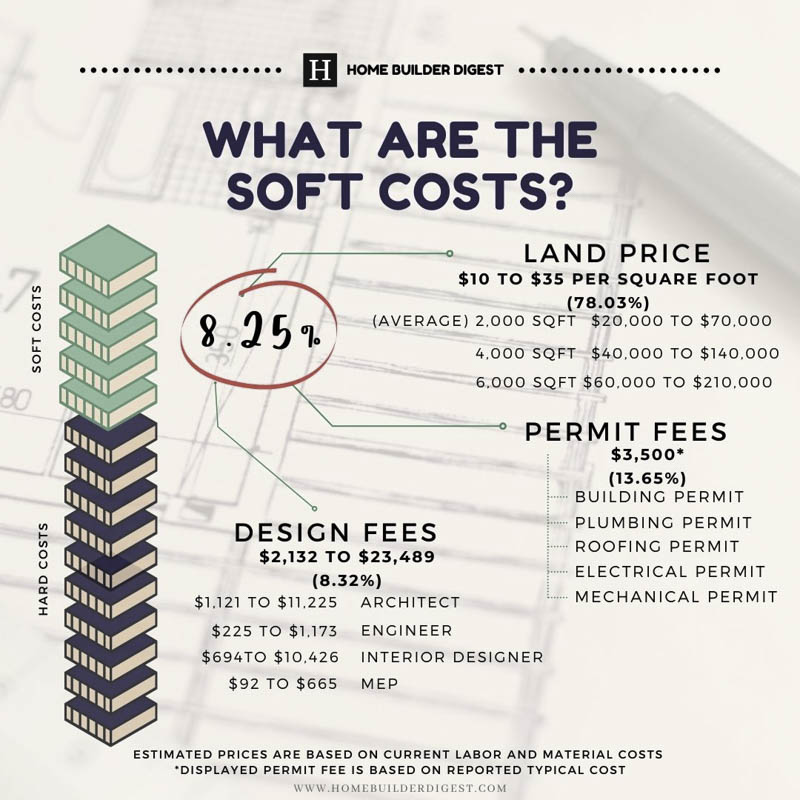
Figure 2. Soft cost percentage and average price range of additional fees, determined from the overall cost of custom home building in Durham.
Cost of the Land
Durham is currently undergoing positive population growth. Its population is expected to increase by 2.5% in 2022. With more people moving into the city, the price of land is likely going to go up.
Zillow shows lots with an average cost of $138,654.95 and an average size of 16,062.75 square feet. The cheapest available lot is $40,000 for 20,908.80 square feet, located in Twin Oaks Drive. The most expensive available lot, meanwhile, costs $400,000 for 14,810.40 square feet and is located on Oakland Avenue.
Redfin, on the other hand, has lots that are priced much differently. The cheapest available lot is $4,000 for 6,011 square feet, located on Joe Louis Boulevard. The most expensive available lot is $7,000,000 for an 80-acre lot on Patterson Road.

Permits and Other Fees
Durham’s local government has several pages on its local website dedicated to the construction permitting process. Application forms are available as several PDF files on the application page. The application status may also be reviewed through the local government’s Land Development Office software.
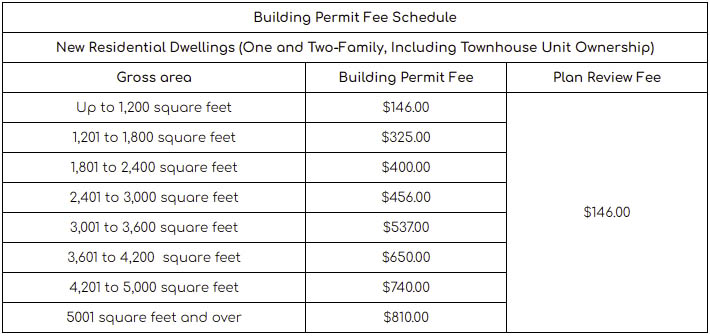
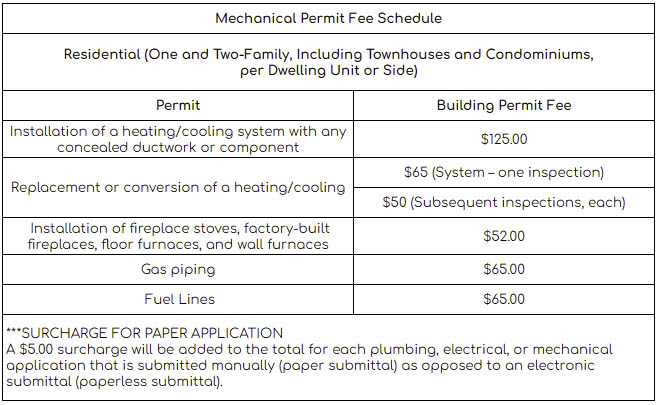
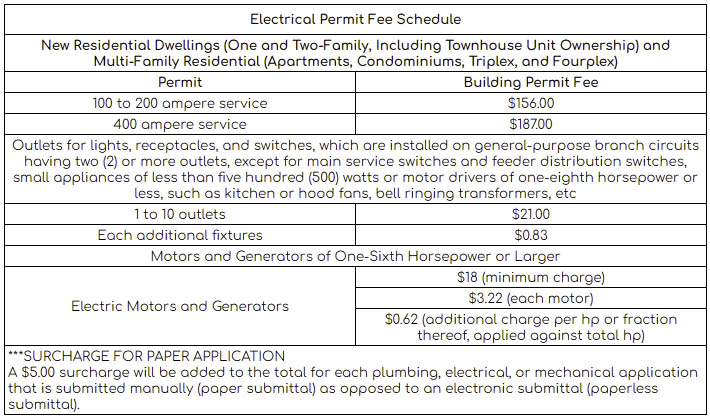
The total permitting costs will depend on the specifications of each project, including but not limited to square footage, the number of floors, permit type, and overall project valuation. Below are several tables featuring costs from Durham’s different fee schedules:
Architecture and Design Fees
Durham architects typically charge based on the total cost of construction costs, charging between 10.48 to 11.01% for different services and project complexity. In comparison, nearby city Raleigh’s architectural costs are about 10%.
It is also possible to find architectural firms that charge by the hour or based on square footage. The pricing will differ depending on several factors, including the work request, project location, and the architect’s position, experience, training, and reputation. Some of the common services being offered are layered drawings, project management, concept development, consultation, and site visits.
What Leading Custom Home Builders and Architects that Serve the Durham Area Say
Ken Combs, the owner, and Ray Orzulak, the estimator, at CQC Home, shared figures for different projects. Value conscious homes can be constructed within the price range of $140 to $175 per square foot, while mid-range projects will cost about $225 to $250 per square foot. A more customized and high-end home will be at least $350 per square foot.
According to them, the Research Triangle Park area is undergoing a wave of high demand for homes and a low supply of inventory and labor. Project managers are also ageing out, which exacerbates the shortage of skilled workers. Additionally, there is low interest for construction work in millennials. Both demand and cost of skilled labor will continue to rapidly increase. Cost trends have changed due to both demand and the effect COVID-19 has on the shipments of materials. The fluctuating material costs has affected the estimation process, especially since the fluctuation is week to week.
The Future of Durham’s Residential Construction Industry
Get a free cost estimate
Market experts are foreseeing a continued increase in real estate prices. Demand will remain the same, with supply struggling to meet it. Homebuyers will eventually shift into beginning new home construction projects, which comes as a relief to the construction industry. The shift is mostly attributed to millennials reaching the homebuying age.
On top of more projects coming to construction firms, the drop in material costs is expected to make business easier. Lumber prices, which have risen 300% over the course of the pandemic, have dropped 27% as a result of certain restrictions easing up. Having an easier time ordering some of the more common materials will make the construction process easier. However, there are still other important materials that remain costly.
Cost Saving Tip for Building a Home in Durham
Source Materials From North Carolina’s Regional Supply Network
Durham’s central location in the Research Triangle—with strong highway access along I-40, I-85, and NC-147—gives custom home builders a logistical advantage when it comes to sourcing materials from North Carolina’s deep regional building supply network. The state has a robust manufacturing base for brick, stone, engineered lumber, cabinetry, hardwood flooring, and granite and quartz countertops, and sourcing these products from in-state or regional suppliers can meaningfully reduce the transportation markup that inflates costs when materials are shipped from across the country. Piedmont brick, locally milled hardwoods, and regionally fabricated stone and countertop products are often available at competitive price points with shorter lead times than equivalent imported products. Work with your builder during the specification phase to identify which finish materials can be sourced from North Carolina-based manufacturers without compromising quality or design intent. This approach reduces per-unit material costs, minimizes supply chain delay risk, and supports the regional economy. Durham’s position along major interstate corridors means that building supply distributors are plentiful and competitive, and experienced local builders have established supplier relationships that enable volume pricing. Asking your builder about their material sourcing strategy early in the process can reveal savings opportunities that are easy to capture but often overlooked by buyers focused only on the construction contract price.
Frequently Asked Questions
Which areas in—or near—Durham are among the best for custom home building?
The Hope Valley and Woodcroft communities in southwest Durham have long been among the most desirable areas for custom home building, offering golf course settings, mature tree canopies, and proximity to strong schools and the Research Triangle Park corridor. The Forest Hills and Watts-Hillandale neighborhoods closer to Duke University attract buyers seeking walkable, established lots with character near downtown restaurants and cultural venues. Southpoint and the areas along NC-54 toward Chapel Hill provide newer infrastructure with convenient commercial amenities and proximity to both Durham and Chapel Hill employers. Chapel Hill itself, immediately southwest, offers a college-town atmosphere with custom building opportunities in neighborhoods like Meadowmont and Southern Village. For buyers seeking more affordable land, the northeast corridor toward Bahama and Rougemont provides rural acreage within commuting distance. Hillsborough, northwest of Durham, combines a historic small-town downtown with rolling Piedmont terrain and larger lots at moderate prices. The RTP area between Durham and Raleigh attracts custom builders who want proximity to major employers like IBM, Cisco, and the biotech corridor. Within Durham, the downtown and American Tobacco district have attracted urban infill builders seeking walkable locations in the city’s revitalized core.
How does Durham’s climate potentially impact home building costs?
Durham’s Piedmont climate features hot, humid summers, mild to cold winters, and consistent rainfall throughout the year—a profile similar to neighboring Raleigh and Greensboro. The summer humidity is the most significant construction consideration, requiring effective moisture management including properly placed vapor barriers, mold-resistant materials in crawl spaces and attics, and well-sealed building envelopes with controlled ventilation. HVAC systems must handle both summer cooling with dehumidification and winter heating, and high-efficiency heat pumps have become the standard in the Triangle market. Durham occasionally receives impacts from tropical storm remnants that bring heavy rain and high winds, and North Carolina’s building code addresses this with wind-load requirements for roofing and structural connections. The moderate frost line keeps foundation costs reasonable compared to northern markets. Consistent rainfall means that site drainage, grading, and gutter systems must be carefully designed—especially given the Piedmont’s clay soils, which retain moisture rather than allowing it to drain away from foundations. The four-season climate allows for year-round construction with relatively few weather-related shutdowns, helping maintain project timelines. Durham’s climate does not impose extreme costs in any single category but requires well-rounded design to manage the range of conditions.
What should I know about soil and terrain conditions before buying a lot in Durham?
Durham sits in North Carolina’s Piedmont region, where the defining soil characteristic is heavy red clay overlying weathered metamorphic and igneous bedrock. This Piedmont clay is moderately to highly expansive—swelling when saturated and shrinking during dry periods—and is the most common cause of foundation issues in the region. For new construction, builders experienced in the Durham market specify foundation systems designed to accommodate clay movement, including deeper footings, reinforced stem walls, or pier-supported designs on challenging lots. A geotechnical investigation before purchasing a lot is essential, as clay content, depth to bedrock, and water table levels vary across the metro area. The rolling Piedmont terrain means that many lots have moderate slopes requiring grading, retaining walls, and engineered drainage—all of which contribute to site preparation costs. Durham County’s environmental regulations regarding stormwater management and tree preservation can affect buildable area and add permitting requirements. Lots near the Eno River, New Hope Creek, or Falls Lake should be checked for FEMA floodplain designations and associated building restrictions. Some developing areas on the metro fringe may still require well and septic systems rather than municipal water and sewer connections.
Broadly speaking, is it cheaper to build or buy an existing home in Durham right now?
Durham’s housing market has been one of the most competitive in the Triangle, driven by the Research Triangle’s robust tech, biotech, and healthcare economy and consistent in-migration from higher-cost metro areas. Existing home prices have risen substantially, and desirable properties often receive multiple offers. Construction costs have also increased due to strong demand, rising material prices, and labor competition in one of North Carolina’s busiest building markets. On a cost-per-square-foot basis, buying an existing home in Durham is typically less expensive than building a comparable custom home. However, many of the most affordable existing homes are older properties that may need updates to HVAC, insulation, electrical, and foundations affected by Piedmont clay. Building new in Durham delivers a home designed for the local climate and soil conditions, with modern systems, current code compliance, and energy-efficient construction. North Carolina’s competitive labor market and strong regional building supply network help keep construction costs manageable relative to the Northeast and West Coast. For buyers who value long-term efficiency, customization, and peace of mind about foundation integrity, building new in Durham’s growing market is a strong option.
Considering building a home in Durham?
Contact us for a free consultation