
Home » Cost Guides » Arizona Cost Guides » How Much Does it Cost to Build a House in Flagstaff?
Known as the City of Seven Wonders and the Dark Sky City, Flagstaff is located near the edge of the Colorado plateau within the San Francisco volcanic field. It is the county seat of Coconino County, Arizona, and the home of the United States Geological Survey Flagstaff Station, the U.S. Naval Observatory Flagstaff Station, and Northern Arizona University. Because of its high elevation and strategic location, the Lowell Observatory chose Flagstaff. It eventually discovered the iconic dwarf planet, Pluto, and several asteroids.
Arizona’s manufacturing industry is on the rise despite the various setbacks from the pandemic’s supply chain issues. As one of the state’s major resources, Arizona’s manufacturing industry is an ideal place for industries to thrive, landing the state in second place for industrial engineering job growth between 2016 and 2020. To help further boost the state’s economy, Flagstaff has launched business development resources and funds which make it ideal for startups to grow in the area. When it comes to accommodating residents, the Trust for Public Land Parkscore reports that around 59% of Flagstaff residents live within a 10-minute walk of a park. Likewise, ranking and rating website Niche places Flagstaff in the top three of the lists for Coconino County.
With that being said, prospective residents and developers ask: how much does it cost to build a home in Flagstaff?
The Cost of Building a Home in Flagstaff


Nationally, building a 2,000-square-foot home costs an average of around $300,000 according to Forbes. Homes of the same size in Arizona would cost around $295,180. Arizona’s housing market is expected to remain strong in the next few years, with home values increasing around 25% year-over-year in the local areas. It is said that investors and millennials are the key players in this current agitated market. However, Arizona homes are said to be overvalued, with overpricing in around 97% of its areas. This includes Flagstaff, which is one of the cities with the biggest spikes in housing prices and has more than 51% of its homes overvalued.
The pricing issue is calculated based on the local household incomes, rents, and construction costs. This becomes a major problem, especially for Flagstaff, whose median home sale price has increased more than double in the last decade, while the median income rose by only 13%. The demand for housing affected builders and property owners all over the country, and it is said that there is less than one month’s worth of inventory available on the market. Another problem faced by prospective buyers is the competition with short-term rentals given that Arizona is a famous tourist destination because of its weather.
The price of a custom single family home in Flagstaff varies with the materials, labor, and professional services required to complete it. New home construction usually includes factors that fluctuate independently from each other, such as framing, foundation, plumbing, interior, and exterior finishes. There may also be city-required documents to fill out before starting the construction. All of these can fall into either the hard or soft costs of building a home.
Hard Costs
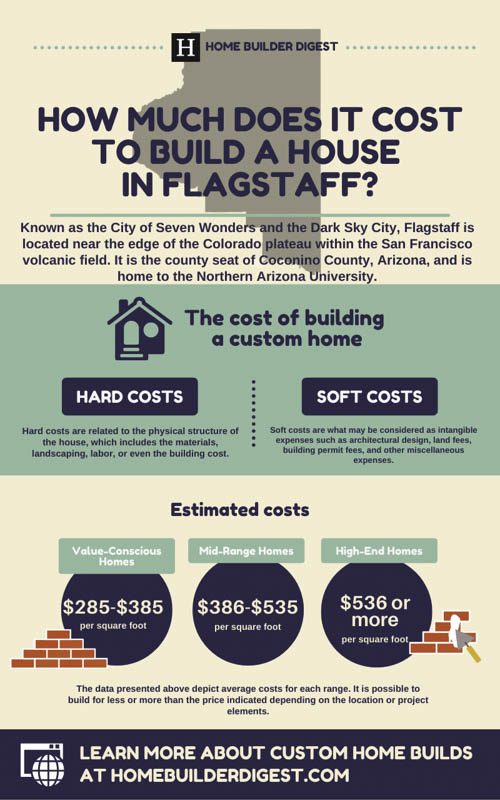
The hard costs are expenses that fund the physical structure and construction of the house. These include the materials, landscaping, labor, and even the total building value. In Flagstaff, basic or standard construction homes start at $285 per square foot, while middle-range or market homes start at $386 per square foot. Luxury or high-end homes are around $536 per square foot or higher.
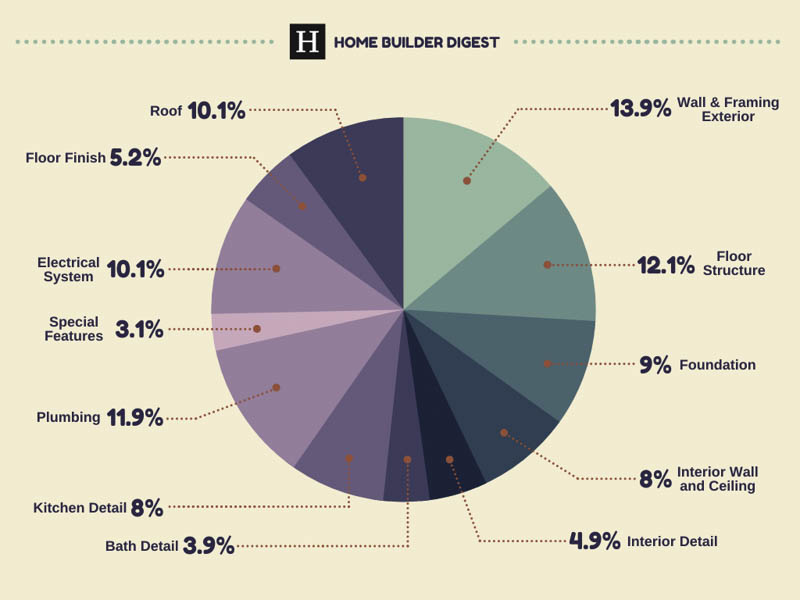
Figure 1. Typical cost breakdown of a single-family home constructed using the conventional method, according to Home Builder Digest.
When it comes to exteriors, Manta shares that framing in Flagstaff costs around $5,302. According to HomeBlue, Metal roofing such as stainless steel, copper, galvanized steel and aluminum ranges from $7.80 to $12.10 per square foot. This price may still increase or decrease depending on several factors like roof slope, roof accessibility, and size. Concrete costs around $120 to $154 per yard, depending on its strength in pounds per square inch (PSI), while the delivery may range from $80 to $270. Flint Concrete USA adds that the cost of installing a plain concrete driveway in Flagstaff costs around $5 to $7 per square foot, while adding decorative finishes may range from $8 to $18 or more per square foot.
For the home systems, these include electrical, heating, ventilation, and air conditioning (HVAC). Blue National HVAC reports that service contracts in Flagstaff range from $196 to $500. On the other hand, for electrical wiring, Manta reports that project owners pay an average of $415 for the service.
Soft Costs
Soft costs are the expenses that go beyond the actual construction of the home, such as architectural design, land development fees, building permit fees, engineering fees, and other miscellaneous expenses.
Cost of the Land
Getting the ideal lot for your dream home is crucial. Generally, land prices may vary due to proximity to metropolitan areas, views, amenities, and topography. According to real estate listing websites, the average cost of land in Flagstaff is $527,271, while the average cost per square foot is $11.11. This value may still increase depending on the development status of the lot since some of the listed properties may be undeveloped for residential construction. Per square foot, the most expensive property in Flagstaff as of May 2022 is a 0.46-acre property listed at $868,000, or $43.38 per square foot. The cheapest per square foot costs around $0.07, or a total of $100,000 for 33.77 acres.
Permits and Other Fees
Permits are filed online through the Citizen Access Portal. Permit fees are calculated depending on the International Building Code (IBC) and the total budget of the Building Department. Plan review fees depend on the project valuation, but the cost will vary for every $50,000 starting at $550,000.

For the actual permit fees, the total annual construction within the past year and the building department’s budget are taken into account for the multiplier. From the budget, the percentage expected to be provided by the building permit revenue is also determined.

Taking the multiplier, the total permit fees are then calculated, along with the building gross area, the square foot construction cost as per the IBC, and the permit fee multiplier.
Permit Fee = Gross Area x Square Foot Construction Cost x Permit Fee Multiplier
Architecture and Design Fees
Architect and design fees generally depend on the size, scope, and complexity of the project. The client’s preferences, needs, and lifestyle may also be taken into consideration for the final design. Some projects may be simple, but others may require extensive planning, attention to detail, and consultation with various industry professionals. The cost of architecture and design is usually taken as a percentage, anywhere between 5 and 20%, of the total project cost; however, some professionals may charge a fixed hourly rate. For the cost of drafting, a Flagstaff-based general contractor says that basic home plans start at $6,000. Drafting custom homes and other large projects may take about 4% of the total project cost for drafting, depending on the customization.
How do the custom home building costs in Flagstaff compare to other nearby cities?
Sun City is located in Maricopa County, 141 miles south of Flagstaff. It houses several golf courses and recreational spaces, including lawn facilities, the Sun City stadium, and the Sun Bowl Amphitheater. According to permits taken from BuildZoom (BZ), the average construction project in Sun City costs around $261,148. While new single family home construction has no notable features for the city, some homes have above-ground propane tanks and fences. Beside Sun City is Sun City West, where the average job value per BZ permits is $271,939. New single family home construction in the area includes some custom homes, and some have above-ground propane tanks and fences.
Surprise is also located in Maricopa County and is bordered by both Sun City and Sun City West. It hosts the spring training of several baseball teams, such as the Kansas City Royals and the Texas Rangers. According to permits gathered from BZ, construction projects in the city cost an average of $410,122. Some of the new construction projects in the area include restaurants, commercial spaces, nursing homes, offices, and single family homes. New single family homes typically have one to two garages, patios, and retaining walls.
What Leading Custom Home Builders and Architects that Serve the Flagstaff Area Say
Kyle Maycumber of High Caliber Construction shares that the construction industry is currently struggling with shortages, especially with labor. Skilled workers are scarce and expensive, while some laborers are unreliable and have caused project time frames to double. Material costs are still increasing with unbelievable lead times, which is pushing some builders to do material allocations and rations to avoid additional purchases.
The Future of Flagstaff’s Residential Construction Industry
The construction industry is gearing up to accommodate the new market as millennials have now joined the home buying scene. Affordable housing has become scarce all over the country, especially with the buying frenzy during the first year of the pandemic due to the historically-low interest rates. It is expected that by 2030, the average cost of a single family home will reach $382,000 nationally. In Flagstaff, with the median home price surpassing $600,000 this February, more and more developers are taking advantage of the high demand, including plans for a 200-unit community of build-to-rent, single family homes. Other developments planned to combat the housing shortage such as a 13.6-acre property set to house 224 multi-family rental apartments and Habitat for Humanity North Arizona’s starter homes.
As Flagstaff is gaining popularity among tourists and potential homebuyers because of its relatively-cool weather, the city government introduced housing assistance programs and subsidies— including rental assistance, eviction prevention, and even downpayment assistance. However, since the home prices are still soaring, it is expected that the Flagstaff market will cool off sooner or later as the current overpriced local housing market is causing buyers to back out and homes to sell slower. This year’s higher mortgage and interest rates are also said to have been effective in slowing down the prices after two years.
Cost Saving Tip for Building a Home in Flagstaff
Plan Your Build Around Flagstaff’s Short Construction Season
Flagstaff’s high elevation and snowy winters create a compressed building season that typically runs from late spring through early fall. One of the most effective cost-saving strategies is to plan your project timeline around this seasonal window to avoid costly winter delays, idle labor charges, and the need for temporary heating during concrete curing and framing. Builders who can break ground by April or May and complete the weathered-in shell before the first significant snowfall in October or November are in the strongest position to control costs. This requires having your design finalized, permits approved, and materials ordered well before the spring thaw—ideally during the preceding winter months when architects and builders may have more availability and flexibility on pricing. Rushing to start construction mid-summer, by contrast, compresses the available work window and can lead to overtime charges or a partially completed structure that must be winterized at additional expense. Working with a builder experienced in Flagstaff’s mountain climate is essential, as they will know how to sequence the critical weather-sensitive phases of construction—foundation, framing, and roofing—within the optimal months. This seasonal awareness alone can save thousands in carrying costs and prevent the budget overruns that come from fighting the weather rather than working with it.
Frequently Asked Questions
Which areas in—or near—Flagstaff are among the best for custom home building?
Within Flagstaff proper, the Continental Country Club area on the east side of the city is a well-established neighborhood with ponderosa pine settings, golf course access, and proximity to Walnut Canyon. The University Heights and Pine Canyon communities attract custom builders seeking mountain luxury with resort-style amenities, including golf and hiking trails set among old-growth forest. Neighborhoods in the Kachina Village and Mountainaire areas south of town offer a more secluded, wooded feel with larger lots at slightly lower price points than central Flagstaff. For buyers who want acreage with sweeping views, parcels along the Snowbowl Road corridor toward the San Francisco Peaks provide dramatic alpine settings, though steeper terrain and limited utilities can add to site development costs. To the east, communities near Doney Park and Timberline offer more affordable lots with volcanic field views and a rural character, though buyers should verify water availability and road access. Nearby Sedona, about 30 miles to the south, offers a dramatically different red-rock landscape for those willing to accept a lower elevation and warmer climate. Munds Park, between Flagstaff and Sedona, provides a forested retreat feel popular with custom cabin and second-home builders.
How does Flagstaff’s climate potentially impact home building costs?
Flagstaff’s climate is markedly different from the rest of Arizona. At 7,000 feet of elevation, the city experiences genuine four-season weather with heavy winter snowfall, regular freezing temperatures from October through April, and dramatic daily temperature swings that can exceed 40 degrees. These conditions require building practices more commonly associated with mountain and northern markets than with the desert Southwest. Foundations must extend below a frost line that is significantly deeper than in Phoenix or Tucson, increasing excavation and concrete costs. Wall assemblies need high-performance insulation, and energy-efficient windows with low U-values are essential to manage heating costs during long winters. Robust heating systems—often including radiant floor heat or high-efficiency forced-air furnaces—are a necessity rather than an option. Roofing must be engineered for heavy snow loads, and ice dam prevention measures such as proper attic ventilation and ice-and-water shield underlayment add to the roofing budget. The compressed construction season also impacts costs, as most exterior work must be completed between late spring and early fall to avoid weather-related delays. On the positive side, Flagstaff’s dry climate reduces concerns about mold and moisture damage that plague humid markets, and the cool summers minimize the need for air conditioning in most homes.
What should I know about soil and terrain conditions before buying a lot in Flagstaff?
Flagstaff’s terrain is shaped by its location within the San Francisco volcanic field, resulting in highly varied soil and subsurface conditions. Many lots feature volcanic cinder soils that drain well but may lack the bearing capacity needed for heavier structures, requiring engineered foundations. Other areas contain dense basalt rock close to the surface, which provides excellent structural support but can significantly increase excavation costs for foundations, utility trenching, and grading. A geotechnical investigation before purchasing a lot is essential, as subsurface conditions can vary dramatically even within a single subdivision. Sloped lots, which are common throughout the Flagstaff area and often command premium prices for their views, typically require additional site work including grading, retaining walls, and engineered drainage systems. Buyers should also investigate water and sewer availability, as some parcels outside city limits rely on private wells—and drilling depth and yield can vary considerably depending on the underlying geology. Septic system feasibility is another consideration for rural lots, as the volcanic soil’s percolation rate must meet county health department requirements. The deep frost line in Flagstaff also means that water and sewer lines must be buried deeper than in lower-elevation Arizona communities, adding to utility connection costs.
Broadly speaking, is it cheaper to build or buy an existing home in Flagstaff right now?
Flagstaff’s housing market presents a challenging picture on both sides of the equation. Median existing home prices have more than doubled over the past decade, driven by limited inventory, strong demand from both full-time residents and vacation home buyers, and the city’s growing appeal as a cooler-climate alternative to Phoenix and Tucson. At the same time, new construction costs in Flagstaff are among the highest in Arizona due to the mountain building requirements, a short construction season, and the cost of transporting materials to a relatively remote mountain market. On a simple cost-per-square-foot basis, buying an existing home is typically less expensive than building a comparable custom home in Flagstaff. However, many of the city’s existing homes are older structures that may need significant investment in updated insulation, heating systems, windows, and roofing to meet current energy efficiency standards and manage ongoing utility costs in the cold climate. For buyers who plan to live in Flagstaff long-term, building new offers the advantage of a well-insulated, energy-efficient home designed for the mountain climate from the ground up, which can meaningfully reduce heating costs over the life of ownership. The choice ultimately depends on timeline, budget flexibility, and whether the buyer’s priority is immediate affordability or long-term value and comfort.
Considering building a home in Flagstaff?
Contact us for a free consultation