

Home » Cost Guides » Kentucky Cost Guides » How Much Does it Cost to Build a House in Lexington?
Known as the heart of the Bluegrass region, Lexington provides fertile soil that is great for growing pasture. It became the center for breeding quality livestock, especially thoroughbred racehorses. With the city being dubbed the “Horse Capital of the World,” the community decided to set up racecourses. Some of the city’s most famous ones include Keeneland, The Red Mile, and the Kentucky Horse Park.
Over the years, Lexington progressively developed and became a business center. Numerous sectors set up their businesses in the city, such as manufacturing, technology, education, and healthcare. With many business and job opportunities, the city’s population increased. It is now home to over 322,000 residents and over 517,000 people living in the Lexington-Fayette metropolitan area — more extensive than St. Louis, Cincinnati, and Pittsburgh’s population.
The Cost of Building a Home in Lexington


Data gathered from the online contractor platform BuildZoom (BZ) shows that the national average cost to build a new custom home ranges from $138 to $320 per square foot. More specifically, value-conscious homes cost $138 per square foot, mid-range homes cost $207 per square foot, and high-end homes cost $320 per square foot. Thus, building a 2,500-square-foot home will cost at around $345,000 – $800,000. The National Association of Home Builders (NAHB)’s estimate is within that range, with new homes costing $485,000 to build.
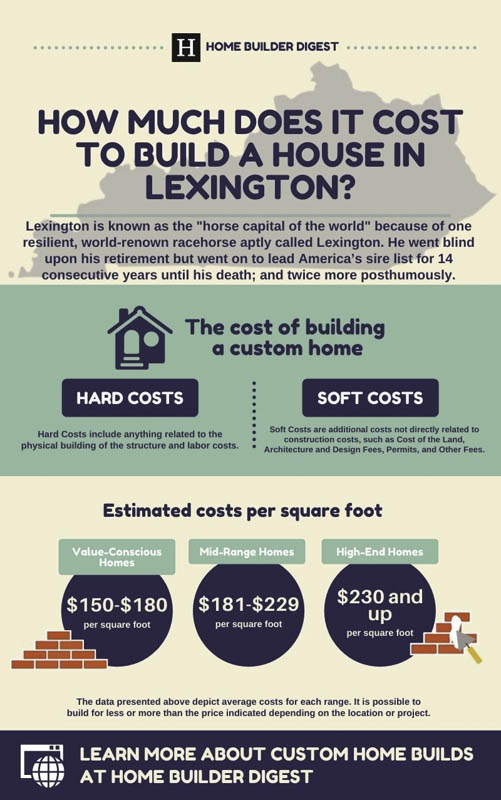
Lexington’s median home building cost is 17% lower than the national median cost, currently at $190 per square foot. A value-conscious approach may decrease the price to $150 per square foot. On the other hand, opting for a more luxurious build will increase the price to $230 per square and more. Building a 2,500-square-foot home in Lexington will cost $375,000-$575,000.
These are only estimates based on the recent new home construction projects across the country and in Lexington. Prices may still either decrease or increase depending on the owner’s customizations. They have the final say on what goes into the home and what can be omitted. However, owners have to keep in mind that numerous factors are to be considered that directly affect the total cost. These are listed below and separated into two categories: hard and soft costs.
Hard Costs
Hard costs refer to all the fees involved in the actual building of the home. These include the materials used, labor fees, extra amenities, and landscaping.
Lexington’s basic home building cost ranges from $90 to $200 per square foot. More specifically, value-conscious homes cost $90 – $130 per square foot. Mid-range and high-end homes cost $130-$160 per square foot and $160-$200 square foot, respectively. The price also varies depending on the quality of materials used, as well as the home’s size, complexity, and level of finish. Building a 2,500-square-foot home will cost $225,000 to $500,000.
The cost breakdown is as follows:
- Foundation: $14 per square foot — $15,000 – $35,000
- (with basement, additional $10,000-$30,000)
- Lumber: $25,000 – $65,000
- Concrete: $1,000 – $10,000
- Drywall: $10 per sheet
- Flooring: $1 – $15 per sheet
- Siding: $2 – $15 per square foot — $5,000 – $37,500
- Insulation: $0.10 – $1 per square foot — $250 – $2,500
- Roofing: $1,000 – $3,000
- Exterior Walls: $1,800 – $4,400
- Doors and Windows: $3,000 – $9,300
- Interior Finishing: $50,000 – $175,000
- HVAC: $1,500 – $13,000
- Electrical and Wiring: $20,000 – $30,000
- Plumbing System: $7,000 – $15,000
Material costs and labor fees significantly contribute to the overall construction cost. Materials usually take about 50% of the building budget. The price varies depending on the quality, type, and quantity of materials. On the other hand, labor fees take about 30-60% and depend on the location, size, home style, and design.
Listed below are the average fees for each services:
- Framer: $7 – $16 per square foot — $17,500-$40,000
- Construction Manager: $3,000 – $50,000
- Roof Installer: $5,000 – $10,000
- Electrician: $50 – $100 per hour
- Plumber: $45 – $200 per hour
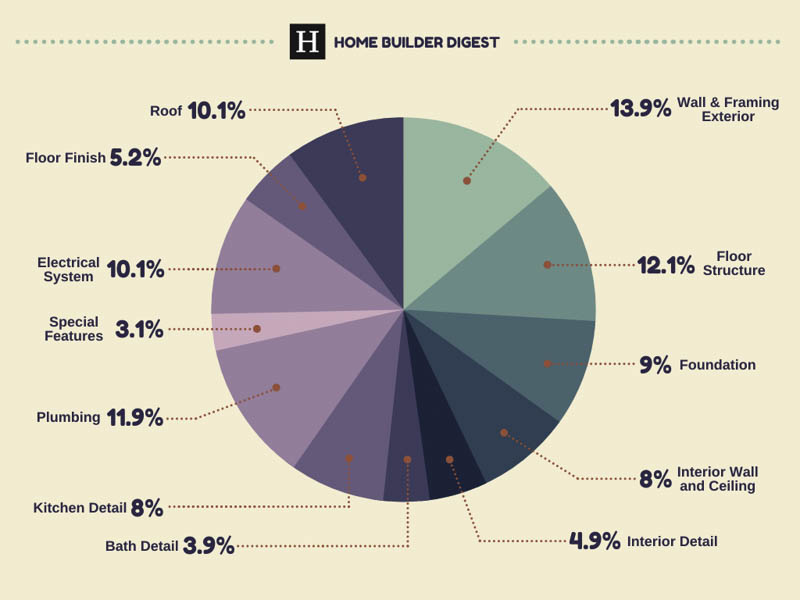
Figure 1. Typical cost breakdown of a single-family home constructed using the conventional method, according to Home Builder Digest. Image Source: National Cost Guide.
Soft Costs
Soft costs cover all the expenses that go beyond the physical home building. These include acquisition of land, permit fees, and architectural or design fees. Most of these are settled on the pre-construction stage, and some are to be paid upon project completion.
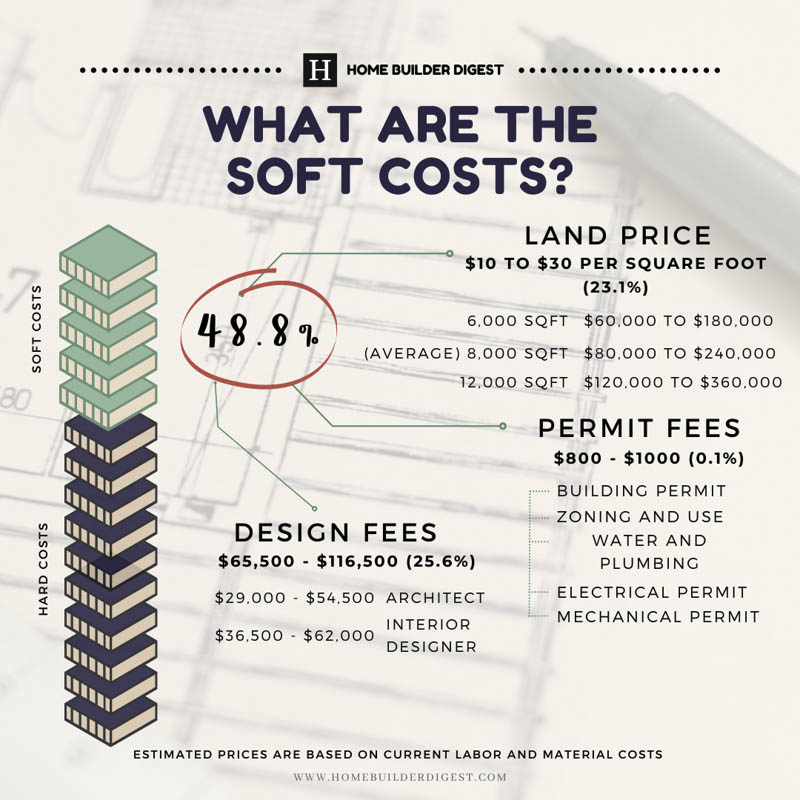
Figure 2. Soft cost percentage and average price range of additional fees, determined from the overall cost of custom home building in Lexington.
Cost of the Land
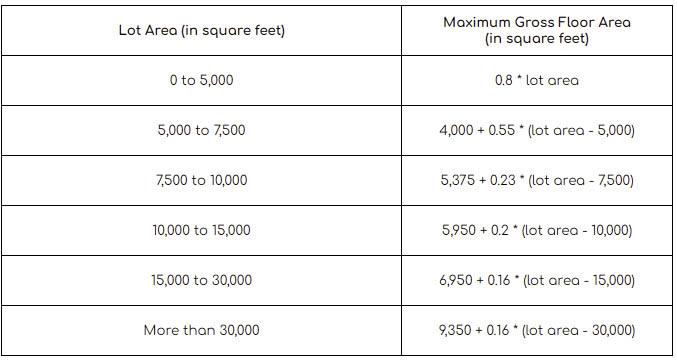
The Zoning Bylaw of Lexington did not implement a minimum required measurement of residential lots. However, the municipal code imposes a maximum gross floor area depending on the lot’s area. A one or two-family dwelling unit should not exceed the size listed below:
According to the real estate marketplace Zillow, the current land listings in Lexington show an average of $333,000 — about $22 per square foot. The cheapest lot available costs $150,000 for a 15,770-square-foot land — roughly $10 per square foot. On the other hand, the most expensive lot costs $550,000 for an 18,730-square-foot land — roughly $30 per square foot.
The median size of residential land for new construction is around 8,200 square feet, as per NAHB. Using this value, purchasing a residential land in Lexington will cost an average of $82,000 – $246,000.
After the acquisition, the land must be prepared for home construction. Land development in Kentucky costs $1,500 – $5000. This will ensure that the property is secure and adheres to municipality standards.
Permits and Other Fees
Every new construction must go through the local government’s board to ensure that the plan is within the city’s regulation and will be safe for everyone, especially the homeowners and the public. After the board’s approval, a permit will be issued that will serve as a signal for the project to start. Multiple permits may be applied for and given depending on the project’s requirements. Additionally, each of those will have a corresponding fee to be settled before construction starts.
The total permit fee for building a new single detached family home in Lexington is around $800 to $1000 for a 2,500-square-foot home. The amount to be paid is based on the total size of the construction. Listed below is the breakdown of fees, as per Lexington’s Municipal Code:
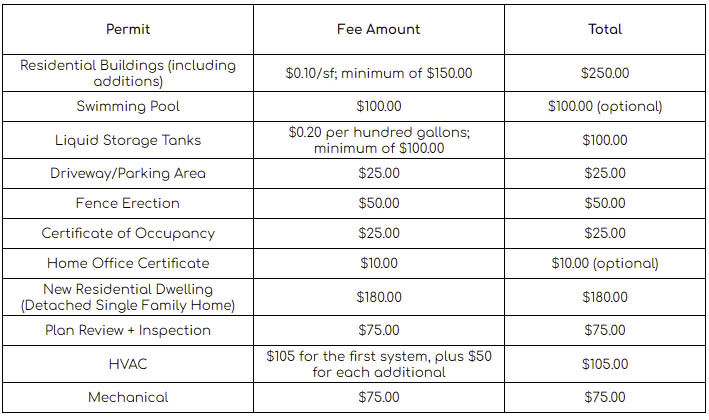
Recent building permits issued in Lexington showed that homeowners had paid an average of $500 to construct their new homes, according to BuildZoom (BZ).
Architecture and Design Fees
Building a custom home allows owners to personalize the home according to their wants and needs. Hiring an architect and designer may come with a price, but it is a sure way of ensuring the project is tailor-fitted to the family, as well as to strictly following the agreed-upon plans. Architects and designers use different methods to charge clients for certain services. The most commonly used pricing method is through the percentage of the project’s total construction cost.
Architectural services in Kentucky usually cost 8 – 15% of the construction cost. Suppose constructing a 2,500-square-foot home cost $362,500. The total architectural fee would be $29,000 – $54,000. This value may increase or decrease as it is directly relative to the services needed, project size, complexity level, and the intricateness of details.
In terms of home or interior design, professional designers in the state cost 10% to 17% of the construction cost. Assuming the value mentioned above, the total design fees will land at about $36,500 – $62,000. Some project owners think hiring an interior designer is optional, but not opting to hire would still require them to work with architects closely. This collaborative work will guarantee that the home layout is designed the best way possible.
How do Lexington’s custom home building costs compare to nearby cities?

According to Business Insider, Kentucky is among the low-cost states in the country’s southern region, with homes priced at $118 per square foot. The state is listed between Louisiana and Alabama, with homes priced at $122 per square foot and $104 per square foot. Additionally, Kentucky is 42% cheaper than the region’s most expensive state Florida, and 23% more expensive than the lowest-priced state Mississippi.
Homebuilding costs across the major cities in Kentucky are relatively the same as Lexington. For Louisville, the average cost is $87-$130 per square foot. Bowling Green and Covington are slightly higher with an average price of $90 – $133 per square foot and $91 – $135 per square foot, respectively.
The trend continues with the current home listings on Realtor.com. According to the real estate marketplace, homes in Louisville are sold with a median price of $137 per square foot, and homes in Bowling Green are sold with a median price of $145 per square foot. Covington listings are 6%-11% lower than the previous cities, with homes priced at $129 per square foot.
What Leading Custom Home Builders and Architects that Serve the Lexington Area Say
Jimmy McKinney, President of J & R Construction Services, explained that it could be challenging to put a definitive price on how much it is to build a house. As mentioned above, the price will depend on numerous factors, including the design, level of finish, location, complexity, and more. He advised that it can be beneficial to work with a design-build remodeling firm or someone who can work closely with an architect to develop plans suitable for the project. McKinney reminds owners that the cost to build a custom home is within their control, and they may choose to spend more or not. As for the firm’s thoughts on the industry’s current status, they expect to see construction projects grow progressively, with a greater increase in remodeling projects than new home constructions. Additionally, material and labor costs have increased at least 27% over the past years. Although there are occasional dips, the long-term trend is still upward and is yet to stabilize.
An estimate of $25 per square foot was added to Padgett Construction’s average home building costs as the supply chain issues significantly affected residential housing costs. On top of that is the acceleration of the skilled labor shortages. Tom Padgett, the firm’s founder, explained that this issue may be brought upon by home builders themselves as they try to negotiate with subcontractors for a much lower price. This type of negotiation is more common on spec buildings and is less likely in high-end custom homes.
Pohl Rosa Pohl’s principal Clive Pohl expressed that each project is unique and has different priorities, thus making it difficult to put a general estimated price on architectural and design fees. With respect to the site’s demands, multiple factors are considered that will inform the firm’s Opinion of Probable Cost (OPC). To prepare owners, the firm discusses fees with the clients right from the start and empower them with “worst-case scenario.” This usually surprises owners rather than sorely disappointed as the design process unfolds. An essential factor they explain to clients is the Total Project Cost (TPC). The firm’s percentage is inversely related to the TPC — as the TPC goes up, the estimated percentage fee goes down. Pohl then reiterates that the choices homeowners make along the way will influence the architectural fees.
Darren Taylor of Gibson Taylor Thompson noticed that longer lead times and severely elevated costs don’t seem to scare potential clients away. Despite the volatile construction market, the industry boomed. Recent projects have also escalated in every size, more commonly on medium to large projects. Additionally, people are investing more in the quality of space for a better quality of environment rather than robust home finishes. Taylor advised project owners to thoroughly plan and carefully budget the time. Trusting the systematic process of a proven team of professionals will also greatly help. In terms of the firm’s architectural fees, they usually bill on an hourly basis while giving their clients a range of fee maximum cost. This will help clients fully understand the soft costs and budget them into the total expenses. The firm’s recent small projects typically cost $4,000 – $15,000. Designing mid-range homes usually range from $15,000 – $45,000. Larger projects cost the most as it is more complex and has numerous elements that come into play. Designing these projects usually starts from $45,000 and more, sometimes reaching up to $200,000 – $300,000.
The Future of Lexington’s Residential Construction Industry
Since the pandemic brought multiple issues to the construction industry, home-buying has been the option for those who want to be homeowners. Despite the housing shortages, home sales across the nation are expected to increase by 6.6%. An addition of 2.9% on home prices is also anticipated on top of the 2021 surge. First-time home buyers — millennials aged 26 to 35 — will keep the real estate market strong and competitive despite builders ramping up single family home production by 5%. This strong demand is also greatly felt in Lexington, pushing the home median sale price to increase up to 11%. The Lexington-BlueGrass Association of Realtors reported that real estate sales in the city have reached all-time highs and exceeded $3 billion for the first nine months of 2021.

Great pressure is put upon the hands of Kentucky construction companies as people rely on them to solve the strong housing demand. Some of these companies have already doubled their production, but the supply chain issue still pushes them back. This demand-driven inflation resulted in cost overruns on most projects, making it more challenging for both the builders and owners. Despite these, firms are forecasting that 2022 will continue to be a solid business for construction as the economy rebounds. They expect the economy to grow at around 3.5-4%. If the current issues are still yet to stabilize, the growth rate will remain at 4%.
In addition, contractors are planning to add even more workers this year. They are focusing on keeping pace with the progressively growing demands for construction. Most firms expect their worker headcount to increase by 10% or less, as adding workers will still be challenging. Additionally, building associations are urging everyone, including public officials, to support the construction industry and make the optimistic outlook for 2022 become a reality.
Cost Saving Tip for Building a Home in Lexington
Use Lexington’s Urban Service Boundary to Your Advantage
Lexington’s unique urban service boundary—one of the oldest in the United States—restricts development on the productive Bluegrass farmland surrounding the city by concentrating growth within a defined area where municipal water, sewer, and services are available. While this policy limits sprawl and preserves the horse farm landscape, it also creates a predictable dynamic that savvy custom home builders can use to their advantage. Lots within the urban service boundary have access to city water, sewer, and established infrastructure, eliminating the significant costs of drilling wells, installing septic systems, and extending utility lines that affect rural parcels. By selecting a lot within or near the edge of the boundary where newer development is occurring—such as the Hamburg area, south Lexington, or the areas near the Polo Club—you can find custom-buildable lots at competitive prices that include full municipal services. The alternative of buying picturesque farmland outside the boundary often comes with hidden infrastructure costs that can add tens of thousands of dollars to the total project, along with potentially more restrictive county building regulations. Understanding how the urban service boundary shapes land availability, pricing, and infrastructure access is one of the most important factors in controlling total project cost when building a custom home in the Lexington market.
Frequently Asked Questions
Which areas in—or near—Lexington are among the best for custom home building?
The southern corridors of Lexington, particularly the neighborhoods along Tates Creek Road and Nicholasville Road, have long been among the most desirable areas for custom home construction, offering strong schools, established commercial amenities, and proximity to the University of Kentucky. The Hartland and Beaumont communities in south Lexington provide master-planned settings with golf courses, community pools, and custom lot availability. Hamburg, on the east side, has grown rapidly with newer infrastructure, shopping, and a mix of production and custom home opportunities. For buyers seeking a more rural estate feel, the horse-country areas along Paris Pike and Old Frankfort Pike north and west of the city offer rolling Bluegrass farmland with board fences and stone walls, though lots outside the urban service boundary may require well and septic installations. Versailles, just west of Lexington in Woodford County, provides a small-town atmosphere with access to bourbon distilleries and horse farms at more moderate land prices. Georgetown to the north offers a growing suburban market anchored by Toyota’s manufacturing presence. Within the city, the Chevy Chase, Ashland Park, and Bell Court neighborhoods attract infill custom builders seeking walkable streets with mature trees near downtown.
How does Lexington’s climate potentially impact home building costs?
Lexington’s climate features four distinct seasons with hot, humid summers, cold winters that include regular snow and ice, and spring and fall transition periods with frequent rain. This full-season range requires homes to be designed for both efficient cooling and reliable heating, typically with high-efficiency heat pump or dual-fuel HVAC systems. Summer humidity demands effective moisture management in the building envelope, including properly placed vapor barriers, mold-resistant materials in crawl spaces and attics, and well-ventilated roof assemblies. Kentucky’s winter temperatures are cold enough to require a meaningful frost line depth, increasing excavation costs for footings and full basements—which are standard and expected in the Lexington market. Ice and snow loads must be factored into roofing design, and proper gutter and drainage systems are essential to manage snowmelt and the region’s consistent rainfall. Central Kentucky is also within a moderate risk zone for severe thunderstorms and occasional tornadoes, and some custom builders recommend storm shelter or safe room options. The four-season climate allows for construction activity throughout the year, though winter cold and spring rain may cause periodic delays. Overall, Lexington’s climate does not impose extreme requirements in any single category but demands competent all-around design to handle the range of conditions.
What should I know about soil and terrain conditions before buying a lot in Lexington?
Lexington sits at the heart of the Inner Bluegrass region, where the defining geological feature is phosphatic limestone bedrock overlaid by fertile clay soils that give the area’s pastures their characteristic blue-green color. The clay soils are moderately to highly expansive, meaning they swell when saturated by rain and contract during dry periods—a cycle that can affect foundations if not properly engineered. A geotechnical investigation is recommended before purchasing any lot, as clay content and depth to limestone vary across the metro area. The limestone bedrock, while an excellent structural bearing surface, can present karst features including sinkholes and underground drainage channels. While large sinkholes are relatively uncommon in developed areas, karst evaluation is a standard part of due diligence for Lexington building sites. Lots within the city’s urban service boundary typically feature gently rolling terrain that requires moderate grading and drainage engineering. Properties outside the boundary, in the surrounding horse country, may have springs, seasonal wet areas, and steeper terrain near creek valleys that add complexity to site preparation. Buyers building outside the urban service boundary should verify well water availability and septic system feasibility, as the limestone bedrock’s percolation characteristics can vary and affect what type of septic system is permitted.
Broadly speaking, is it cheaper to build or buy an existing home in Lexington right now?
Lexington’s housing market has experienced steady appreciation driven by the region’s diversified economy, strong university presence, and growing appeal to relocators seeking an affordable alternative to larger metros. Existing home prices have risen but remain below the national median, and the market offers a range of options from older Bluegrass bungalows to more recent suburban construction. On a cost-per-square-foot basis, buying an existing home in Lexington is generally less expensive than building a new custom home. However, the city’s older housing stock includes many homes built on foundations that may have been affected by clay soil movement, and updates to HVAC, insulation, electrical, and plumbing are common needs in older properties. Building new in Lexington provides a home engineered for the local soil conditions, equipped with modern energy-efficient systems, and designed with the open floor plans and finishes that define current market demand. Kentucky’s competitive construction costs and Lexington’s relative affordability compared to peer markets make custom building a realistic option for a broader range of budgets. For buyers who value long-term efficiency, customization, and peace of mind about foundation integrity, building new in Lexington is an increasingly attractive option.
Considering building a home in Lexington?
Contact us for a free consultation