
The cost of living in Oakland is quite high compared to the national average by over 74%, and 25% higher than the California average. The average price to purchase a house is $959,760 — over three times the national average. Unsurprisingly, almost 60% of all Oakland residents are renters. Similar to other cities in California, residents are burdened with high taxes. This means residents are expected to return a significant portion of their income to the government. The city sales tax is also higher than the state average by 2%.
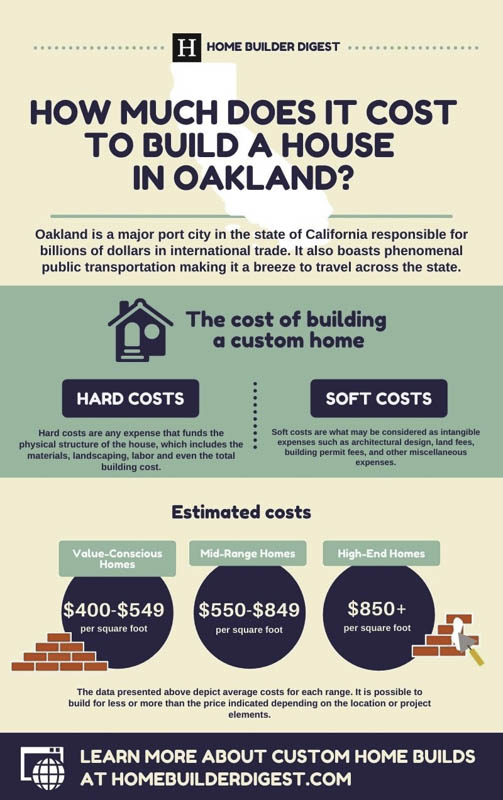


Similar to several other cities across the United States, Oakland’s construction industry also suffered shortages in supply during the COVID-19 pandemic, resulting in an inability to construct new houses. The cost of housing has significantly gone up in recent years. The cost to build a house in Oakland now ranges from $500 to $700 per square foot for value-conscious homes, $700-$800 per square foot for mid-range homes, and over $800 per square foot for high-end or luxury construction projects. The city is currently in the process of revising old zoning regulations in order to provide affordable housing by way of allowing multi-house buildings to be constructed in neighborhoods otherwise restricted to single-family homes.
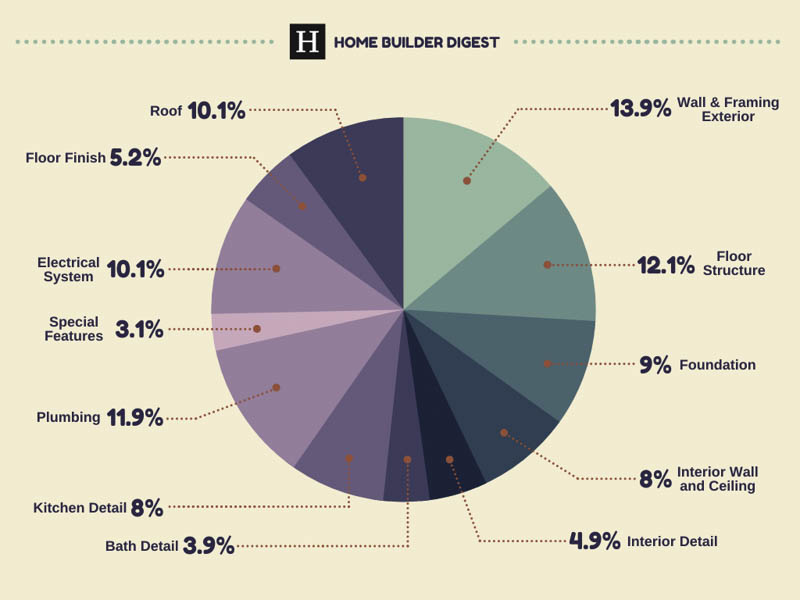
Figure 1. Typical cost breakdown of a single-family home constructed using the conventional method, according to Home Builder Digest. Image Source: National Cost Guide.
Hard Costs
Expenses directly involved in the construction of the physical building – such as material fees, labor, landscaping and utilities – are considered hard costs. These do not yet include any other underlying costs such as fees charged for permits or inspections.
Simple homes in Oakland normally range from $400-$500 per square foot, $550 per square foot for mid-range homes and upwards of $850 per square foot for premium homes, a range that comes close to the cost average for a San Francisco Bay Area home. Oakland-based, high-end design-build firm building Lab has a price tag of $500-$700 for value-conscious homes, $700-$800 per square foot for mid-range homes and $800 per square foot for high-end custom homes.
Basic 1,500 square foot roofs in the city cost on average around $9,950. The typical range for asphalt roofing runs between $4.90 to $8.40 per square foot. Foundation installation in Oakland costs around $8.49 per square foot for 4-inch reinforced slabs. For heating and ventilation, the majority of homeowners dished out an average of $2,018, which already includes labor costs for installation as well as needed materials and equipment. On average, homeowners in Oakland pay around $480 to rewire their homes—which covers labor costs, the cost of materials and other project costs such as surface preparation.
Soft Costs
Figures and costs not involving the physical construction of a home falls under soft costs. Soft costs comprise of state or city-imposed taxes, permits and regulations, design and architect fees and the cost of a plot of land where construction will take place.
Cost of the Land
Oakland lots listed on real estate website Zillow range from $50,000 for 9,452 square feet (or $5.29 per square foot) to $3,250,000 for 104,108 square feet (or $31.22 per square foot).
Permits and Other Fees
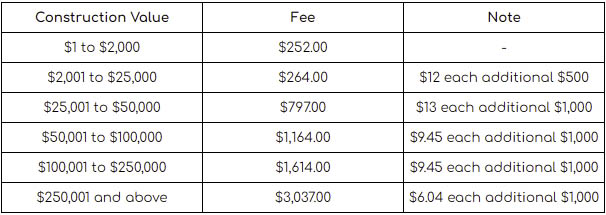
The city’s local government computes the fees for necessary building permits based on the construction value of a project. The filing of building, electrical, mechanical and plumbing permits are met with an application fee of $74 per permit. Below is a rundown of the needed permits along with their accompanying fees.
Mechanical, electrical and plumbing (MEP) inspection fees also come with a minimum transaction of $115; or 15% of the total building permit cost accumulated by the homeowners. So homeowners with an accumulated fee of $500 still have to pay $115, whereas homeowners with a total fee of $5000 are required to shell out $750 for MEP inspection fees.
Inspection Fee for New Construction
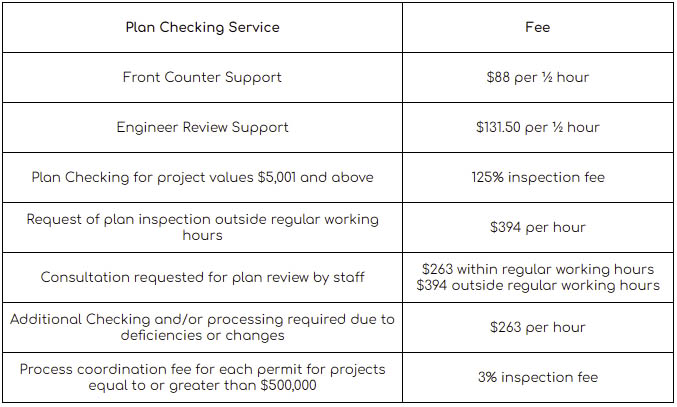
Plan Checking Fees
Architecture and Design Fees
There are various ways architects in Oakland charge for their service. Professionals may charge based on a percentage of construction cost. Some choose to charge an hourly rate while some opt to charge a fixed rate for their services.
How do the custom home building costs in Oakland compare to other nearby cities?
As mentioned earlier, compared to other cities in the state of California and even the national average, custom homes are built at a higher price in Oakland. Aspiring Oakland homeowners are expected to face home costs of around $959,760, while neighboring Alameda, Berkeley and Lafayette homes average at $347,193, $912,114 and $722,650, respectively. The price of a home in Oakland is still lower than in San Francisco.
What Leading Custom Home Builders and Architects that Serve Oakland Say
Laryssa Stecyk, founder of Broadway Design Build, provided a range of their home construction projects. They charge approximately $425 per square foot for value-conscious homes, $550 per square foot for mid-range and upwards of $850-$1,000 per square foot for high end custom homes. It’s highly unlikely for them that a home can be built for less than $400 per square foot without cutting any corners. She highly recommends that clients set realistic expectations, understanding that delays are inevitable for construction projects—especially with the many challenges the construction industry is facing due to the pandemic.

Meanwhile, Building Lab posted a price of $500-$700 per square foot for value conscious homes, $700 to $800 for mid-range homes and $800 and above for high-end projects — with many of their clients opting for more high value custom homes. They’d like clients to know that it’s important for all stakeholders to be involved in the planning process so that project goals can be clearly understood and realistic. They also suggest that clients are able to project and account for all costs involved, especially soft costs that tend to be overlooked. Project-owners should expect that there will be bumps in the road, especially if they will be working through multiple years so they need to ensure that they are working with people they respect, trust and communicate well with.
Personnel from Larson/Shores Architecture and Interiors normally charge 10 to 15% of the estimated construction budget for new or renovated construction. The firm doesn’t make adjustments based on the budget-consciousness of the work, stating that the same amount of work is needed to complete the project. They firmly believe that the construction industry will remain strong, although prices will continue to be high. So they advise homeowners to expect and be ready for high prices on their construction projects – from labor, materials, permit fees and beyond.
The Future of Oakland’s Residential Construction Industry
In the past few years, there has been concern about the rising prices of hard costs and the market’s volatility — especially with raw materials and labor. Due to the deficit in laborers, builders are forced to contract the help of specialized construction services that usually have higher asking prices. The upward trajectory of prices is unlikely to end in the next few years. Many construction projects have been facing delays in construction—incurring additional fees in the form of property holding costs. By 2030, the value of homes is expected to rise to $1,713,554 with the current upward trend in building costs.
Cost Saving Tip for Building a Home in Oakland
Navigate the Permitting Process Strategically
Oakland’s permitting process is one of the most consequential cost variables a custom home builder faces in the Bay Area—and one of the few that can be meaningfully managed with the right preparation. The city’s Building Services Division handles new residential construction permits, and projects that arrive with complete, code-compliant plan sets move substantially faster than those that require multiple correction cycles. Before submitting, engage a local architect or expediter who regularly works with Oakland’s plan check reviewers and understands current Title 24 energy compliance documentation requirements in detail. Many projects stall not because of fundamental design problems but because of missing or improperly formatted energy calculations, fire separation details, or accessibility compliance exhibits. Pre-application meetings with city staff, which Oakland offers for complex projects, can identify potential objections before they become formal correction notices. Scheduling carries its own cost implications as well: a project that breaks ground in spring rather than fall maximizes the productive construction window and reduces carrying costs on financing. Because Oakland’s permit timeline can stretch from several months to well over a year for more complex projects, submitting a complete, thoroughly coordinated package the first time is not just a convenience—it can save tens of thousands of dollars in interest, escalated material costs, and extended contractor mobilization fees.
Frequently Asked Questions
Which areas in—or near—Oakland are among the best for custom home building?
The Oakland Hills neighborhoods, stretching from Montclair through Piedmont Pines and into the Skyline communities, remain the premier destinations for custom residential construction, offering sweeping Bay views, wooded canyon settings, and larger lots than are available in the flatlands. Montclair Village in particular attracts custom builders for its relatively accessible terrain within the hills, strong neighborhood services, and proximity to Piedmont and Rockridge. Claremont and Elmwood, along Oakland’s border with Berkeley, appeal to buyers who want established walkable neighborhoods with craftsman architectural character and proximity to the University of California campus community. For buyers seeking lower land costs with urban connectivity, parts of the Maxwell Park and Dimond District neighborhoods offer infill opportunities. Directly across the estuary, Alameda provides a distinctly different option—a grid-planned island city with lower construction costs than Oakland proper, strong schools, and an increasingly active custom home market centered on its Victorian-era residential neighborhoods and marina-adjacent parcels. To the east, Castro Valley and San Leandro offer more affordable land in the East Bay hills with reasonable commute access to Oakland and San Francisco.
How does Oakland’s setting and climate potentially impact home building costs?
Oakland occupies a transitional climate zone between the cool, fog-influenced Bay shoreline and the warmer, drier hills—a gradient that influences construction decisions in ways specific to this market. The Oakland Hills sit in a Wildland-Urban Interface zone, which creates one of the most significant cost variables in the region: fire hardening requirements. After the devastating 1991 Tunnel Fire, Oakland and the surrounding Alameda County communities established strict requirements for new construction in Very High Fire Hazard Severity Zones, including ignition-resistant exterior cladding, multi-pane windows with tempered glass, enclosed eaves, and ember-resistant vent screens. These measures add meaningful cost to a project but are non-negotiable for hillside sites and provide genuine value in a market where fire risk is an ongoing concern. Oakland also sits within a seismically active region, close to the Hayward Fault, and structural engineering for new residential construction must account for lateral loads that exceed requirements in most other U.S. markets. On the positive side, Oakland’s mild Mediterranean climate—characterized by dry summers and moderate winters—means exterior materials weather slowly, rain delays are concentrated in a predictable winter window, and air conditioning is rarely needed even in warm inland locations, reducing mechanical system costs compared to inland California markets.
What should I know about soil and terrain conditions before buying a lot in Oakland?
Oakland’s terrain ranges from flat, bay-fill lowlands near the waterfront to steep, geologically complex hillsides along the East Bay range, and the soil conditions vary accordingly. The flatland areas, including much of West Oakland and the former industrial zones near the estuary, were partially built on bay fill and can present challenges including soft, compressible soils with poor bearing capacity, high water tables, and potential liquefaction hazard in a major seismic event. These conditions typically require deeper foundation systems or engineered piles rather than standard slab-on-grade construction, adding significant cost. The hillside neighborhoods present a different set of considerations: expansive clay soils are common, and the combination of seasonal wetting and drying causes significant ground movement that can damage foundations not properly engineered for the conditions. Steep slopes require geotechnical analysis for landslide potential, and many hillside lots require retaining walls, cut-and-fill grading, and engineered drainage systems that can represent a substantial portion of the total project budget. A thorough geotechnical investigation—including soil borings, laboratory analysis, and a written report with foundation recommendations—is essential before purchasing any Oakland lot, particularly in the hills. Buyers should also check whether a lot falls within a Geologic Hazard Abatement District, which can affect development requirements and ongoing property assessments.
Broadly speaking, is it cheaper to build or buy an existing home in Oakland right now?
Oakland’s existing home market has experienced extraordinary price appreciation over the past decade, driven by spillover demand from San Francisco and the broader Bay Area’s constrained housing supply. While the market has moderated from its peak, median prices for existing homes in desirable neighborhoods remain high by most national standards. On a strict cost-per-square-foot comparison, purchasing an existing Oakland home is generally less expensive than building a comparable new custom home from scratch, given the city’s high hard construction costs, the premium added by fire hardening requirements, seismic engineering, and permit fees. However, that comparison obscures some important nuances. Many of Oakland’s existing housing stock dates to the early and mid-twentieth century, and older homes in the hills in particular may require significant investment in deferred maintenance, foundation retrofitting, wildfire hardening upgrades, electrical panel replacement, and energy efficiency improvements before they meet the standards a buyer would take for granted in new construction. Building new in Oakland gives buyers full control over fire resilience, seismic performance, energy efficiency, and design—none of which can be assumed in an older home without a thorough inspection and significant additional investment. For buyers with long time horizons and specific design requirements, new construction can represent better long-term value despite its higher upfront cost.
Considering building a home in Oakland?
Contact us for a free consultation