

Home » Cost Guides » Texas Cost Guides » How Much Does it Cost to Build a House in San Antonio?
San Antonio is the 7th largest city in the US with a rich and diverse culture and an abundance of interesting places and festivals to offer. Its varied industries and roaring economy make it an exceptional destination for families and young professionals. In addition to its robust economy, San Antonio is also ranked as one of the best places when it comes to the cost of living, commute, and safety. When comparing San Antonio with big cities like New York and California, the city offers its residents a lot more space to build their houses. This, partnered with 59% less expensive home construction, has been attracting Californians to move to the Lone Star State, according to StorageCafe.
Considering all these factors, residents and developers have one thing to ask, how much does it cost to build a house in San Antonio?
The Cost of Building a Custom Home in San Antonio
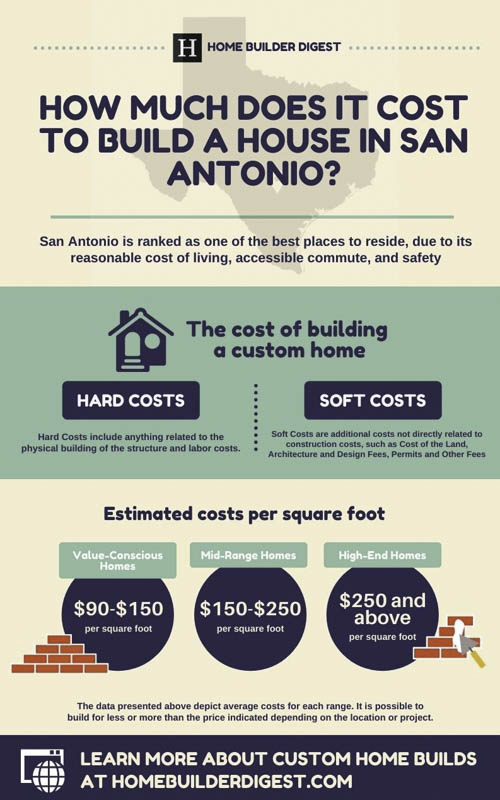


By budgeting $90 per square foot, one can have the basic home necessities in San Antonio. This cost can go up to $150, and further to $250 for a mid-range home. For high-value homes, one can have the luxury of fancy high ceilings and high-end materials for a price beyond $250 per square foot. Besides the use of materials, other factors that greatly affect the construction prices are size, location, characteristics of land, choice of contractor, and house architecture style.
Recently, the economic impact of the pandemic affected the building costs and residents’ purchasing power. While this staggered the prices of construction materials, the rate of employment among residents increased in the last year. This being the case, San Antonio went against the current trend of the residential building industry by experiencing a continuous spike in the construction of new houses. While national trends reflect a slower pace in construction, San Antonio is thriving.
Building houses is usually a step-by-step process that begins with a plan and is followed by actual construction. These plans are commonly referred to as soft costs while the construction is referred to as hard costs. To guide new homeowners, Home Builder Digest put together a list of the hard and soft costs needed to complete your home.
Hard Costs
Practical, technical, and creative: three words that best describe how designers and builders respond to the rich history of San Antonio and the active lifestyle of its inhabitants. These details, together with the city’s humid subtropical climate and relatively flat landscape with occasional hills and wide river plains, are big factors to how the residential neighborhood of the town was built. Contractors in the city direct their attention to the foundation, HVAC, roofing, interior detailing, and all other hard costs contributing to the physical building of a house. Below are the average costs for each segment that makes up the majority of home building:
- Electrical — According to howmuch.net, electrical wiring will cost approximately $10,000 for a 1,200 square-foot home. These numbers result in an average of $8 per square foot, including labor and materials.
- Roofing — Asphalt shingles, the most common type of roof in San Antonio, cost $3 to $6 per square foot. If including all other equipment, materials, and labor, it will cost $5,000 to $10,000 in total.
- Plumbing — Heating and plumbing covers about 13% of the entire home building cost. For an estimate, ProMatcher’s data reveals that plumbing contractors get paid $64 to $73 per hour,
- HVAC — Residents pay roughly $9,500 for their AC installation. It can also go as low as $6,000, or as high as $18,000, depending on the unit’s size, efficiency, additional features, and length of warranty.
- Foundation — Establishing a house foundation in San Antonio is 4% lower than the national average. This is equivalent to $5,000 to $20,000 for 1,000 square-foot-home, or $5 to $20 per square foot.
- Framing — Western platform framing, balloon framing, and post and beam framing are the three most prevalent types of framing in San Antonio. This will cost $20 per square foot or an average of $4,000 to $8,000 total amount spent.
- Labor — Based on the recent Payscale reports, construction laborers are paid from $10 to $18 per hour. This means paying a total of $23,000 to $37,000, including bonuses and tips.
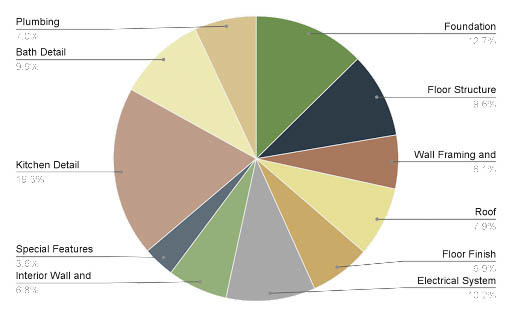
Figure 1. Average cost breakdown of a single-family home constructed in San Antonio, according to Home Builder Digest.
Soft Costs
Soft costs in construction refer to anything that does not deal with the direct or physical construction of a home. These often come in the form of taxes, design services, permit fees, land, and other legal fees. It can happen anywhere within the construction process from pre to post-construction. Different projects may call for different soft costs depending on their scope and requirements. While soft costs seem less intimidating, these can be problems later on in the construction if overlooked. Listed below are some of the soft costs that are necessary for building a home:
Cost of the Land
According to the listings in Realtor, square foot prices of lots and lands in San Antonio start at $2. This is equivalent to spending $16,000 to $220,000 on average for 6,000 to 8,700 square feet of land, the common lot size for an average single-family home in San Antonio. Statistically, houses cover only 20% or 1,200 to 1,800 square feet of the land.
Lots that have pre-existing houses require further effort which can cost an additional $6,000 to $13,000 for the demolition. The same goes with buying rural land, which may demand the confirmation of the acreage of unsurveyed land and other topographical aspects. For convenience, it is better to opt for finished lots in areas already zoned for residential homes because these offer access to utility hookups. All these and other details regarding residential construction in San Antonio are compiled and stated on the government’s website, to maintain a sound and safe practice of home building.
Architecture and Design Fees
Rates for San Antonio residential architects and engineers average $5,000 per project. According to ProMatcher, architects may demand other costing methods, such as a per hour basis which costs $75, per square foot basis for $3, and by percentage which may cost 11% of the whole project. Structural engineers, on the other hand, get paid hourly for $102 to $122, depending on their credentials and scope of work.
According to Manta, interior designers are paid $700 to $5,700 depending on the agreement with the client. Some factors that affect the extent of design work include the space and shape, direction of natural light, and atmosphere.
Permits and Other Fees
Now that the land and blueprints are all taken care of, it’s time to start applying for permits. Permits are given to ensure that construction projects will adhere to a city’s building codes and unified development code to protect the safety and health of its residents. The national cost of the permits needed to safely build a home will range between $150 to $6,000 according to HomeAdvisor. Some of the common residential permits given by the City of San Antonio office include building, electrical, and plumbing permits. According to the City of San Antonio website, permit fees in San Antonio can range between $900 to $1,800 and more. These numbers are dependent on the type of affidavit submitted that protects trees and heritage sites in the city.
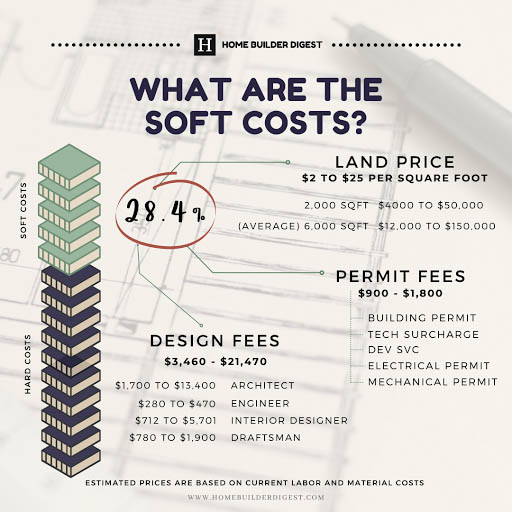
Figure 2. Breakdown of soft costs in San Antonio, according to Home Builder Digest.
How do the custom home building costs in San Antonio compare to other cities in Texas?
<a class=”btn btn–primary bz-modal-trigger” style=”position: relative; display: block; margin-top: 20px; border-radius: 30px; font-weight: bold; line-height: 1.15em; padding: 11px; width: 280px; text-align: center; text-decoration: none; border: none; background-color: #88aaa7; color: #fff; text-transform: none; font-size: 20px; font-family: Avenir; cursor: pointer;”><span class=”btn__text”>Get a free cost estimate</span></a>Construction costs in Texas are 5% higher than the 2021 national average which is anywhere near $287,466 and up, according to HomeAdvisor. In San Antonio, an additional 8% increase on top of the national average is expected. It puts the city among one of the more expensive places to build a home when comparing it to cities like El Paso, Arlington, Fort Worth, and Plano. Yet still more affordable in comparison to more affluent neighborhoods who charge an additional 15% compared to the national average. These cities include Bay City, Huntsville, and Houston where construction prices go from $300 and up per square foot.
San Antonio’s best areas include Terrell Hills, Shavano Park, Alamo Heights, and Tanglewood. Home construction for a mid-ranged home in these areas ranges between $250 to $350. This means that building a 2,000-square-foot custom home will land anywhere between $500,000 to $700,000. While for a 3,000-square-foot custom home, one will spend around $750,000 to $1,000,000.
Major Custom Home Building Trends Across the Web for San Antonio
Home construction prices in San Antonio are among the things that continue to attract residents and newcomers to build a home. In 2019, the average single-family home construction in Texas ranged from just below $290,000, including the cost of the land. However, as the pandemic put everything to a halt, prices have since then increased by large numbers. Reviewing sites and blogs including Clever, ProMatcher, Fixr, and HomeAdvisor will give one a general overview of the different costs of building a home in Texas depending on the size, specifications, and location.
According to Home by Four, San Antonio home construction prices are about $160 per square foot. Considering the increase in materials and labor costs, a high-end single-family 3,000-square-foot home will land anywhere near $480,000 and up. This price estimate includes the different fees, foundation, floor plan, land, and more.
What Leading Custom Home Builders and Architects that Serve San Antonio Say
We reached out to home builders and architects serving San Antonio to obtain in-depth information regarding the costs of residential construction. Guy Floyd, of Creative Custom Builder, shared that in the last two years, the construction industry has faced some difficulty in labor, materials, and pricing. When asked about the current price per square foot of homes, he placed mid-range custom homes at a $220 to $275 price range and the high-end custom home at a $275 to $315 range. He added that this is partly due to the “skyrocketing lumber, steel mill products, plastics, and copper piping prices” and ongoing labor shortage, port congestion of overseas materials, and overall transportation delays. One thing Floyd advised is to plan ahead the design of the home. This way, contractors can order the materials needed in advance which can lower the overall construction costs of new homes.
As for Felix Ziga of Ziga Architecture Studio PLLC, his advice is to acknowledge the importance of licensed architects and true design-build firms with legal coverage, professional criteria, great software, and architectural competencies. This credibility gives assurance of high-caliber work, especially today when the economy is facing labor and material shortages. Accordingly, Ziga notes that architectural design fees have moved up to $3 to $6+ per square foot or 6% to 15+% of total construction cost in the past year or two, depending upon the project and scope of work. Ziga added that architects usually charge in one of four ways: cost per square foot, per hour, a percentage of the construction cost, or a fixed fee. His tip is homeowners should look for a clear and well defined scope of work so as to make the outcome as predictable as possible. Ziga Architecture Studio works closely with clients to understand their scope of work, and offers a range of services, from basic architectural design to program management, builder negotiation and bidding assistance, and interior design and historic preservation work, which informs their fees.
The Future of San Antonio’s Residential Construction Industry
There is no place in the US that has not experienced the effects of the pandemic. However, this did not slow down the construction of new homes in San Antonio despite increased material costs, specifically with lumber. According to the San Antonio Report, builders have seen an increase in lumber prices that reached over 67% to 340% when comparing them from pre-pandemic prices. This puts an additional cost of $35,000 and up on top of the whole home construction fee.
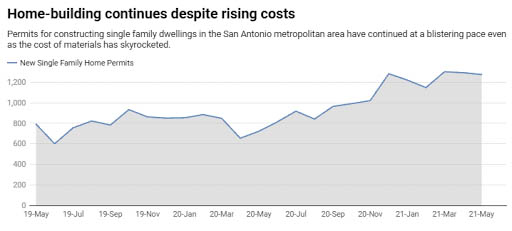
Waylon Cunningham, “New Home Construction Continues Despite Staggering Lumber Prices” San Antonio Report, June 30, 2021.
A similar report from Texas A&M University’s Real Estate Center said that as homes were posted and bought, most people were left to compete for a limited home selection. This in return supports the increasing interest in new construction. As seen on Texas Real Estate Research Center’s graph, San Antonio has been one of the driving factors in the increased construction index for Texas. Since July of 2021, the city maintained its momentum and has reported over 1,267 single-family construction permits in the past five months.
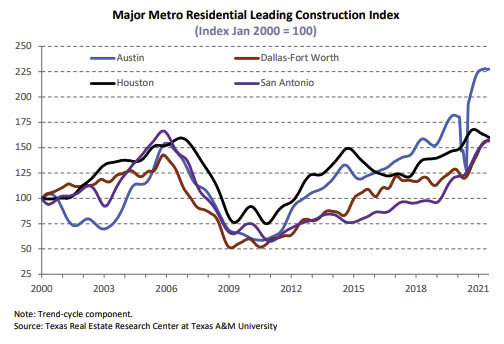
Luis Torres, Wesley Miller, Jacob Straus, and Brendan Harrison, “Texas Housing Insight” Texas Real Estate Research Center, September 7, 2021.
However, according to San Antonio Report’s recent interview with industry analyst, Jack Inselmann, 2021 might be a year of repercussions brought by 2020’s astounding success. Inselmann suggests that the construction may be further affected by COVID surges, job loss, and a tight supply of lots for new constructions. In addition, Ed Berlanga of the Greater San Antonio Builders Association shared his concern for the home building industry saying that “Lumber is skyrocketing on us in the last month. We are cost-driven, so whatever the costs are, that’s how we evaluate what our sales price increases are.”. While 2021 seems to be doing well in terms of increased construction projects, it is still indefinite how strong the year will end.
Cost Saving Tip for Building a Home in San Antonio
Use San Antonio’s Competitive Builder Market to Your Advantage
San Antonio is one of the fastest-growing large cities in the United States, and its residential construction market reflects that growth. Unlike tighter markets where builder capacity is constrained and project timelines stretch out, San Antonio has a broad and competitive custom home builder ecosystem—a condition that directly benefits buyers who know how to use it.
The practical implication is straightforward: get multiple bids. San Antonio’s abundance of custom and semi-custom builders means that competing for your project is a realistic expectation, not an optimistic hope. A well-prepared design package sent to three or four qualified firms will typically produce bids that vary enough to reveal both the market rate and the outliers, giving you meaningful negotiating leverage and a clearer picture of what your project should actually cost.
Beyond the bid process itself, San Antonio’s scale means that local building material suppliers are well-stocked and competitively priced, and that specialty subcontractors—tile setters, cabinet shops, millwork suppliers—are available in sufficient numbers that no single firm has pricing power over the market. This is a genuine advantage compared to smaller or more isolated markets where supply and labor scarcity can inflate costs substantially.
San Antonio also benefits from Texas’s lack of state income tax and relatively low regulatory burden on new construction compared to California, the Pacific Northwest, or the Northeast. These structural advantages combine to make the city one of the most accessible large American markets for custom home construction, and buyers who approach the process with preparation can capture that advantage fully.
Frequently Asked Questions
Which areas in—or near—San Antonio are among the best for custom home building?
The Hill Country communities north and northwest of San Antonio—particularly Boerne, Fair Oaks Ranch, and the Helotes corridor—are among the most coveted custom home destinations in South Texas. These areas combine proximity to San Antonio’s employment base with dramatic limestone Hill Country terrain, mature live oak canopy, and a rural character that the city proper cannot offer. Boerne in particular has developed a strong reputation for high-quality custom construction on larger acreage parcels.
Within San Antonio itself, the north side neighborhoods along the US-281 and Loop 1604 corridors have been the most active for custom construction over the past decade. The Sonterra and Stone Oak areas offer newer infrastructure, strong schools within the North East and North Side ISDs, and proximity to the major healthcare and technology employment clusters that have anchored north San Antonio’s growth.
The communities along the RM-1535 and Hausman Road corridors in northwest San Antonio attract buyers seeking larger lots within the city limits, with access to the NISD school district and proximity to the expanding medical center complex. Semi-rural parcels in this area offer a reasonable compromise between city convenience and the space that Hill Country living provides at a higher price.
For buyers interested in established luxury neighborhoods with mature landscaping and distinctive architecture, Alamo Heights, Terrell Hills, and Olmos Park—the small independent cities embedded within San Antonio’s urban fabric—provide a different character entirely. Infill custom construction in these communities requires navigating individual city ordinances and architectural review standards, but the resulting address carries exceptional long-term value.
How does San Antonio’s climate potentially impact home building costs?
San Antonio’s climate is hot subtropical, characterized by long, intensely hot summers, mild winters, and a precipitation pattern heavily influenced by Gulf of Mexico moisture. Summer temperatures regularly reach the upper 90s, with heat index values pushing well past 100 degrees during peak months. This drives HVAC sizing and specification decisions that have real cost implications.
Cooling is the dominant mechanical expense. Systems must be sized for sustained peak loads rather than average conditions, and the long cooling season—which can run effectively nine months of the year—means that operating costs accumulate substantially over time. Investing in a well-insulated building envelope, high-performance windows on south and west exposures, and properly shaded outdoor living spaces reduces the cooling load and allows a smaller, less expensive mechanical system to handle the job.
San Antonio’s location in South Texas also places it within the path of significant thunderstorm activity, occasional tornado events, and the outer bands of Gulf hurricanes. Texas building codes require wind-resistant construction practices, and builders in the region are well-versed in the framing, sheathing, and roof attachment specifications that give homes structural resilience in high-wind events. These practices add modest cost but are genuinely important for long-term durability.
The city’s position at the eastern edge of the Texas Hill Country means that some lots on the north and northwest sides feature the karst limestone terrain characteristic of the Edwards Plateau. This can affect foundation choices, drainage design, and landscaping budgets in ways that flat urban lots do not present. Buyers considering hillside or near-Hill Country sites should investigate site conditions early.
What should I know about soil and terrain conditions before buying a lot in San Antonio?
San Antonio’s geology reflects its position at the transition between the soft sedimentary soils of the Gulf Coastal Plain and the harder limestone karst of the Texas Hill Country. The dominant soil type across most of the urban area is a dark, expansive clay known locally as Houston Black clay or simply black gumbo—one of the most challenging residential building soils in the country.
This clay expands dramatically when wet and shrinks when dry, and the seasonal cycling in South Texas’s variable rainfall creates ground movement that has caused foundation problems across the region. San Antonio has a well-documented history of foundation issues in residential construction, and virtually every local builder and engineer is familiar with the mitigation strategies that address this soil behavior.
Post-tensioned concrete slabs are the standard foundation approach for new residential construction in San Antonio and across the Texas Hill Country transition zone. These slabs are engineered to flex with soil movement rather than crack under it, and they are both the code-compliant and the practically proven solution for the local soil environment. Buyers should expect post-tensioned slabs as the standard and be skeptical of significantly cheaper foundation bids that propose alternatives without robust geotechnical justification.
North and northwest San Antonio sites on or near the Edwards Aquifer Recharge Zone introduce a different set of regulatory and site considerations. Development within the recharge zone is subject to impervious cover limits and stormwater quality requirements enforced by the Edwards Aquifer Authority. These regulations affect lot coverage, drainage design, and sometimes foundation choices, and should be reviewed thoroughly before a lot in this area is purchased.
Broadly speaking, is it cheaper to build or buy an existing home in San Antonio right now?
San Antonio has long been one of the most affordable large cities in Texas and the United States for both building and buying, and it remains so relative to Austin, Dallas, and Houston despite price appreciation over the past several years. The city’s deep inventory of existing homes and its active production home builder market provide genuine alternatives at a range of price points.
On a straightforward cost comparison, purchasing an existing San Antonio home is generally less expensive than building a comparable custom home new. The city’s production builder market—among the most active in the country—also provides a semi-custom middle ground that allows buyers to customize features within a builder’s platform at lower cost than a fully custom project.
The case for custom building in San Antonio is strongest for buyers who want Hill Country-adjacent sites, specific architectural styles reflecting the city’s Spanish Colonial and Mediterranean heritage, or lots with distinctive natural features that existing inventory cannot replicate. For these buyers, San Antonio’s combination of relatively low construction costs, a competitive builder market, and accessible land prices outside the immediate urban core makes custom home building a genuinely viable option by national standards.
Considering building a home in San Antonio?
Contact us for a free consultation