
Data from the online contractor platform BuildZoom (BZ) shows that the national average cost to build a new custom home ranges from $138 to $320 per square foot — around $345,000 to $800,000 for a 2,500-square-foot home. The National Association of Home Builders (NAHB) estimates that new home construction costs $485,000, which is within the range given by the site. Additionally, Home Builder Digest’s estimates are also within the field, suggesting that it will cost about $400,000 to build a 2,600-square-foot home.
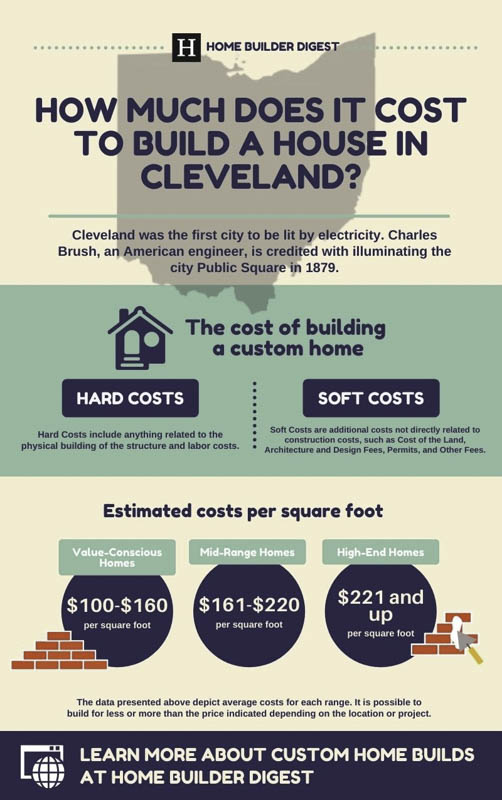
Homebuilding cost in Cleveland is also within the given range, with a median price of $160 per square foot. This value can go as low as $100 per square foot if opting for a more value-conscious approach. Opting for a custom-built luxury home will raise this estimate and may go as high as $220 per square foot or higher. Aspiring homeowners will need to have an average budget of $250,000 – $550,000 to construct a 2,500-square-foot home in Cleveland.
The values given above are only estimates and do not definitively answer how much it costs to build a home in Cleveland. Experts suggest setting aside 15% as a contingent budget given that several issues — supply chain and lack of labor workforce — in the construction industry are yet to be solved, thus making fees volatile. Aside from that, numerous factors come into play before reaching the total home building costs, including size, location, materials, level of customization, and site complexity. These factors are split into two categories: hard costs and soft costs.


Hard Costs
Get a free cost estimate
Hard costs refer to the expenses that go toward the physical construction of the home. This category includes the materials used, labor fees, installation of major systems, extra amenities, and landscaping.
The basic construction of custom homes in Cleveland typically cost $125 per square foot. This rate can go as low as $100 per square foot or as high as $150 per square foot, depending on several factors: the quality of materials, labor fees, complexity, size, and design. Building a 2,500-square-foot home will cost approximately $250,000 – $375,000, excluding site work, land, and other expenses beyond construction work.
Listed below is an estimated price breakdown of each house work:
- Foundation: $10,000
- Materials: $100,000 – $110,000
- Labor fees: $40,000 – $45,000
- Interior Finishing: $35 – $80 per square foot
- Mechanicals (wiring, heating, insulation, plumbing): $50,000 – $60,000
- Roofing: $10,000 – $15,000 — Asphalt shingle: $4 – $6 per square foot
- Land and Site Improvement: $100,000
Besides the factors mentioned above, construction of extra amenities also contributes to the overall home construction costs. These home additions can be quite expensive, and some require maintenance fees. Listed below are some of the most common home additions and their respective price ranges:
- Balcony: $6,000 – $11,000
- Large Decks: $4,600 – $12,000
- Outdoor Kitchen: $6,000 – $23,000
- Porch: $6,200 – $27,500
- Garage: $26,500 – $54,000
- Inground Pools: $38,000 – $105,000
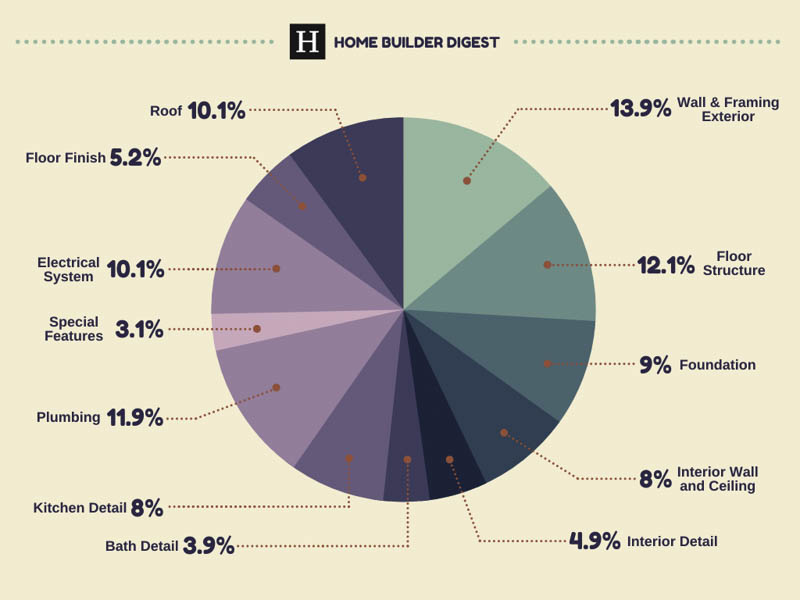
Figure 1. Typical cost breakdown of a single-family home constructed using the conventional method, according to Home Builder Digest.
Soft Costs
Soft costs refer to the expenses that go beyond the physical construction of the home. These include purchasing of land, settlement of permit fees charged by the city, and architecture and design fees.
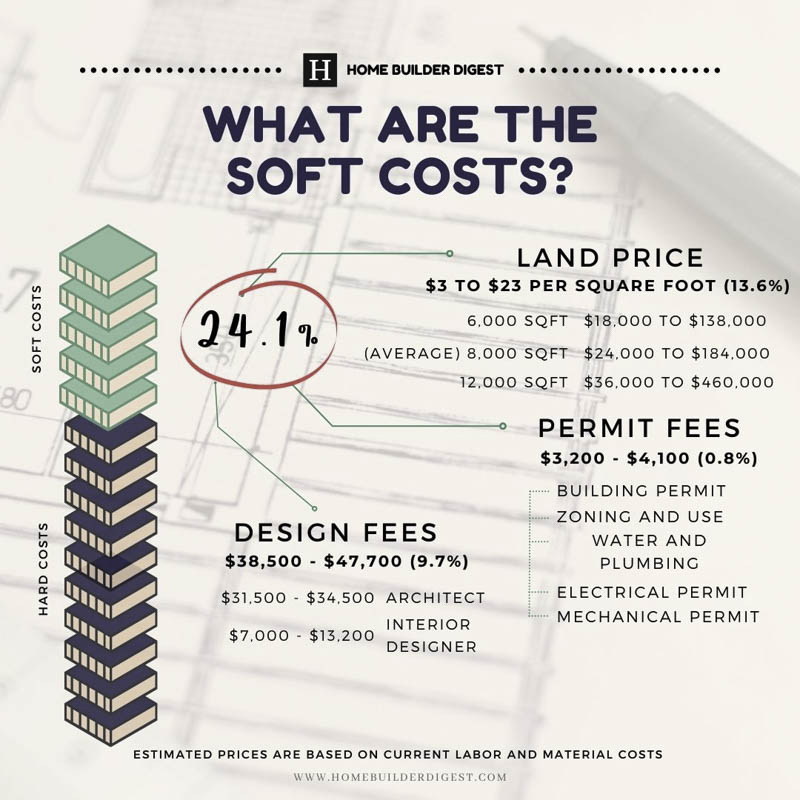
Figure 2. Soft cost percentage and average price range of additional fees, determined from the overall cost of custom home building in Cleveland.
Cost of the Land
Cleveland’s Zoning Code states that the minimum lot area for single-family homes is 4,200 – 7,200 square feet. The required land size will also depend on the max gross floor area of the residential unit in relation to lot size.
Current residential land listings available in the online real estate marketplace Zillow show an average cost of $68,300, or $7 per square foot. The cheapest land available is situated in the historic Slavic Village area and costs $18,000 for a 5,663-square-foot lot — approximately $3 per square foot. On the other hand, the most expensive land is situated within close proximity to the downtown and Tremont area and costs $275,000 for an 11,761-square-foot land — roughly $23 per square foot.
Following regulations set by the local government, acquiring land in Cleveland will cost $30,000 to $50,500.
Permits and Other Fees
Every home construction requires a permit to be secured from the government’s Department of Building and Housing. This ensures that homes are up to the regulations set upon in the building code, thus ensuring the safety of everyone. This will also serve as a signal to start project constructions.
The city of Cleveland requires a plan examination fee based on the total floor area in square feet of the project. It is to be settled upon submission to the reviewing committee. Any plans submitted more than once or revised after permit issuance will be charged with an additional plan examination fee. The plan examination fee costs $20 per 1,000 square feet of the proposed project. It will cost $50 to examine a 2,500-square-foot residential home plan plus a 1% state of Ohio surcharge. An additional fee of $250 will also be charged for all site development reviews.
As for the main building permit, new construction of single family dwelling homes in Cleveland costs $10 per $1,000 of the declared construction value, with a minimum fee of $150. Suppose a basic construction for a 2,500-square-foot home costs $315,000. The total building permit fee for this project would be $3,150 plus a 1% state of Ohio surcharge.
Other home construction fees to be paid to the local government are as follows:
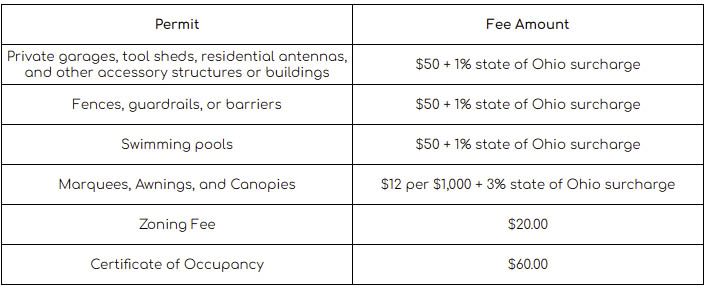
Architecture and Design Fees
Architects and designers work hand-in-hand with the client to make their vision come to life. They will draw up preliminary home designs incorporating the owner’s wants and needs with respect to their budget. A more detailed plan is then drafted, which will be presented to contractors for pricing and bidding along with its submission to the local government for review. Lastly, the architects and designers will coordinate with the contractor and oversee the actual building phase to ensure it strictly follows the plan.
Residential architects in Cleveland typically charge 10-11% of the total construction costs. This percentage can increase or decrease depending on numerous factors, including the home’s complexity, intricateness of details, and the scope of work. When building a $315,000-home, the total architecture fee will land at about $31,500 – $35,000. Any task beyond the arranged agreement will be charged differently — usually on an hourly basis — and added to the total design fee.
How do Cleveland’s custom home building costs compare to other nearby cities?

Get a free cost estimate
Ohio is located in the midwestern region of the country. Records show that although the Midwest is in the lower-end compared to other regions, it is still 4% higher than the national median home building contract price with $130 per square foot. With Ohio specifically, the trend continues as the state is the second cheapest state to own a house in, as per Business Insider. Ohio’s median listing price is $111 per square foot, making it 3% more expensive than the cheapest state, Indiana, and 70% cheaper than the most expensive state, Minnesota.
In terms of the average home building cost across the major cities in Ohio, it ranges between $105,000 – $450,000. Values are estimated based on basic homebuilding aspects mentioned in the previous categories. Howmuchly reported the following price ranges:
- Parma: $105,000 – $380,000
- Youngstown: $160,000 – $405,000
- Cincinnati: $180,000 – $405,000
- Dayton: $200,000 – $395,000
- Lorain: $200,000 – $402,000
- Canton: $210,000 – $405,000
- Columbus: $240,000 – $450,000
- Akron: $257,000 – $370,000
- Cleveland: $267,000 – $384,000
- Toledo: $305,600 – $400,000
What Leading Custom Home Builders and Architects that Serve the Cleveland Area Say
Andrew Gotlieb of Keystate Homes explained that home building costs are volatile. Numerous factors directly affect the estimates, such as supply and demand, labor costs due to seasonal change, and supply and labor shifting due to supply chain and labor disruptions. Additionally, tariffs on metal and lumber were implemented in the region four years ago. This, along with pandemic-related material production and demand issues, are one of the construction industry’s most significant problems. Gotlieb made it clear that they try their best to be honest and transparent with clients. He expressed that as a custom local home builder, they have no control over the pricing and labor, unlike national home builders. With the unstable state of the industry and high housing demands, they are anticipating that prices will still progressively increase. Gotlieb assures clients that although many challenges are to be faced in building a home, he and his team will provide instant equity in a quality build with the best price possible.

Matt Berges of Berges LLC reminded soon-to-be homeowners that many variables impact the total home building costs. “As costs go up, and interest rates go down, buyers keep coming. If costs and interest rates go up too high, less people will be buying, and maybe the costs will eventually drop back down,” he explained. Berges added that it could be tough to forecast the industry’s future as almost everything is unstable. All the builders can do is guess what will happen and anticipate the best.
The Future of Cleveland’s Residential Construction Industry

Get a free cost estimate
A common trend that can be seen across the nation is the spike in home values buoyed by the pandemic and high demand. According to Zillow’s Home Value Index, the homes in the United States are priced at $312,000 as of January 2021 and roughly increase by 21% as of January 2022 — currently valued at $376,000. Zillow predicts that this value will further increase the following year by 17.3%. This price surge was greatly felt in Cleveland, wherein home values have increased to $103,000 as of January 2022 — a 21% increase from the previous year’s $85,000.
The economy also suffered immensely because of the pandemic and brought various industry problems. Supply chain issues and lack of labor workforce are the most notable ones in the construction industry. This resulted in a 4.5% rise both in construction costs and labor wages, along with material costs surging up to 23%. Experts predict that it will increase further by 4-7% by 2022. Despite the historically high price inflations, housing demands are still proven to be strong. Construction companies haven’t seen a trend of project cancellations because of cost-escalations.
Additionally, the supply issues are causing massive delays in projects, and homes are not being built fast enough despite builders ramping up the pace. Fortunately, as of October 2021, the U.S. Census Bureau recorded that nearly 1.5 million permits for private housing units were issued. Most of those units are expected to be complete in 2022, thus effectively easing strong housing demands. Alongside this, the economy is continually recovering, which may significantly help in stabilizing the prices in various aspects of the construction industry.
Cost Saving Tip for Building a Home in Cleveland
Maximize Energy Efficiency to Offset Cleveland’s High Heating Costs
Cleveland’s long, cold winters make heating one of the largest ongoing expenses of homeownership, and the most impactful cost-saving decision you can make during construction is investing in a high-performance building envelope from the start. Upgrading to continuous exterior insulation, triple-pane windows, and a properly air-sealed structure costs modestly more during the build phase but delivers substantial savings on heating bills every winter for the life of the home. In Cleveland’s climate, the difference between a code-minimum home and a well-sealed, highly insulated one can amount to hundreds of dollars per month during the heating season. Pairing a tight envelope with a high-efficiency furnace or heat pump system—and designing ductwork to minimize losses in unconditioned spaces—compounds those savings further. Ohio’s Home Energy Assistance programs and federal energy tax credits can offset a portion of the upfront investment in qualifying equipment. Additionally, a highly efficient home appraises higher and is increasingly attractive to resale buyers who are sensitive to utility costs. When working with your builder, request an energy model of the home during the design phase so you can compare the incremental construction cost of efficiency upgrades against the projected annual energy savings—in Cleveland, the payback period is typically faster than in milder climates, making it one of the best investments you can build into the project.
Frequently Asked Questions
Which areas in—or near—Cleveland are among the best for custom home building?
The western suburbs of Rocky River, Bay Village, and Westlake are perennial favorites for custom home building, offering lakefront or lake-proximate lots, excellent school districts, and established neighborhood character. On the east side, Chagrin Falls, Hunting Valley, and Gates Mills provide a more rural, estate-like setting with wooded acreage, equestrian properties, and some of the highest-value custom homes in the metro area. Solon and Hudson, further southeast, combine strong schools and community amenities with newer developments that offer larger lots for custom builds. Within Cleveland proper, neighborhoods like Tremont and Ohio City have attracted a wave of new urban construction, including custom infill homes on existing lots close to downtown restaurants, breweries, and cultural institutions. Avon and Avon Lake on the western fringe offer newer subdivisions with lake access and a growing commercial base. For buyers seeking waterfront custom building, the Gold Coast communities along Lake Erie—from Lakewood through Bay Village and further west—command premium land prices but deliver unmatched lakefront settings. Brecksville and Broadview Heights, near the Cuyahoga Valley National Park, appeal to nature-oriented buyers seeking wooded, hilly terrain within commuting distance of downtown.
How does Cleveland’s climate potentially impact home building costs?
Cleveland’s climate is defined by cold, snowy winters influenced by Lake Erie’s lake-effect weather patterns, combined with warm, humid summers. This four-season extremity directly impacts construction specifications and costs. Foundations must extend below a deep frost line—typically four feet or more in Northeast Ohio—which increases excavation and concrete requirements compared to markets with milder winters. Homes must be designed with robust insulation packages, high-performance windows, and tight air sealing to manage heating costs during winters that can last five months or longer. Heavy snow loads require roofing systems engineered for the weight of accumulated snow and ice, and ice dam prevention through proper attic ventilation and insulation detailing is critical to avoiding costly water damage. Lake-effect snowfall patterns mean that properties closer to the lakeshore may experience significantly more snow than areas further inland and at higher elevation, which should be factored into roofing and structural design. The humid summer months require HVAC systems with adequate dehumidification capacity and moisture-resistant construction practices in basements and crawl spaces. On the positive side, Cleveland’s relatively affordable labor market helps offset some of the climate-driven construction costs, and the region’s long building tradition means experienced cold-climate builders are readily available.
What should I know about soil and terrain conditions before buying a lot in Cleveland?
Cleveland’s soil conditions vary considerably across the metro area and present specific challenges that buyers should understand before selecting a lot. Much of the region features heavy clay soils—common throughout Northeast Ohio—that are prone to the shrink-swell cycle: expanding when saturated by rain or snowmelt and contracting during dry periods. This movement can cause foundation cracking, basement wall bowing, and drainage problems if not properly addressed during design and construction. A geotechnical investigation is strongly recommended for any lot, as it will identify clay content, bearing capacity, water table depth, and recommendations for foundation type. Basement construction is standard in Cleveland and expected by most buyers, but the high water table in many areas requires waterproofing systems, sump pumps, and exterior drainage tile to keep basements dry. Lots near the Cuyahoga River, Rocky River, or the Lake Erie shoreline may sit within FEMA flood zones or be subject to erosion setbacks that restrict the buildable area. In the hillier eastern suburbs, lots with significant slope may require retaining walls and engineered grading. Shale bedrock is present in some areas and, while it provides excellent bearing capacity, can increase excavation costs for basement construction and utility installation.
Broadly speaking, is it cheaper to build or buy an existing home in Cleveland right now?
Cleveland remains one of the more affordable major metro areas in the United States for both building and buying, which makes the comparison particularly interesting. Existing home prices, while they have appreciated meaningfully since the pandemic, remain well below the national median, and there is a substantial inventory of older homes available across the metro area. On a straightforward cost-per-square-foot basis, buying an existing home in Cleveland is almost always less expensive than building a comparable new custom home. However, Cleveland’s housing stock is among the oldest in the country, with many homes dating to the early and mid-twentieth century. These older homes frequently need significant investment in updated heating systems, electrical, plumbing, insulation, and windows—improvements that can total tens of thousands of dollars and are difficult to estimate before purchase. Building new in Cleveland offers the advantage of a fully insulated, energy-efficient home designed for the region’s demanding climate, with modern systems, a dry basement, and a builder warranty. Given Cleveland’s relatively affordable land and labor costs compared to national averages, custom construction here can deliver exceptional value for buyers willing to invest the time and upfront budget to build exactly what they want.
Considering building a home in Cleveland?
Contact us for a free consultation